With a history of more than 4,000 years, Vietnamese culture is becoming one of the oldest in the world. Here is a condensed summary of articles on Vietnam culture.
Written by Tieu Bao (Local Expert)
Updated on Feb 02, 2026
0 comment
Originally from Vietnam, Tieu Bao spent years in France to pursue his studies. Passionate about travel and adventure, he has discovered all the countries of Southeast Asia, including Thailand, Laos, Cambodia, Bali, and Burma. Since 2020, he has spent most of his time in Thailand, Cambodia, and Laos to manage Kampá Tour's trips in these countries. Do not hesitate to ask him questions or comments so that he can answer you directly at the bottom of this article.
With a history of more than 4,000 years, Vietnamese culture is one of the oldest in Asia. Here is a condensed summary of articles on Vietnam culture. The article explains well about their cultural identity, their uses and customs, their traditional drinks and their arts.
A cultural identity defended throughout the centuries
Before understanding the culture of Vietnam, you have to start at the beginning, that is, understand what “Vietnam” means. The name of this country is made up of 2 words: Viet, which designates the Viet ethnic group; and Nam, which means South. The Vietnamese ethnic group represents 86% of the population of this country. Vietnam is therefore the country of the South Viet. Similarly, Yugoslavia is composed of Yougo which means South, and Slavia which designates the Slavs, which gives to the South Slavs. The question that arises is: what has become of the Northern Viet? The answer is: they disappeared! Or more accurately, they have become Chinese. So what is a Vietnamese?
"He is a man of Vietnamese ethnicity who did not want to become Chinese, who does not want to become Chinese and who will never want to become Chinese."
According to Huu Ngoc, a well-known cultural researcher in Vietnam, a common mistake is to believe that Vietnamese culture is an appendage of Chinese culture, just as Vietnam is an appendage of China. But looking closer, we realize that there are 2 very different cultures. For example, Vietnamese ancestral culture has an element in common with southern China, Laos, Cambodia, Thailand, Malaysia, Indonesia, etc., that is, with all the subtropical countries of Southeast Asia, but not with ancient China. north: it is the bronze drum.
“In these regions, growing rice in submerged soil required a lot of water and when rain did not come, farmers used bronze drums to invoke the mercy of the Rain Day. Traditional Chinese culture is based on dryland agriculture, which has led to many other differences later on. Furthermore, China is said to have developed around the Yellow River and Vietnam around the Red River,” says Huu Ngoc.
An important role of the Vietnamese language
According to Huu Ngoc, language also plays a very important role in the construction of Vietnamese identity: “Certainly, 60% to 70% of the words in our language come from Chinese, but if we lost 30% of the rest, In other words, we would lose 30% of the uniqueness of our cultural identity, and our culture would be absorbed into Chinese culture.
It happened that Ho Chi Minh found Vietnamese expressions composed of several words of Chinese origin and changed these words to Vietnamese ones to promote the purity and originality of the Vietnamese language. This is a bit like what happened in France in the 16th century when the French language was beginning to develop. An ancient language that has preserved the founding myths of Vietnam.
Thus, beliefs have passed through the ages and still persist today: animism, the cult of fertility, death, ancestors, belief in geniuses, etc. Unlike those in China, Vietnamese deities were mostly women. Before the arrival of the Chinese in the 2nd century BC. J.-C., the role of women dominated in Vietnam. The society was very matriarchal (under the authority of the mother).
When 2 cultures meet, one culture with a weak identity can be completely assimilated and replaced by the other. But when cultural identities are strong, a phenomenon of acculturation occurs, that is, cultures take from each other what seems good to them and reject what does not suit them. Mr. Ngoc concludes his speech by saying that this is how Vietnamese culture has evolved without ever losing its roots, they have taken from outside what seemed good to them.
A permanent presence in the spiritual life
In order to introduce you to the distinctive Vietnamese culture, this article presents one aspect of its manners and customs: ancestor worship and burial.
Worship of the ancestors
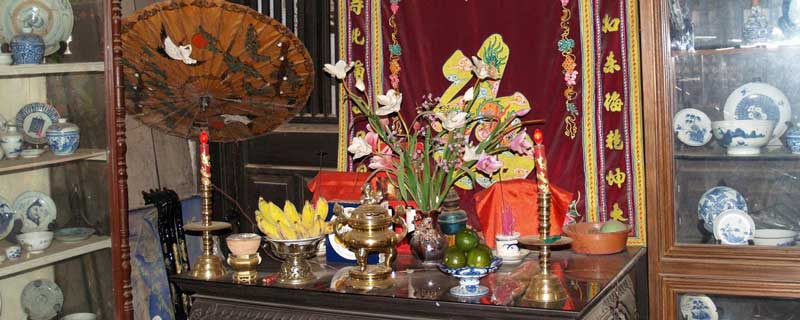
The altar of the ancestors placed in the central room of the house
The belief that dying means returning with the ancestors to the Nine Sources, but that from there their souls constantly return to visit to protect their offspring, is the basis of ancestor worship. This cult is present among many peoples of Southeast Asia and constitutes the specific feature of this cultural area, but according to the ethnologist's observations, it is among the Vietnamese where it is most widespread and developed, to the point of almost becoming a cult religion. In his great work Luc Van Tien, Nguyen Dinh Chieu wrote:
“Thà đui mà giữ đạo nhà
Còn hơn sáng mắt ông cha không thờ”.
(It's better to be blind and follow the rules
than seeing clearly and not respecting the ancestors)
Unlike Westerners who pay attention to the date of birth, Vietnamese people attach great importance to the day of death in ancestor worship because it is the day when man enters eternity.
The ancestor altar is always placed in the central hall in the most respectable place. According to the Vietnamese conception, there is no difference between the world in which we live (Yang) and the world of the dead (Yin): therefore, we present perfectly material things to the altar of our ancestors: food, clothing, items of daily use . and money (the latter made of paper, called Vang ma - votive items).
Only the food is real, and it is usually accompanied by flowers, incense, and alcohol (optional) which must be rice. One thing that should not be missing is a cup of clear water: it is the rice producer's most precious asset after the land. After burning the incense sticks, the votive paper is burned and a small cup of alcohol or water is poured over the embers. This is how the dead receive their gifts in the afterlife.
The flames and smoke then ascend to the sky, and the liquid alcohol mixes with the fire to impregnate the earth: an osmosis of fire-water (Yin-Yang) and sky-earth-water ("Three Powers") takes place before our eyes. loaded with philosophical value.
Burial in Vietnam
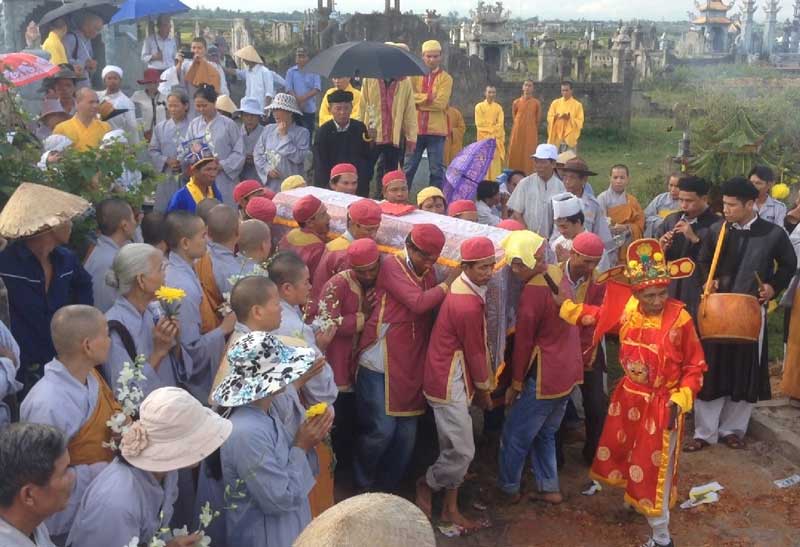
Burial in Vietnamese culture
A girl, the eldest of the deceased's granddaughters, carries the portrait of the deceased and stands at the front of the funeral procession. At the front, the musicians are also in her place. After them comes the geomancer who will guide the coffin bearers throughout the journey. The rice bowl and egg must remain horizontal throughout the journey, otherwise the geomancer and the porters will not be compensated for their trouble. The deceased's two youngest children took their places behind the coffin. Lastly, bring close family members, friends, and neighbors of the family.
During the procession, family members throw red and white rectangles, quan tai "coffin", intended to occupy the evil spirits who, trapped by their gluttony, will linger to taste these delicacies that contain only emptiness. Everyone is very careful not to crush them and we can guess their presence on the ground by observing the lateral movements of the individuals following the coffin. A young woman who does not wear any sign of mourning passes in the procession handing out cigarettes and tea.
After having traveled part of the path that leads to the "cemetery", the procession stops when it reaches an intersection of roads: the Vietnamese believe that these places are frequented by spirits. During this pause, the two youngest children do not move from their place. The women and men of the family ensure that many incense sticks remain lit, many “mã vàng” are thrown, cigarettes, tea are offered. Then the funeral column leaves.
When the line of mourners reaches the place where the beer is buried, it is carried to the grave. The bearers make an effort to leave it in a horizontal position, but a false movement causes the coffin to move and the entire assembly to move. Many sticks are lit and the crying becomes louder and more acute. Around the grave, the young members of the family light sticks on the graves surrounding that of their deceased member so that the former tenants will be benevolent towards the dead. The younger children are near the grave, accompanied by the wife of the deceased. The portrait is no longer held by the young woman, it has been replaced by a young man and is located at the head of the coffin: it will not move from this place until the family leaves.
When the coffin is in place, each family member pours a handful of dirt on the coffin and the burial begins. The women of the family light incense sticks on all the graves near that of the deceased. When the coffin is no longer visible and a mound has formed, the offered wreaths are placed on the mound and the photographic portrait is placed at the foot of the coffin.
Votive papers are burned around the tomb surrounding the family; The deceased's brother appreciates the assistance. Friends and neighbors leave and only the family remains around the grave. They greet the coffin three times and wish the deceased a good rest, then, in a chorus of sobs, the family says goodbye for the last time, going around the tomb, from right to left; The two sons remain in front of the buried coffin and are the last to leave. The young man takes the photographic portrait to place it on the domestic altar of the family home.
The return home is done without specific order but no one will take the path taken when leaving. Refreshment (Tra no miêng: "in payment of the debts of the mouth") is offered to all the guests while the wife and one of the youngest children go to the domestic altar to confirm the arrival of the deceased to the other world and welcome him to his new environment.
This temporary burial will be followed by a final burial. When the geomancer has decided on an auspicious date, the remains are unearthed and another burial performed. During this new and definitive burial, a stone tomb will cover the mortuary remains. This ceremony will be celebrated with less pomp than the first and will confirm the status of the deceased's family ancestor.
Arrangements for the burial of the dead tend to change according to the social changes that occur in the country. For Vietnamese living in France, these practices have had to be simplified but remain a nerve center in the family and individual lives of all Vietnamese.
The eternal existence in traditional drinks
As for a culture, we not only focus on its uses and customs but we must also approach its traditional drinks.
The art of Vietnamese tea
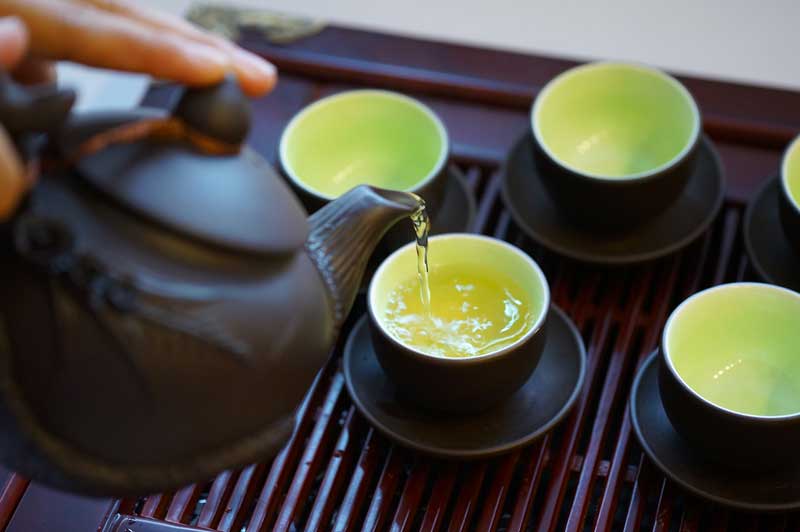
The art of Vietnamese tea - a true living art
The art of tea is difficult, from the choice of the tea itself, its preparation, the action of boiling the water, making the infusion, and distributing it in the cups that leave all the aroma, until the moment you sit down and savor its quintessence. in measured gestures, with all your senses and with all your soul.
Since ancient times, the Vietnamese have known how to flavor tea with many species of flowers: lotus, jasmine, chlorate, chrysanthemum,... combining the flavor of tea and floral aromas to enjoy all the fragrances of heaven and earth. Each flower gives the tea its particular aroma, but the most original is the lotus. In the lotus pond, in the afternoon, in a small boat, we approach the flowers and place a tea bag inside each one that is impregnated with all the aromas and vital forces of the flower.
Then, the next day, at dawn, the owner of the house only has to make his rounds again in a small boat to make his collection. To act on a larger scale, we collect the white anthers at the top of the stamens, gao sen (lotus rice), which we mix with the tea. We place everything in an airtight enclosure for one or two days, until the lotus rice withers and we perfect the drying of the tea over very low heat.
Just one kilogram of tea requires a hundred flowers and meticulous work of several days, which explains its price and value: this luxury product is used only on great occasions to mark the honor that the owners of the place pay to their hosts.
Vietnamese alcohol
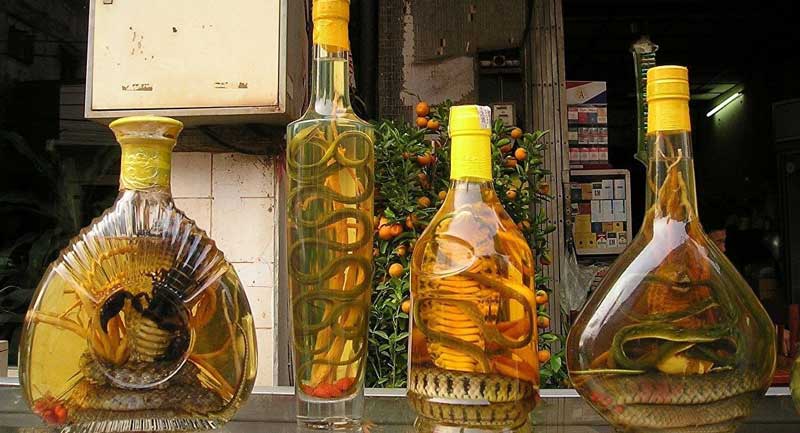
The famous snake spirits
Vietnamese alcohol is made from glutinous rice. Steamed rice, fermented and then distilled, is called Ruou trang (white alcohol) or ruou de (rice alcohol), which distinguishes it from other alcohols flavored with fruits or flowers, called ruou mùi (fragrant alcohol) or ruou mau (colored alcohol) such as chrysanthemum, lotus, lemon, etc.
It is also a very good companion to medication. Among the medicinal alcohols, there are precious alcohols for snakes (tam xa = three snakes or ngu xa = five snakes) or for iguanas.
However, for tasting, connoisseurs only use rice alcohol. For ancestor worship, a glass of white alcohol is always necessary to the exclusion of any other alcohol, perfumed or medicinal. In Vietnam, some regions are famous for their alcohol such as Van town or Ke Mo town.
In his book “Geography”, written in 1435, Nguyen Trai (famous politician of the 15th century) noted that Thuy Phuong district (now Thuy Khue in Hanoi) is the most famous center of alcohol production. In Le-Tring's time, there was still a statue of the drunken Buddha at this place (the alcohol is so good there that even the stone Buddha failed in one of the five Buddhist commandments).
An omnipresence in the traditional arts
Vietnamese culture is also reflected in its arts which are very rich and diverse in festivals. To complete the article, we present his few performing arts.
Imperial music and dance
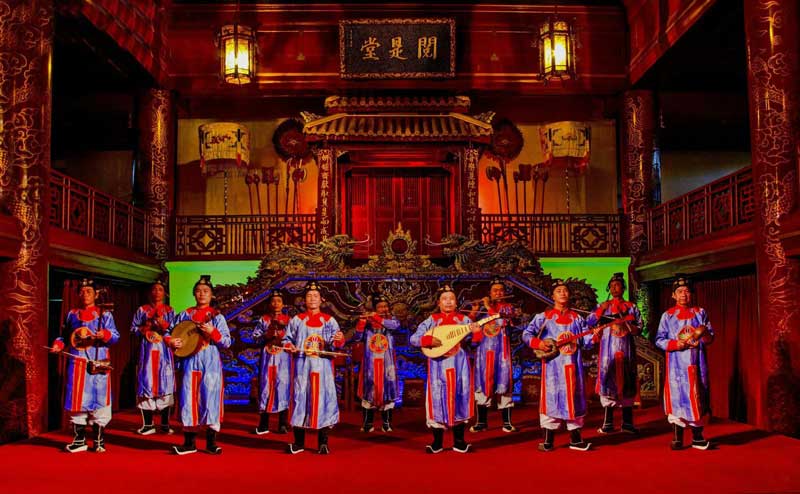
Imperial music and dance of Hue
Imperial music and dance experienced strong development during the reign of King Le Thai Tong in several very diverse music and dance forms such as Trung cung chi nhac, Yen nhac, Nha nhac, Dai nhac, Van vu, Vo vu… Under the Nguyen Dynasty, imperial music and dance reached its peak with the melodies of Bat Dat performed in the celebration of Heaven, practiced by the kings of the Nguyen Dynasty, in Dan Nam Giao, Mua quat (fan dances), Tam tinh chuc tho, Bat tien hien, Luc triet hoa ma dang, Luc cung hoa dang, during the great ritual ceremonies of the feudal court.
Many of them have been preserved and developed to this day. In 2003, the court music of Hue (Nha nhac cung dinh Hue) was recognized as Intangible Cultural Heritage of the World by UNESCO. Therefore, attending an imperial music show is an essential activity during a trip to the city of Hue.
Vietnamese Water Puppets
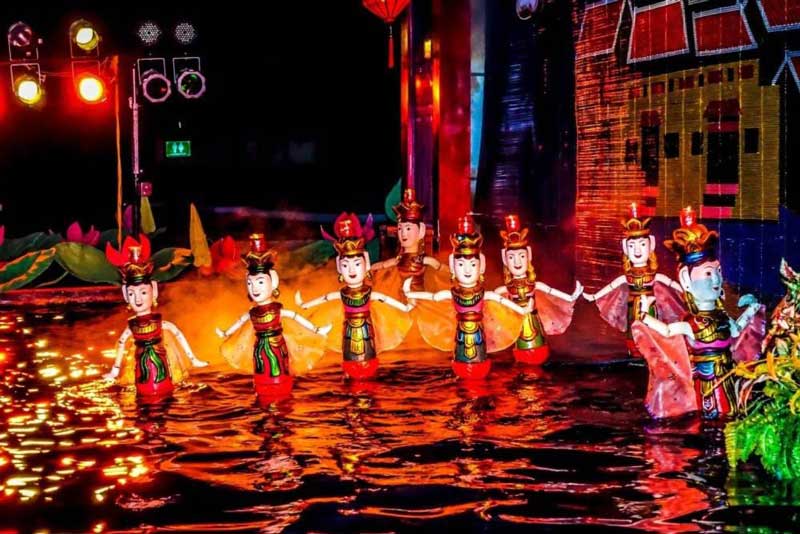
A water puppet show in Hanoi
This Vietnamese art is a traditional theatrical genre very popular around the world that appeared under the Ly dynasty (1009-1225). A water puppet play consists of many characters. Each puppet is a popular sculptural work, representing typical physical features and characteristics, different from each other. The puppets are made of wood, covered on the outside with a waterproof material.
The characteristic character of the water puppets is “Chu Teu” with well-rounded features and a permanent optimistic smile. The actors in this type of theater must stand in the water, behind the curtain to manipulate the poles, ropes and pulleys of the puppets. The music that accompanies the show includes percussion, wooden bells, tap dancing...
Cheo (traditional opera)
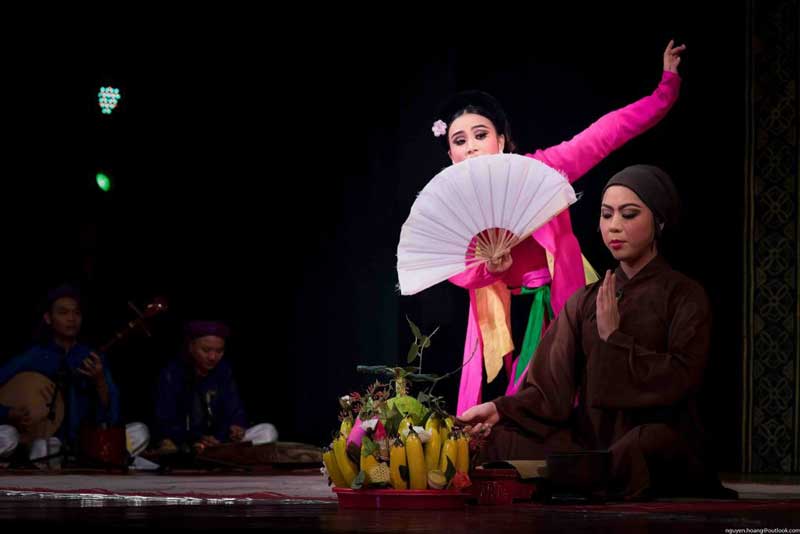
Cheo - traditional Vietnamese opera
Derived from Vietnamese folk music and dance, Cheo is the most prominent traditional theater genre in Vietnam. At first it was widespread in the towns, and little by little it became an exceptional popular operatic genre in the Northern Delta. Cheo popular opera includes dance, singing, music and texts that collect historical or social anecdotes.
The narration of a cheo piece abounds in lyrical expressions of “ca dao” (folk songs), “tuc ngu” (proverb), and illustrates human optimism through humorous, ironic and intelligent expressions. Humanism is clearly reflected in this theater, reflecting the aspiration for happiness, for a united society, for human protection, for the victory of good over evil.
The Cheo characters are symbolic, conventional and their mentality does not change from the beginning to the end of the play. This heritage of traditional popular theater that remains popular among different generations of audiences is made up of Quan Am Thi Kinh, Chu Mai Than, Kim Nhan…
Cai luong (renovated theater)
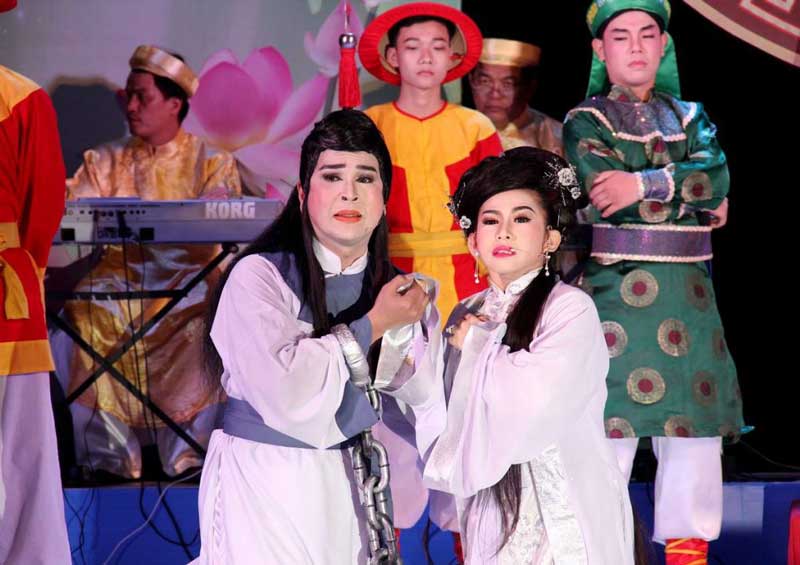
Cai luong - renovated theater in the early 20th century
Cai Luong is a genre of song-mixing theater, which appeared in the early 20th century. The origin of “Cải lương” is the set of popular airs, “music performed by amateurs” in the west of the Southern region. The “Cải lương” also incorporates scenic elements and music from the “Tuồng” theater.
Similar to other traditional theaters in Vietnam, “Cải lương” includes dance, singing, and music. The essential instruments in this theater are the guitar and the “moon” zither. The best plays are: Luc Van Tien, Luu Binh – Duong Le, The Life of Mrs. Luu, To Anh Nguyet and Mong Hoa Vuong, Half a Lifetime of Beauty, Chiman Vih Nam (Bird Viet, Nam branch ), Queen Mother Duong Van Nga, etc.
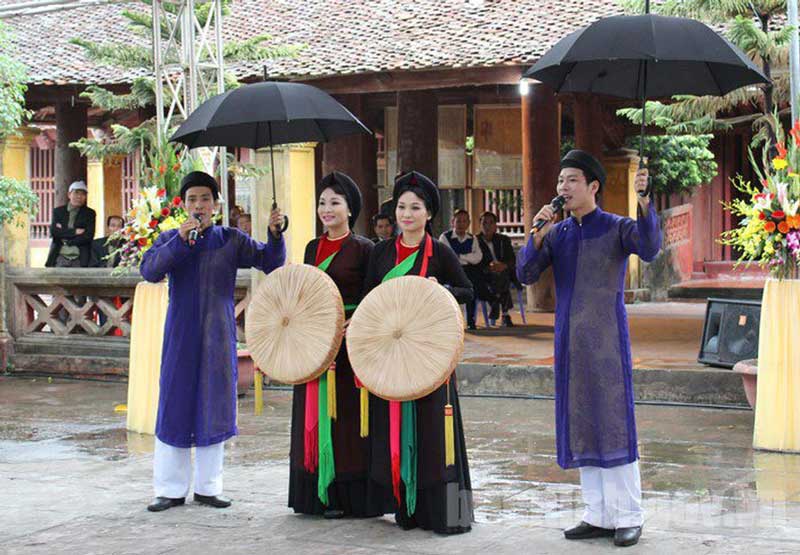
Hat Quan ho (Quan Ho's songs - Bac Ninh)
Quan ho famous sóng from Bac Ninh
They come from the alternating songs of girls and boys practiced since ancient times. The singing “quan ho” is essentially practiced in each village, once a year on the occasion of the village festival. It translates the friendship between girls and boys and the twinning of the two towns. We always sing the Quan ho as a duet, according to an established order both in the theme and in the tunes and according to a principle of symmetry of word and tone.
To this day, about 180 Quan ho melodies have been preserved and include lyrical and beautiful words, folk expressions, images and specific techniques. All this gives Quan ho's songs exceptional beauty and appeal.
Planning your trip?
Save time and get expert advice for FREE!
✅ 15 years of local experience
✅ Save up to 40 hours of planning
✅ Travel stress-free from start to finish
Book your free consultation today!






 Our team
 Our team
 Our team
 Our team



 Other
Other Add us as a preferred source