Exploring Vietnam in 2 Weeks: My Detailed Travel Itinerary Diary
A two-week Vietnam itinerary can cover Hanoi, Sapa, Ninh Binh, Lan Ha Bay, Hue, Hoi An, Ho Chi Minh City and the Mekong Delta with one night train and two domestic flights. This diary follows Bernadette and Jean-Paul Aubert, travelers from Étampes, France, day by day, and adds practical notes on visas, weather and money checked in October 2026.
Written by Lan DUONG (Travel Consultant)
Updated on Oct 13, 2026
0 comment
Lan DUONG is an experienced travel consultant at Kampá Tour. Thanks to her many years of work in this field, she has in-depth knowledge of the field that she likes to share with you through her articles on this blog. If you have any questions, don't hesitate to ask them in the comments to this article so that she can answer them directly!
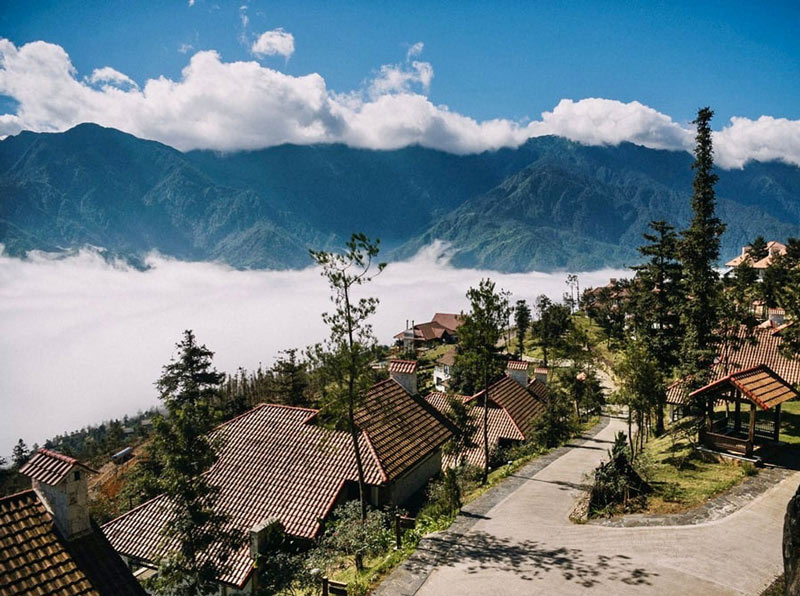
Bernadette & Jean-Paul Aubert during their visit to Sapa
1. What to Do in Vietnam in 14 Days?
In 14 days you can see Vietnam's three regions: the north for Hanoi, Sapa, Ninh Binh and Halong Bay, the center for Hue and Hoi An, and the south for Ho Chi Minh City and the Mekong Delta, which gives first-time visitors the widest first impression of the S-shaped country.
What you prioritize depends on your taste: culture or nature, famous sites or quieter ones. This trip should be yours first of all, but if you are planning 2 weeks in Vietnam for the first time, I recommend the classic stops below.
Halong Bay on Land - Tam Coc, Ninh Binh
In northern Vietnam, you find Hanoi, a capital with more than a thousand years of history; Halong Bay, a UNESCO World Heritage natural site; the limestone and rice-field landscape of Ninh Binh, where the Trang An Landscape Complex was listed by UNESCO in 2014; and the terraced rice fields of the Tonkin highlands around Sapa.
In central Vietnam, two UNESCO-listed cities show the country's heritage. Hue was the capital under the last imperial dynasty, and Hoi An is an old trading port that mixes history, food, countryside, beach and shopping.
In the south, Ho Chi Minh City places colonial buildings next to modern towers, and the Mekong Delta is a watery world of canals, fruit orchards and floating markets.
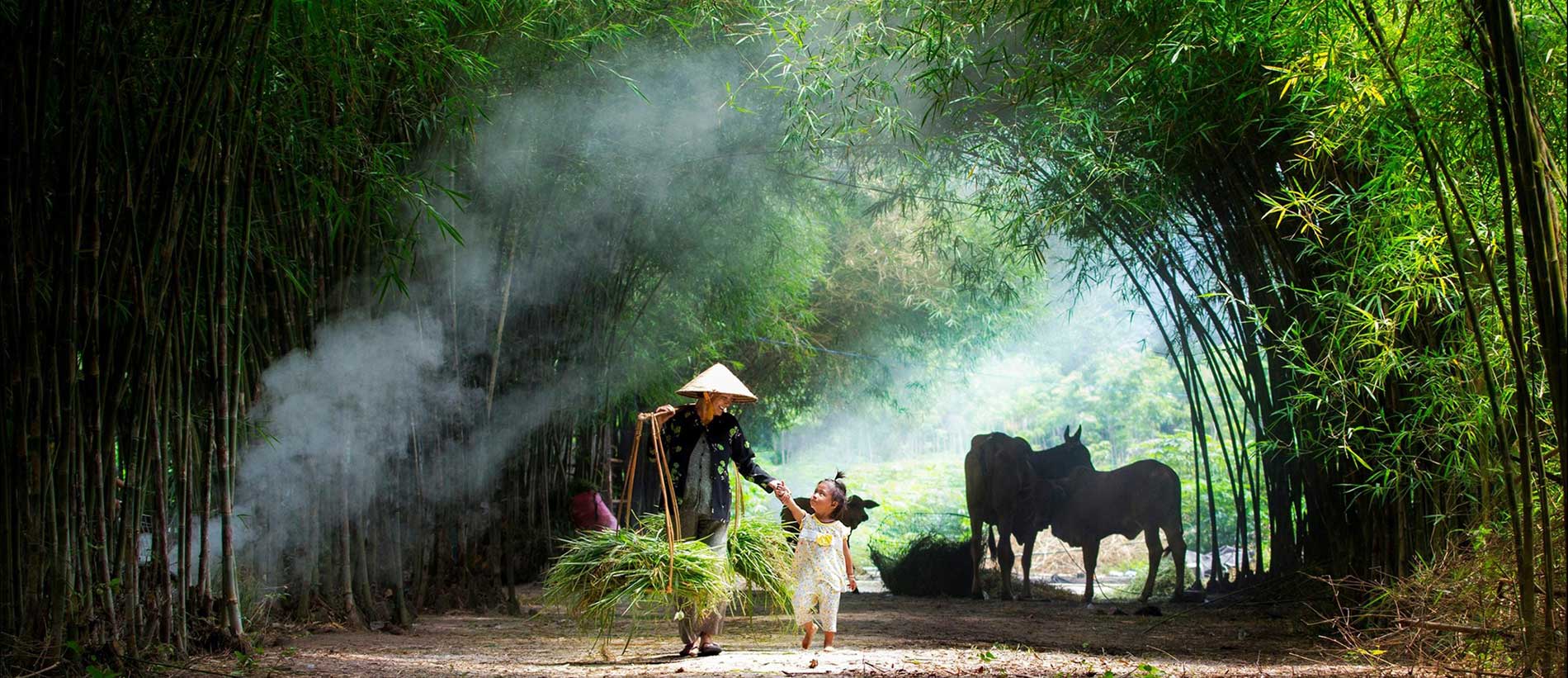
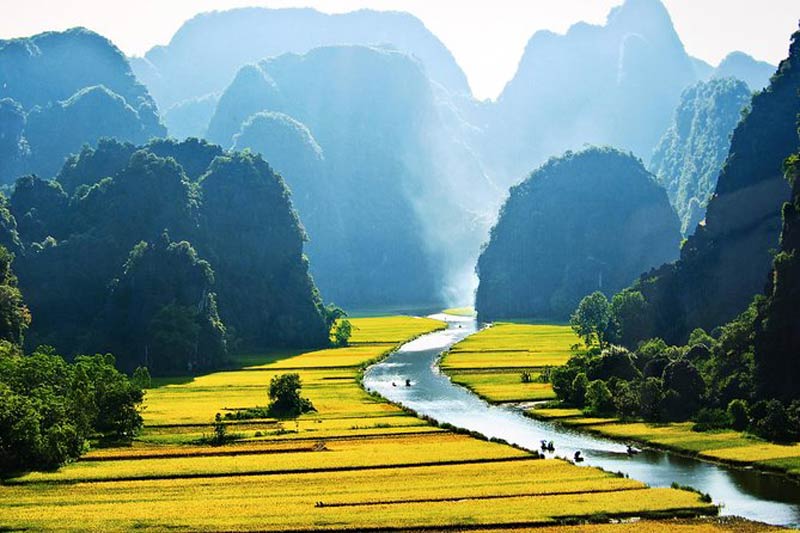
The Vietnamese countryside with rice fields as far as the eye can see
2. My 2-Week Itinerary in Vietnam
2.1 Brief Itinerary for Vietnam in 14 Days
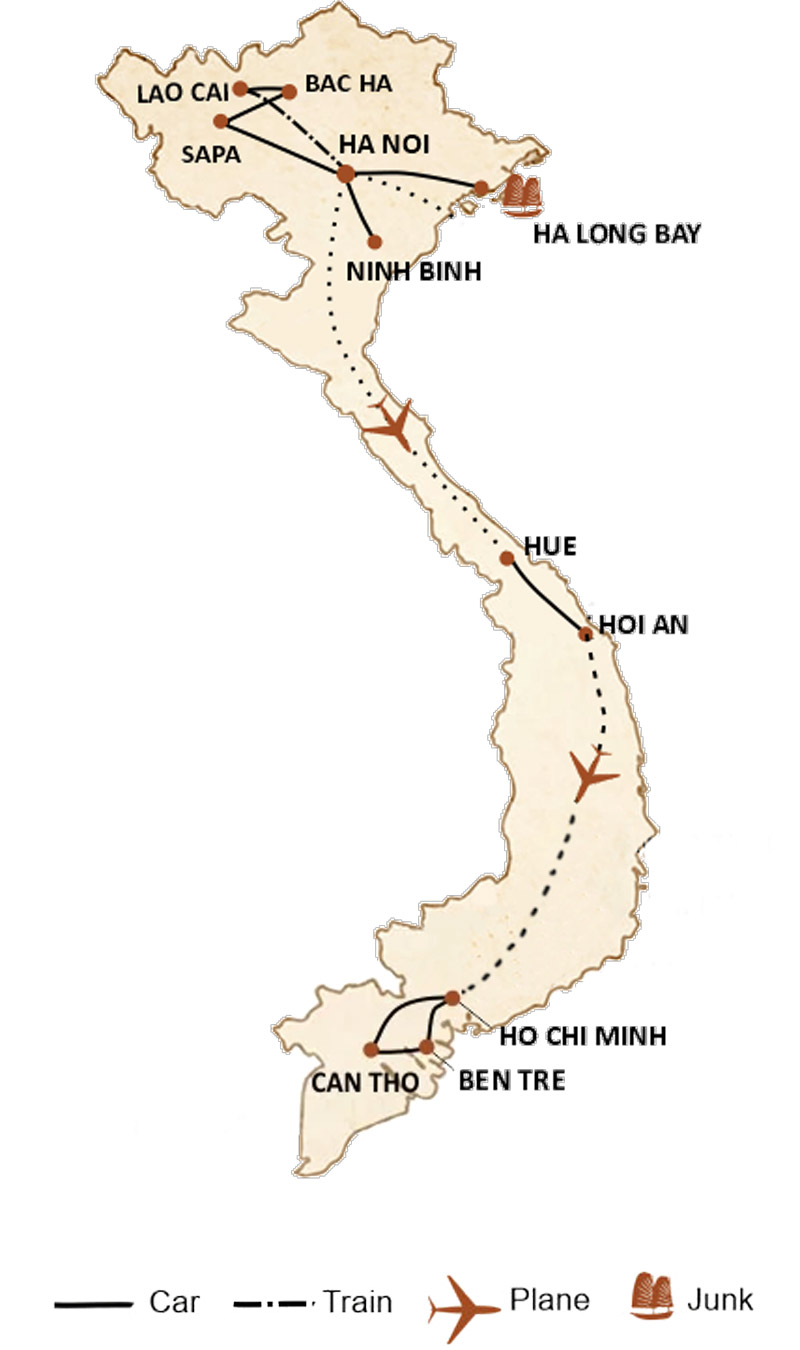
Here is my best proposal for a 2-week Vietnam itinerary, with the transfer between each stop. Travel times are approximate and were checked in October 2026.
Vietnam itinerary map 14 days
Day
Route
What you do
Transfer
Day 1
Hanoi
Arrival and first city tour
Airport transfer
Day 2
Hanoi – Lao Cai
City tour, then the night train
Night train, 8 to 9 hours
Day 3
Lao Cai – Bac Ha
Hike and homestay with a Tay family
Road
Day 4
Bac Ha – Sa Pa
Visit a weekly market, then transfer to Sa Pa
Road, 2.5 to 3 hours
Day 5
Sa Pa – Hanoi
Hiking in ethnic villages, then back to Hanoi
Bus, 5 to 6 hours
Day 6
Hanoi – Ninh Binh – Hanoi
Boat ride at Tam Coc, rice fields and caves
Road (day trip)
Day 7
Hanoi – Lan Ha Bay
Cruise, swimming and kayaking
Road and ferry, about 3.5 to 4 hours to Cat Ba
Day 8
Lan Ha Bay – Hanoi – Hue
Sunrise on the bay, then the flight to Hue
Road, then flight
Day 9
Hue
Citadel, Thien Mu Pagoda, imperial tombs, Dong Ba market
No long transfer
Day 10
Hue – Hoi An
Lang Co lagoon, Hai Van Pass, Cham Museum, An Bang Beach
Road
Day 11
Hoi An
Old town, craft villages by bike
On foot and by bike
Day 12
Hoi An – Ho Chi Minh City
Flight from Da Nang, museums, rooftop evening
Flight
Day 13
Ho Chi Minh City – Mekong Delta
Delta villages, night with a local family
Road
Day 14
Mekong Delta – Ho Chi Minh City
Cai Rang floating market, Cholon, Ben Thanh, departure
Road, then flight home
>>> Good to know: Match the days to the calendar. The main Bac Ha market runs on Sundays, from about 6:30 AM to 2:00 PM, so Day 4 needs to fall on a Sunday if you want to see it. That makes Day 1 a Thursday. Day 14 is the tightest day. The Cai Rang market is best at sunrise, and the road from Can Tho back to Ho Chi Minh City takes several hours, so check your departure time before you book. If you can add a 15th day, spend it in Ho Chi Minh City.
Like most travelers, I started my 2-week trip to Vietnam with a city tour of Hanoi to get to know its best-known places. I gave it my first two days.
Bustling life in the heart of Hanoi's old quarters - Photo: Unsplash/ David Emrich
I particularly loved Hoan Kiem Lake, in the middle of the city, which is the soul of Hanoi. On weekends the area around the lake is closed to traffic, and I was lucky to catch several performances there. I loved the lively atmosphere of the old quarter, which felt to me like the very expression of Vietnamese identity, and I enjoyed the street food the capital is known for.
I visited the Museum of Ethnology, which presents the beautiful ethnic mosaic of Vietnam. Then I went to Bat Trang, a craft village on the outskirts of Hanoi that specializes in ceramics, where I watched artisans carry on a centuries-old craft.
Ceramic products from the village of Bat Trang Hanoi
In the evening I took the sleeper night train to Lao Cai, in the far north of Vietnam. The train covers about 296 km in 8 to 9 hours: the SP1 leaves Hanoi at 9:40 PM and the SP3 at 10:00 PM, and both arrive between 5:30 and 6:10 AM (schedule checked in October 2026).
Day 3: Lao Cai – Bac Ha
I arrived at Lao Cai station early in the morning, had a good local breakfast, and then headed to Bac Ha, a small mountain town in a beautiful region. A beautiful hike took me past terraced rice fields cascading down the mountains, where several ethnic minorities live.
Staying with a local family is one way to spend a night in northern Vietnam
That night I stayed with a family of the Tay ethnic group, which remains one of the highlights of my trip. I shared a convivial dinner with them, accompanied by a few glasses of corn liquor.
Day 4: Bac Ha – Sa Pa
Accompanied by a local guide, I explored the countryside around Bac Ha. I met Flower Hmong women in their colorful traditional costumes, and I took part in some fieldwork with villagers, an experience I found very enriching! We then continued to Sapa, a hill station from the French colonial period.
Hmong women in traditional attire - Janette Asohe
Day 5: Sapa – Lao Cai – Hanoi
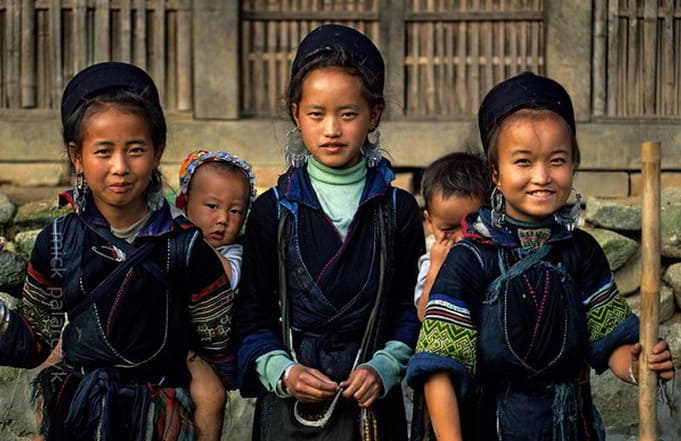
I spent the day visiting the ethnic villages around Sapa with my local guide, who was always ready to share interesting information. I met Black Hmong women in their indigo costumes and Red Dao women with their elaborate headdresses. The highlight was the terraced rice fields, layered up the slopes so steeply that the views made me stop and look. It was hard to leave this scenery, but I took the bus back to Hanoi, a ride of about 320 km that takes 5 to 6 hours on the highway, with my head full of images!
Black Hmong children in their indigo traditional costumes
Day 6: Hanoi – Ninh Binh (Terrestrial Halong Bay) – Hanoi
Today I set off to discover the terrestrial Halong Bay in Tam Coc, Ninh Binh. I felt calm and relaxed as soon as I arrived. The area is so peaceful that the only sound during the boat ride was the rower, and here they row with their feet! I recommend this terrestrial Halong Bay for its rice fields, caves and rural landscapes.
I got up early to visit Halong Bay. Instead of the classic circuit, I chose a cruise in Lan Ha Bay, which lies next to Halong Bay along the coast of Cat Ba Island and is a good alternative when Halong is crowded. Cruises usually leave from the Cat Ba side, about 3.5 to 4 hours from Hanoi by road and ferry. During the cruise we swam in the bay and went kayaking. My favorite part: the excellent fresh seafood meals served on board!
A cruise in the Halong Bay area, my favorite part of the trip
Day 8: Halong Bay – Hanoi – Hue
Following the advice of the junk's captain, I woke up very early to watch the sunrise. What a sight, to see the sun rise over limestone islands that look as if they came straight out of the beginning of the world! We sailed a little further through the bay, had a delicious lunch, and said goodbye to the crew before heading back to Hanoi and flying on to Hue. This cruise is one of my best memories of the trip.
Sunrise in Halong Bay
Day 9: Hue – City Tour
This day was for Hue, the capital of Vietnam under the Nguyen dynasty from 1802 to 1945, whose monuments UNESCO listed in 1993. I visited the old imperial citadel, the elegant Thien Mu pagoda perched on the bank of the Perfume River, and the emperors' tombs nestled in the countryside. I also walked through the vibrant Dong Ba market and ended the day tasting Hue's specialties, as the city is known for one of the most refined cuisines in the country.
Thien Mu Pagoda on the banks of the Perfume River - Teseum
Day 10: Hue – Hoi An
In the morning I drove toward Hoi An along the East Sea and wide stretches of rice fields. After the Lang Co lagoon we climbed the Hai Van Pass, also called the Cloud Pass, which opens wide views over the coast. Passing through Danang, we visited the excellent Museum of Cham Sculpture, which the archaeologist Henri Parmentier helped create, before reaching Hoi An, where I could not resist a swim at An Bang Beach.
Day 11: Hoi An
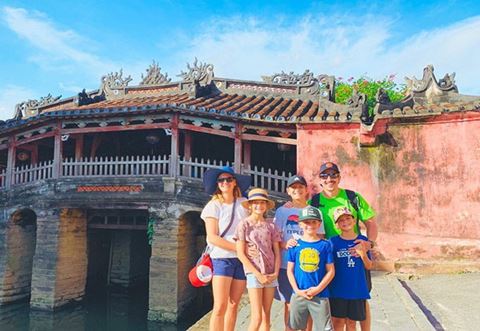
Hoi An, an old trading port that UNESCO listed in 1999, is the town I liked best in Vietnam. It is a pleasure to stroll its pedestrian streets, see its centuries-old wooden houses, cross the Japanese bridge with its tiled roof, and eat the local food. In the afternoon I cycled through the countryside to visit craft villages, where artisans helped me make my own souvenirs: lanterns and pottery. At night, lit by hundreds of lanterns, the old town becomes a different place altogether.
Hoi An Japanese Covered Bridge in Hoi An's old quarters
Day 12: Hoi An – Ho Chi Minh City
To save time, I took a flight from Da Nang, the airport nearest to Hoi An, to Ho Chi Minh City, the largest city of southern Vietnam. Colonial architecture stands next to very modern buildings, and the city is full of contrasts and energy. It also has several museums, such as the Fine Arts Museum and the War Remnants Museum: see our guide to Ho Chi Minh City's museums. In the evening I had a cocktail on one of the city's rooftop terraces, with a panoramic view of a metropolis that never seems to sleep.
Day 13: Ho Chi Minh City – Mekong Delta
Next stop was the Mekong Delta, where the Mekong River reaches the sea through a network of channels that the Vietnamese call Cuu Long, the Nine Dragons. The delta showed me yet another side of Vietnam: a surprising watery world where nature reigns and is generous with the people who live there. Orchards produce tropical fruit, coconut palms grow like a jungle and rice fields stretch to the horizon. Spoiled by this nature, the locals are generous hosts. I spent a night with a local family, helping to prepare dinner and sharing it with them.
Cai Rang floating market, Can Tho
Day 14: Mekong Delta – Ho Chi Minh City – Departure
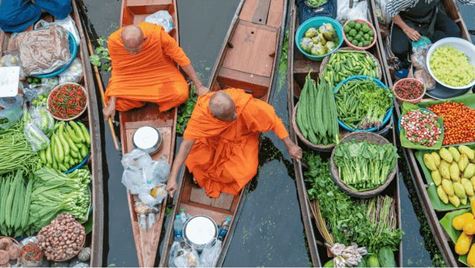
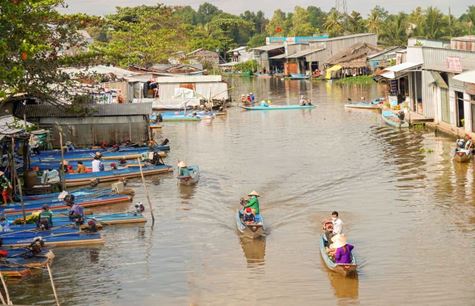
I made the effort to get up very early to see the Cai Rang floating market in Can Tho, and what a reward it was: hundreds of boats of different sizes come to trade, and it was hard to take in this jumble of boats and the intense activity on the water. I even had breakfast on a boat serving soups, sandwiches and coffee! Go at sunrise if you can, because trading is busiest in the first hours of the morning. After lunch with my hosts, I headed back to Saigon.
Notre-Dame Cathedral, a landmark of Ho Chi Minh City
After a visit to Cholon, Saigon's Chinatown, and the Ben Thanh market to buy some souvenirs, I had a relaxing massage before flying back to Europe with lasting memories of the trip.
Cholon - Saigon's Chinatown
My 2-week trip to Vietnam is coming to an end, but I am already thinking about another trip to explore the country in more depth. I am sure I will be back! I hope this 2-week Vietnam itinerary helps you prepare yours.
3. Essential Information about Vietnam Before You Go
Do I Need a Visa for Vietnam?
It depends on your passport: citizens of the United Kingdom, Germany, France, Italy, Spain, Denmark, Sweden, Norway, Finland, Russia, Japan and South Korea can enter without a visa for 45 days until 14 March 2028, while US, Canadian and Australian travelers need a visa, usually an e-visa applied for online before flying.
Twelve more European countries (Belgium, Bulgaria, Croatia, the Czech Republic, Hungary, Luxembourg, the Netherlands, Poland, Romania, Slovakia, Slovenia and Switzerland) have 45 days for tourism until 14 August 2028. The e-visa is valid for up to 90 days, costs USD 25 for a single entry or USD 50 for multiple entries, and takes about three working days; apply only on the official portal, evisa.gov.vn. These rules were checked in October 2026 and can change, so read our Vietnam visa guide before you book.
When Is the Best Time to Follow This Itinerary?
April is the safest month for this north-to-south route, because the north is warm, Hue and Hoi An are dry and sunny, and Ho Chi Minh City ends its dry season, whereas September to November is also good in the north but brings rain, storms and possible floods to Hue and Hoi An.
Tropical storms can cancel Halong Bay cruises, mainly from June to September. Around Sapa, the rice terraces turn golden in late August and September, when the rice is ripe and the harvest takes place. For a month-by-month view of the north, read our guide to the best time to visit North Vietnam, and for the whole country see the best time to visit Vietnam.
What Currency Do I Use in Vietnam?
Vietnam uses the Vietnamese dong (VND): on 12 October 2026 the mid-market rate was about 25,800 to 25,900 VND per US dollar and about 28,900 VND per euro, although bank and exchange-counter rates differ, so check the rate you are actually offered. Carry cash for markets and village stays: ATMs are scarce around Bac Ha and often out of service.
Can I Extend This Trip to Cambodia or Laos?
Yes, Vietnam shares borders with Cambodia and Laos, so this route can be extended into a combined Indochina trip, for example with a few extra days around Siem Reap or Luang Prabang, and our team can plan the flights or border crossings with you.
If you would like to follow this route on a private, tailor-made trip, our team can adjust the pace, the hotels and the activities to your group.
5. FAQ: Questions About a 2-Week Trip to Vietnam
Is 2 Weeks in Vietnam Enough for a First Trip?
Two weeks is a good length for a first overview of Vietnam, as long as you accept several transfers, because this route uses a night train, two flights and long road days that make the pace steady rather than relaxed. For a slower trip, drop the last three days in the south and spend those nights in the north and center.
Is the Night Train to Lao Cai Worth Taking?
The night train saves a hotel night and brings you to Lao Cai around dawn: the 296 km journey takes 8 to 9 hours, with shared four-berth cabins or private two-bed cabins, so it is worth taking if you accept basic beds and some noise. Earplugs help. The alternative is a sleeper bus along the highway, which takes 5 to 6 hours for about 320 km.
Which Day Is the Bac Ha Market, and Is It Worth the Detour?
Bac Ha's main market runs on Sundays from about 6:30 AM to 2:00 PM, and it is best to arrive early, before tour groups reach it at around 9:30 AM, so plan the route so that your night in Bac Ha falls on a Saturday. Part of the market is a livestock area with buffaloes, horses and poultry, and the buffalo market itself has moved to Saturday mornings at a separate site. If animal sales would upset you, stay at the textile and produce stalls or spend the day in the villages around Sapa instead.
Can I Skip the South for a Slower Pace?
Yes, you can drop the last three days (Ho Chi Minh City and the Mekong Delta), which removes a domestic flight and a long road transfer and lets you add nights in Hanoi, Ninh Binh, Hue and Hoi An for a slower pace. The trade-off is that you miss the south and change your departure city, so check flight options before you book.
Planning your trip?
Save time and get expert advice for FREE!
✅ 15 years of local experience
✅ Save up to 40 hours of planning
✅ Travel stress-free from start to finish
Book your free consultation today!









 Our team
 Our team
 Our team
 Our team

.jpg)
.jpg)
.jpg)
.jpg)
.jpg)
.jpg)
.jpg)
.jpg)
.jpg)
.jpg)
.jpg)
.jpg)
.jpg)



 Other
Other Add us as a preferred source