1. Can we start in Thailand and finish in Cambodia, or add Vietnam or Laos?
Yes. Every trip is private, so there are no fixed departures: you can start in Bangkok or Siem Reap and finish in the other, swap destinations or lengthen the route, with the direction usually set by which international flights suit you best. Vietnam or Laos can be added by air; allow at least five to seven extra days, otherwise the new country becomes a stopover rather than part of the trip. See our Vietnam, Cambodia, Laos and Thailand tours.
2. How is the price calculated and what does it include?
Quoted prices are based on a group of four travellers staying in standard hotels, and they do not include international flights. Because the trips are private, the final price depends on when you travel, the category of hotels you choose and above all the size of your group: the same itinerary costs less per person for six than for two. Send us your dates and group size and we will put together a detailed quote.
3. How do you travel between Cambodia and Thailand?
By air. Direct flights between Siem Reap and Bangkok take about an hour, and Phnom Penh also has direct flights to Bangkok. The land border between the two countries has been closed to travellers since June 2025 and no reopening date has been announced, so we do not use it; official travel advice also warns against the areas close to the border. We confirm the flights and the current border position when we finalise your itinerary.
4. Do we need visas for Cambodia and Thailand?
The two countries have separate rules, so check both. For Cambodia, most nationalities need a visa, 30 USD on arrival or online at evisa.gov.kh, and arriving travellers are asked to complete the free e-Arrival card before arrival (Cambodia visa guide). For Thailand, citizens of 60 countries and territories, including the United States, the United Kingdom, Canada and Australia, enter without a visa for up to 30 days from 15 September 2026, and every traveller must complete the free Thailand Digital Arrival Card online within three days before each arrival (Thailand visa guide). We help with these procedures, but rules change, so please confirm the position for your own passport before booking flights.
5. When is the best time to travel to Cambodia and Thailand together?
November to March suits both countries and is the easiest window to plan around, though it is also Thailand’s busiest and most expensive period. Cambodia is in its dry season, the north of Thailand is at its best from November to February and the Andaman coast (Phuket, Krabi) is dry from November to March (best time to visit Thailand). From April to August the Gulf islands such as Koh Samui usually have better weather than Phuket and Krabi. Cambodia in the rainy months is still workable, with short afternoon showers, greener countryside and fewer visitors at Angkor (best time to visit Cambodia).
6. How many days do we need for Cambodia and Thailand together?
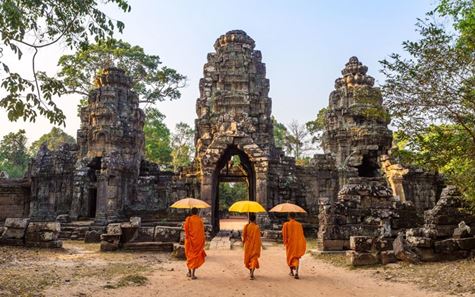
Ten days is the practical minimum: three or four days for Siem Reap and the Angkor temples, then Bangkok with one other part of Thailand. Two weeks lets you add either the northern hills around Chiang Mai and Chiang Rai or a stretch on the southern coast. Eighteen days is what you need to do both halves of Thailand, north and south, alongside Cambodia without moving every second day, as on our 18-day itinerary from Angkor to the Andaman coast.




 Our team

 Our team

 Our team

 Our team