Ho Chi Minh Mausoleum: An iconic must-see place in Hanoi
The Ho Chi Minh Mausoleum is one of Hanoi’s most important historical and ceremonial landmarks. Standing in Ba Dinh Square, it houses the preserved body of Ho Chi Minh and occupies a place closely linked to the birth of modern Vietnam.
Visiting it, however, is quite different from visiting a museum or a typical tourist attraction. The time spent inside is brief, entry follows strict rules, and the mausoleum opens only during limited morning hours.
Written by Oliver PHUNG (Tour Guide)
Updated on Sep 28, 2026
0 comment
Oliver Phung is a Northern Vietnam-based tour guide and blogger. His favorite topics to write about include cuisine, culture, travel, and under-the-radar experiences. Oliver possesses a deep, detailed understanding of the region, from the indigenous culture of the Hmong in the Northwest to the highland lifestyle of the Tay in the Northeast. Whether he is exploring ancient architecture or geological landscapes, he is always eager to share his insights with his readers.
Beyond his work at Kampá Tour, he produces specialized travel content on platforms such as Reddit, Instagram, LinkedIn, and various other publications.
⚠️ Important update (September 2026): the Mausoleum is closed for its annual maintenance from September 4 to November 2, 2026 and reopens to visitors on November 3, 2026, according to the announcement of the Ho Chi Minh Mausoleum Command.
The Ho Chi Minh Mausoleum, known locally as Lăng Bác, or Uncle Ho’s Mausoleum, stands at the centre of Ba Dinh Square in Hanoi.
It contains the embalmed body of Ho Chi Minh, the revolutionary leader and first president of the Democratic Republic of Vietnam, who died on September 2, 1969.
Construction began on September 2, 1973, four years after his death, and the mausoleum was inaugurated on August 29, 1975.
Interestingly, Ho Chi Minh had expressed a wish in his testament to be cremated, with his ashes placed in different parts of Vietnam. The decision was instead made to preserve his body and construct the mausoleum so future generations could visit the site.
Today, the mausoleum is not simply a historic monument. It remains an active national memorial visited by Vietnamese families, school groups, veterans, official delegations and international travelers.
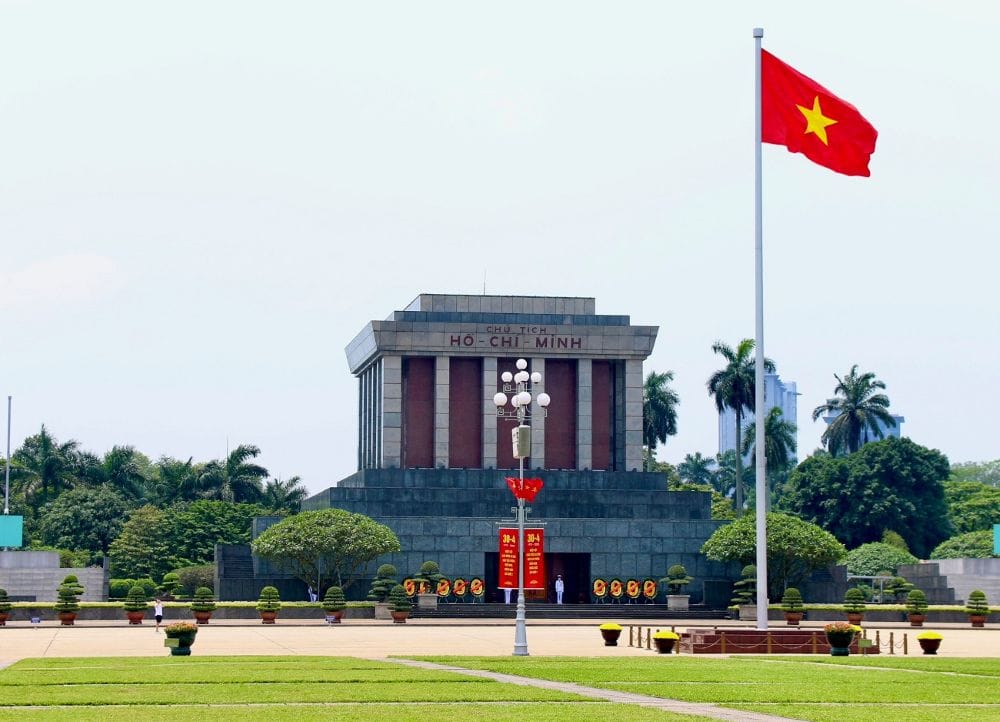
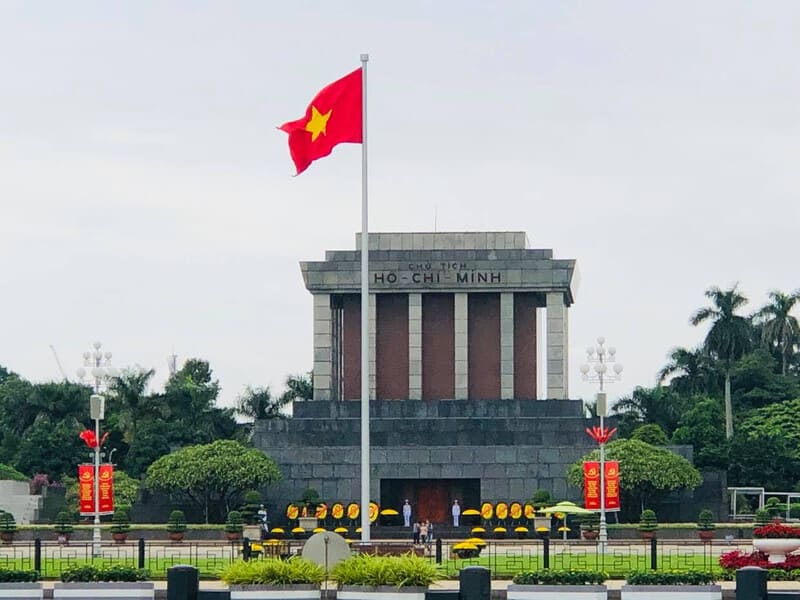
Ho Chi Minh Mausoleum in Ba Dinh Square
Is Ho Chi Minh Mausoleum worth visiting?
Yes, particularly if you want to understand modern Vietnamese history and Ho Chi Minh’s place in the country’s national memory.
The actual passage through the memorial chamber is short, generally around ten minutes. So if you are expecting a large attraction filled with exhibitions, there is relatively little to “see” inside.
That is not really the point of the visit.
Much of the experience comes from the solemn atmosphere, the procession of visitors, the ceremonial character of the site and the historical setting of Ba Dinh Square. It offers a type of experience that a conventional museum cannot reproduce.
It is particularly worthwhile for travelers interested in modern Vietnamese history, political history or national traditions. If you have only a few hours in Hanoi and those subjects do not interest you, the Old Quarter or Temple of Literature may be a higher priority.
For most first-time visitors, however, the mausoleum becomes considerably more rewarding when combined with the Presidential Palace area, House No. 54, Ho Chi Minh’s Stilt House, the fish pond, Ho Chi Minh Museum and One Pillar Pagoda.
Why is Ho Chi Minh Mausoleum historically significant?
The importance of the mausoleum begins with Ba Dinh Square itself.
On September 2, 1945, Ho Chi Minh read the Declaration of Independence here, announcing the establishment of the Democratic Republic of Vietnam. Twenty-four years later, he died on the same date, September 2, 1969.
The mausoleum was subsequently constructed on this historically significant square between 1973 and 1975.
This connection between the declaration of independence, Ho Chi Minh’s death and the later construction of the memorial helps explain why Ba Dinh is not viewed simply as another public square in Hanoi.
For Vietnamese visitors in particular, the mausoleum remains a place of remembrance as well as a historical landmark.
Ba Dinh Square, where Ho Chi Minh read the Declaration of Independence on September 2, 1945
What does Ho Chi Minh Mausoleum look like?
The mausoleum is monumental without being highly decorative.
The three-level structure measures approximately 21.6 metres high and 41.2 metres wide. Its exterior is clad mainly in grey granite, while the façade bears the inscription “CHỦ TỊCH HỒ - CHÍ - MINH” in dark red stone. Its design drew inspiration from Lenin’s Mausoleum in Moscow while incorporating elements intended to reflect Vietnamese architecture and identity.
The national symbolism extends beyond the building itself.
Construction materials and plants were contributed from different parts of Vietnam, turning the surrounding landscape into part of the memorial concept. Around the mausoleum, 79 cycad trees symbolize Ho Chi Minh’s 79 years of life.
This is worth noticing when you visit because the gardens are not merely decorative landscaping. They were conceived as part of a monument intended to represent the country as a whole.
What should you expect inside Ho Chi Minh Mausoleum?
Expect a short, quiet and highly regulated visit.
After passing security, visitors enter in an orderly line and continue through the central memorial chamber without stopping.
Ho Chi Minh’s preserved body lies in a glass coffin guarded by four honor guards. Visitors are expected to remain silent, and photography or filming is strictly prohibited inside.
The line moves continuously, so you may spend much longer waiting outside than actually inside the mausoleum.
This often surprises first-time visitors.
Rather than thinking of the mausoleum as a conventional sightseeing attraction, it is more useful to see the passage through the chamber as a ceremonial experience. Its meaning comes as much from the silence, the formal procession and the people visiting alongside you as from the few minutes spent looking at the memorial itself.
What are the opening hours and entrance fees?
The Ho Chi Minh Mausoleum opens in the morning only, and its hours change according to the season.
From April 1 to October 31, it opens Tuesday to Thursday from 7:30 AM to 10:30 AM, and on Saturdays, Sundays and public holidays from 7:30 AM to 11:00 AM.
From November 1 to March 31, it opens as follows: Tuesday to Thursday from 8:00 AM to 11:00 AM, on Saturdays from 8:00 AM to 11:30 AM, and on Sundays and public holidays from 8:00 AM to 11:00 AM.
The mausoleum is normally closed on Mondays and Fridays. However, it remains open on certain important occasions, including Ho Chi Minh’s birthday on May 19, National Day on September 2 and the first day of Tet, even when those dates fall on a Monday or Friday.
Annual maintenance closure
The mausoleum closes for approximately two months each year for technical maintenance and preservation work.
The dates vary from year to year.
In 2026, the closure runs from September 4 to November 2, and the mausoleum reopens on November 3. A few travel sites list September 5 to November 3, but the announcement of the Mausoleum Command gives September 4 to November 2.
If your trip falls around the annual maintenance period, check the latest schedule before planning your morning around the mausoleum.
Entrance fees
Entering the mausoleum is free for Vietnamese citizens. Most 2026 sources say it is also free for foreign visitors, although a few guides list 25,000 VND for foreigners, so confirm at the gate.
Other attractions in the wider complex have separate entrance fees. Ho Chi Minh Museum costs 40,000 VND for foreign visitors. For One Pillar Pagoda, some guides say entry is free and others list 25,000 VND for foreign visitors, so ask on site. The Presidential Palace historical site (House No. 54 and the Stilt House) also has its own ticket, so ask for the current price at the ticket office.
Young children are generally not admitted to the memorial chamber. Sources give a minimum age of 2 or 3 years, so check at the gate if you are travelling with a small child.
Is there a dress code for Ho Chi Minh Mausoleum?
Yes. Dress and behavior rules are taken more seriously here than at most attractions in Hanoi.
Visitors should wear clean, respectful clothing. Men should avoid tank tops and shorts, while women should keep their shoulders and knees covered and avoid very short or revealing clothing.
Visitors also pass through a security check before entering. Large bags, professional camera equipment and prohibited items may need to be deposited or cannot be taken into the memorial area.
Inside and while approaching the mausoleum, follow the instructions given by guards. Remove your hat, maintain silence and continue moving with the line.
Photography and filming are prohibited inside. Visitors should also avoid putting their hands in their pockets, crossing their arms, touching the walls, smoking or chewing gum. Weapons, explosives, flammable substances, food and drinks are prohibited.
These rules are not simply ordinary museum etiquette. They reflect the fact that the mausoleum continues to function as an active national memorial.
What else should you see in the Ho Chi Minh Mausoleum Complex?
Do not leave immediately after visiting the mausoleum.
The memorial chamber itself is brief. Much of the context that makes the experience worthwhile comes from the surrounding historic sites.
The wider area covers around 14 hectares and includes the Presidential Palace, House No. 54, Ho Chi Minh’s Stilt House, the fish pond, Ho Chi Minh Museum and One Pillar Pagoda.
Presidential Palace and House No. 54
One of the strongest contrasts in the complex appears almost immediately.
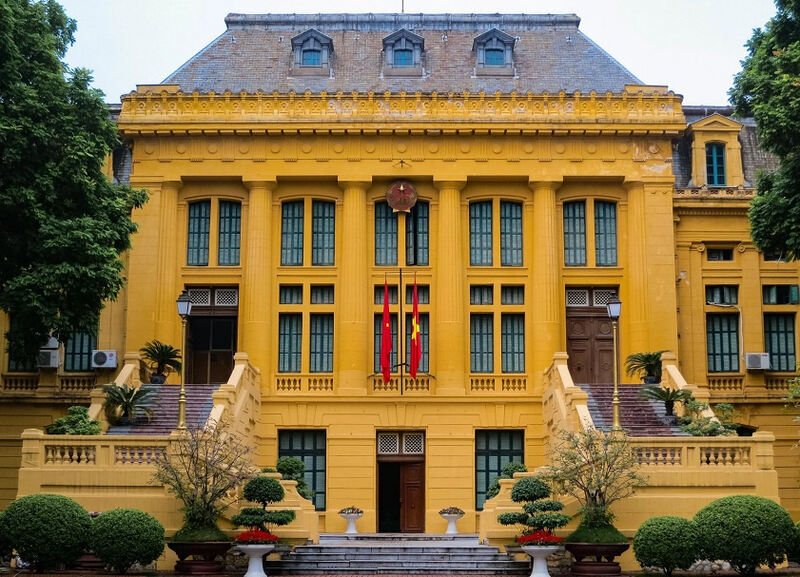
The large yellow Presidential Palace was constructed during the French colonial period and later used for official state functions. Ho Chi Minh, however, chose not to make the grand palace his personal residence.
The Presidential Palace
Instead, he moved into the much smaller House No. 54 in December 1954. The building had previously been used by an electrician working in the former Governor-General’s compound. Ho Chi Minh lived there until moving to the nearby Stilt House in 1958, although he continued returning to House 54 for meals and health checks.
Inside, some of the smallest details tell the most memorable stories.
One example is the thermometer still displayed in the dining room. According to the Presidential Palace historical site, Ho Chi Minh used it to check the temperature each day. When it fell below 10°C, he would remind the Minister of Education to allow primary-school children to stay home for health reasons.
This is exactly the kind of detail that is easy to miss if you walk through quickly.
A nearby garage also preserves vehicles once used by Ho Chi Minh, including a Pobeda and Peugeot 404.
According to the official website of the Presidential Palace historical site, it is open every day except Monday afternoons. In summer (April to October) the hours are 7:30 AM to 11:00 AM and 1:30 PM to 4:00 PM; in winter they are 8:00 AM to 11:00 AM and 1:30 PM to 4:00 PM.
House No. 54
Ho Chi Minh’s Stilt House
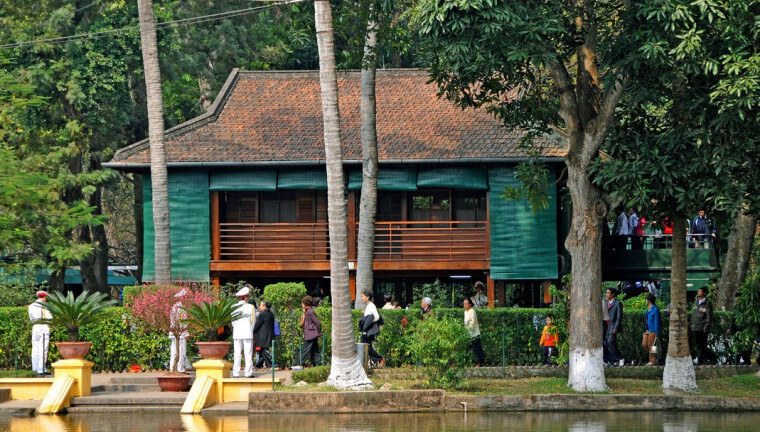
In 1958, Ho Chi Minh moved to a small wooden stilt house nearby and continued living and working there until his death in 1969.
The two-storey structure was inspired by traditional houses found among ethnic communities in northern Vietnam. Compared with the imposing Presidential Palace only a short distance away, its modest size is immediately noticeable.
Several personal objects remain on display, while the surrounding garden and simple working spaces give visitors a more tangible sense of everyday life than the monumental mausoleum can provide. The Presidential Palace historical site still preserves the Stilt House together with objects associated with Ho Chi Minh’s final 11 years.
Ho Chi Minh’s Stilt House
Uncle Ho’s fish pond
Next to the Stilt House is a large pond surrounded by trees and tropical vegetation.
A story often shared by local guides says that Ho Chi Minh would feed the fish after work and clap his hands to call the carp to the surface.
It is a simple anecdote, but it makes this quieter part of the complex surprisingly memorable, especially after the formality of the mausoleum.
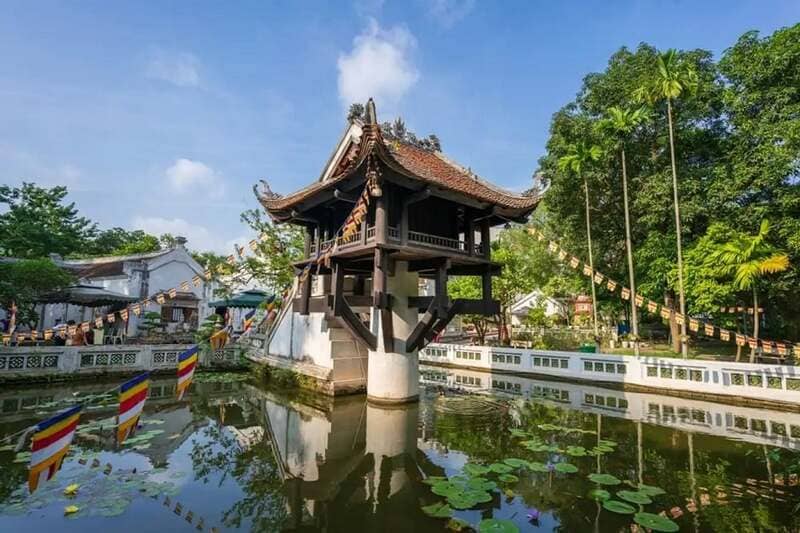
One Pillar Pagoda
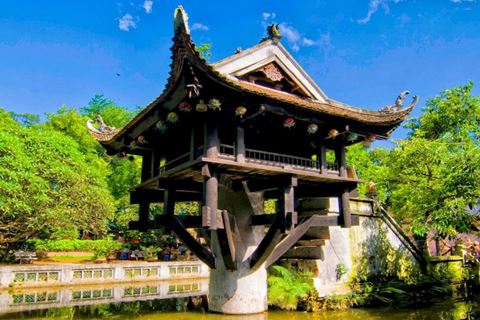
One Pillar Pagoda is so close to the mausoleum complex that it makes little sense to pass through Ba Dinh without stopping for a few minutes.
Built in 1049 under Emperor Ly Thai Tong, the small wooden pagoda stands on a single stone pillar and is designed to resemble a lotus rising from the water.
Its unusual form is connected with one of Hanoi’s best-known legends. According to the traditional story, the childless emperor dreamed that the Goddess of Mercy appeared on a lotus throne and handed him a son. After he later had a male heir, he commissioned the pagoda in gratitude, designing it to evoke the lotus in his dream.
The legend helps explain why the pagoda is more than simply an unusual photo stop and why it has long been associated with blessings and family wishes.
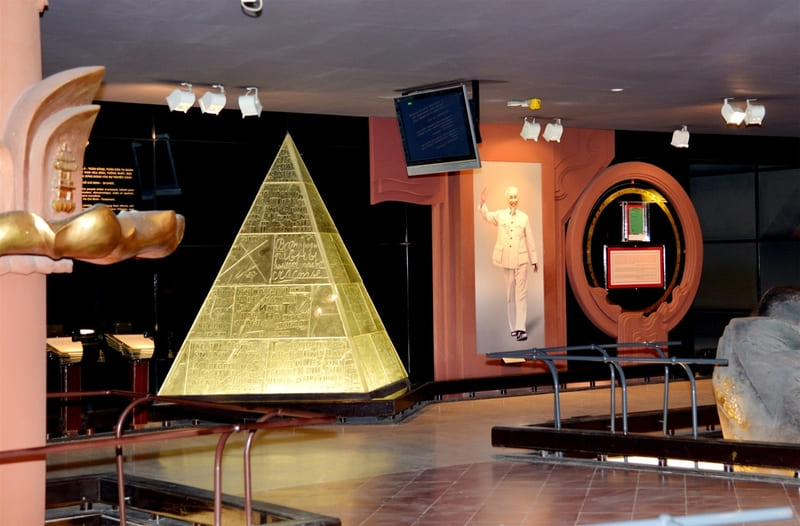
The Ho Chi Minh Museum serves a different purpose from the mausoleum.
The mausoleum is primarily a memorial and ceremonial space; the museum is where visitors go for historical interpretation.
Its exhibitions explore Ho Chi Minh’s biography, Vietnam’s revolutionary history and the broader international events that shaped his political life.
The museum is open Tuesday, Wednesday, Thursday, Saturday and Sunday, from 8:00 AM to 12:00 PM and from 2:00 PM to 4:30 PM, and is closed on Mondays and Fridays. It is located at 19 Ngoc Ha Street.
If you leave the mausoleum wanting to understand more rather than simply see more, the museum is the most logical next stop.
Ho Chi Minh Museum
Can you watch the flag ceremony at Ba Dinh Square?
Yes. The daily flag ceremonies offer a very different way to experience Ba Dinh Square.
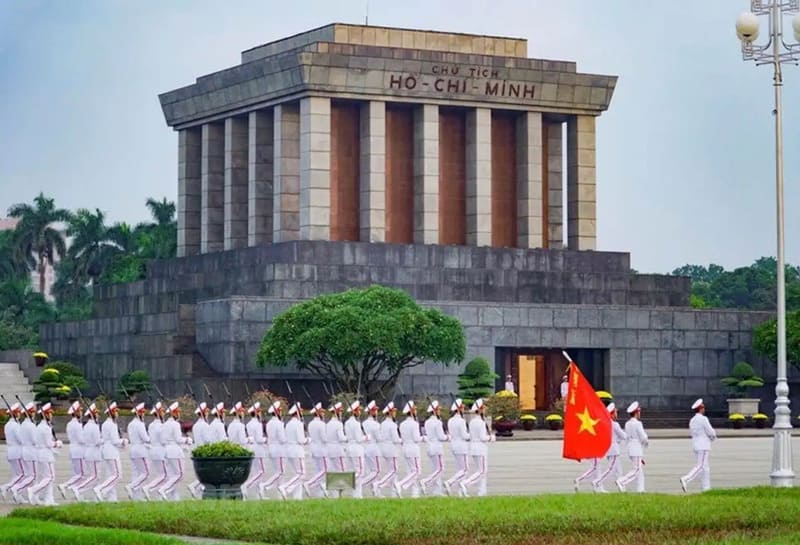
By law, the national flag is raised every morning at 6:00 AM from April 1 to October 31 and at 6:30 AM from November 1 to March 31. It is lowered every evening at 9:00 PM.
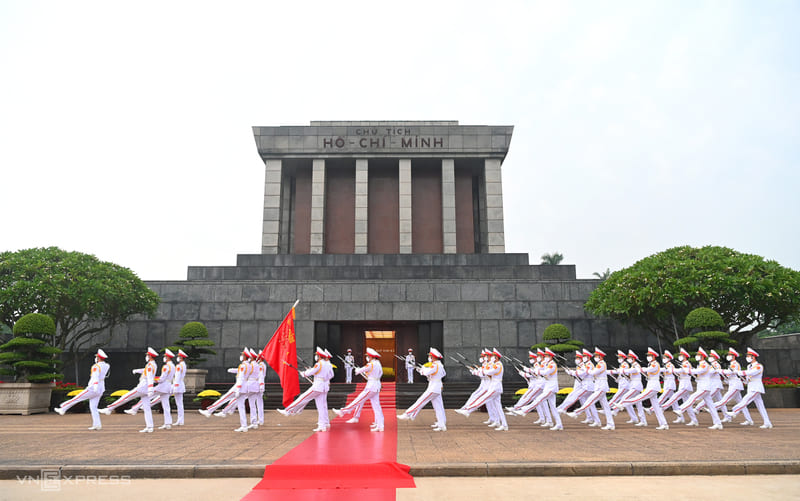
The ceremonies take place every day and involve an honor guard marching across the square accompanied by the national anthem. In very bad weather the ceremony can be held in a shortened form.
If you want to watch, arrive around 15 minutes early to find a good position. You do not need to enter the mausoleum to see the ceremony.
For travelers staying near central Hanoi, the evening flag-lowering ceremony can also be useful if the mausoleum itself is closed or your itinerary does not allow a morning visit.
Flag-raising and lowering ceremony at Ba Dinh Square
How do you get to Ho Chi Minh Mausoleum?
Address:No. 2 Hung Vuong Street, Ba Dinh Ward, Hanoi.
From the Hoan Kiem Lake area, allow around 15 minutes by car, depending on traffic.
Ride-hailing apps such as Grab, Xanh SM and Be are among the simplest options because you can see the fare before confirming the journey.
Bus No. 09 also connects the Hoan Kiem area with Ba Dinh, while travelers who enjoy walking can reach the complex from the Old Quarter in roughly 30 to 40 minutes. The standard fare is 7,000 VND, and several local sources report that fares for trips under 15 km rise to 8,000 VND from November 1, 2026.
One practical detail matters more than the official address if you plan to enter the mausoleum:
The visitor queue begins on Ngoc Ha Street (around numbers 17 to 19), behind the complex.
Knowing this in advance can save unnecessary walking around Ba Dinh Square looking for the entrance.
How can you avoid wasting time during your visit?
Go early. The mausoleum opens only in the morning, and the queue can grow quickly. Arriving around 30 minutes before opening is a sensible choice, particularly on weekends.
Check the annual closure before leaving your hotel. Unlike most Hanoi attractions, the mausoleum can close for around two months for maintenance. In 2026 it is closed from September 4 to November 2.
Plan more time than the mausoleum itself requires. The passage through the chamber may take around ten minutes, but exploring the surrounding complex comfortably can fill much of a morning.
Avoid major holidays if possible. Around National Day, April 30 and Tet, queues of one to two hours are not unusual.
A weekday morning is generally easier. If your Hanoi schedule is flexible, visiting outside weekends and major commemorative dates usually means a calmer experience.
Dress correctly before you arrive. This is not a site where it is worth taking a chance on borderline clothing. Respectful dress and a light bag make security much simpler.
What else can you visit near Ho Chi Minh Mausoleum?
Once you have finished the Ba Dinh complex, two major historical attractions are particularly easy to add.
Imperial Citadel of Thang Long
The Imperial Citadel of Thang Long is roughly a 10-minute walk from the mausoleum.
It is the better continuation if you want to stay with Hanoi’s political history but move much further back in time. The UNESCO-listed complex preserves archaeological and architectural evidence connected with centuries of rule at Thang Long, the former name of Hanoi.
Temple of Literature
The Temple of Literature is around an 8-minute drive from the mausoleum area.
Founded in 1070, it offers a different perspective on Vietnamese history through Confucianism, education and traditional architecture.
For a first morning in Hanoi, the Ba Dinh complex combined with either the Imperial Citadel or Temple of Literature creates a much more rounded historical introduction to the capital than visiting the mausoleum alone.
The Ho Chi Minh Mausoleum is worth visiting not because there is a great deal to see inside, but because of what happens around those few minutes in the memorial chamber.
The silence inside, the Vietnamese visitors coming to pay their respects, Ba Dinh Square outside, the contrast between the monumental mausoleum and Ho Chi Minh’s modest living quarters, and small details such as the thermometer at House No. 54 or the fish pond nearby all give the site a context that a simple list of historical dates cannot.
For first-time visitors who want to understand modern Vietnam, it is one of Hanoi’s most meaningful historical stops.
Just remember that timing matters here more than at most attractions in the city. Check the opening schedule and annual closure before you go, dress appropriately, arrive early and allow enough time to explore the wider Ba Dinh complex rather than visiting the mausoleum alone.
Planning your trip?
Save time and get expert advice for FREE!
✅ 15 years of local experience
✅ Save up to 40 hours of planning
✅ Travel stress-free from start to finish
Book your free consultation today!














 Our team
 Our team
 Our team
 Our team

.jpg)
.jpg)
.jpg)



 Other
Other Add us as a preferred source