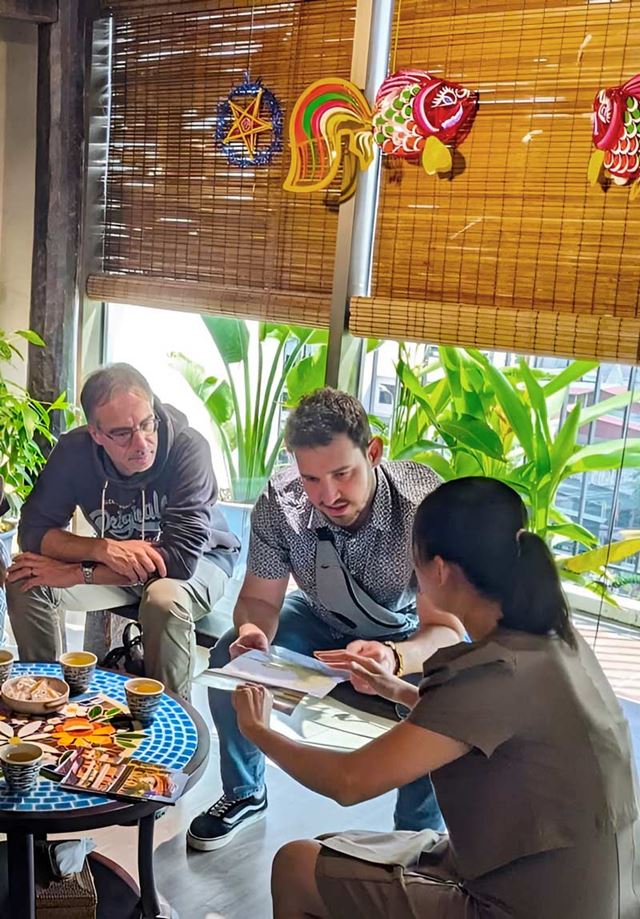
Halong Bay Cruises: How to Choose One, and What to Ask First
Most guides to Halong Bay cruises hand you a ranked list of boats. I am not going to, and the reason matters: star ratings on this bay are self-declared, and several travellers have described being asked to post a five-star review before they had even left the vehicle.
So this guide does something different. It covers how long to go for, what a cruise actually costs once drinks and tips are counted, what happens when the authorities close the bay, and the six questions that tell you more about a boat than any rating will. I have also included the two days I spent on the water, hour by hour, so you can see what the schedule really feels like.
Written by Oliver PHUNG (Tour Guide)
Updated on Sep 21, 2026
0 comment
Oliver Phung is a Northern Vietnam-based tour guide and blogger. His favorite topics to write about include cuisine, culture, travel, and under-the-radar experiences. Oliver possesses a deep, detailed understanding of the region, from the indigenous culture of the Hmong in the Northwest to the highland lifestyle of the Tay in the Northeast. Whether he is exploring ancient architecture or geological landscapes, he is always eager to share his insights with his readers.
Beyond his work at Kampá Tour, he produces specialized travel content on platforms such as Reddit, Instagram, LinkedIn, and various other publications.
Getting from Hanoi to Halong Bay takes about 2.5 to 3 hours by road, covering roughly 130 to 170 km depending on where in the city you set off from. Almost everyone arrives by bus, limousine van or private car, and which one you take usually depends on how you booked the cruise rather than on price.
If you booked through a travel agency, the transfer is normally arranged for you, either from your hotel or from a central meeting point.
If you booked directly with a cruise company, you may need to organise your own way there, although many lines run pickups from fixed points in Hanoi's Old Quarter such as the Opera House square.
Two things to plan around. Boarding is usually between 12:00 and 12:30, which means leaving Hanoi around 7:00 or 7:30 in the morning. And most road transfers stop once or twice on the way, often at a souvenir complex. That stop is normal and you are not obliged to buy anything, but if you would rather go straight through, book a private car and say so in advance.
Coming from Ninh Binh instead? The drive is roughly 3 hours. Booking a private car independently is often cheaper than the transfer a cruise line will quote you, and it lets you leave when you want rather than when the shuttle does.
2. Best time to take a Halong Bay cruise
October is the most reliable single month. The rains have eased, the air is clearer than in winter, and the sea is usually calm. March to May is the other dependable window. If those months do not fit your trip, the bay still works year round, but the trade-offs change.
March to May
Warm and settled, with temperatures generally in the low to high twenties Celsius and rising towards the end of May. Skies are often clear, which matters more here than most travellers expect: the difference between a clear day and a hazy one changes the colour of the water completely.
June to August
The hottest and wettest stretch, and the period with the highest storm risk. This is also when the water is warmest for swimming and when domestic tourism peaks. Travel in these months if you want to swim, but build a spare day into your itinerary. When a storm approaches, the bay closes and no boat sails.
September to November
The rains taper off, temperatures settle around the mid twenties, and visibility is usually at its best. This is peak season for international visitors, so cabins on the smaller boats go first. Book several weeks ahead if you are travelling in this window.
December to February
The driest months and the quietest on the water, but also the coolest and often the haziest. Days can be grey and flat, and evenings get genuinely cold on deck, so bring a jacket. Swimming is not realistic. Several travellers who went in winter told me the mist suited the landscape and they would not change it, so this is a matter of what you want from the trip rather than a season to avoid.
3. Ha Long, Bai Tu Long or Lan Ha: which bay to cruise
All three share the same limestone geology and offer much the same activities. The real difference is how many other boats you will see. If crowds are what would spoil the trip for you, that single factor should decide your route.
The central and most visited part, roughly 170 km from Hanoi and the easiest to reach. This is where the landmark stops are: Ti Top island, Sung Sot cave, Thien Cung cave, the Fighting Cock islet. It is also where the day-trip fleet concentrates, so the cave jetties and the Ti Top staircase queue up between mid morning and mid afternoon in high season.
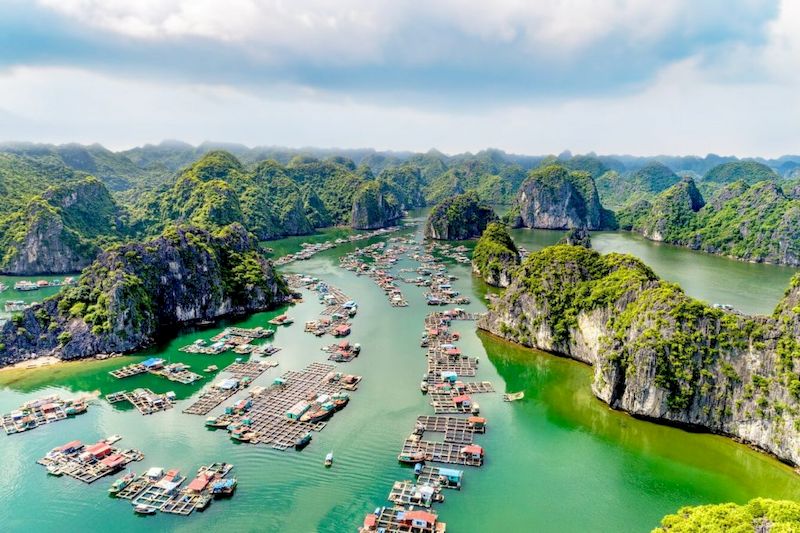
Northeast of Halong proper, near Cam Pha. Fewer operators hold permits here, which is why it stays quiet. Routes take in Cong Do, Cap La, Thien Canh Son cave, Vung Vieng fishing village and Bai Tu Long National Park. Travellers who have done both bays consistently describe far fewer boats and noticeably cleaner water here.
South of Halong, beside Cat Ba Island. Smaller in scale and quieter than the centre, and the best choice if you want to be active: kayaking, swimming, cycling through Viet Hai village, rock climbing. Many Lan Ha itineraries include a stop on Cat Ba, which adds land to a trip that is otherwise entirely on water.
Lan Ha Bay is near Cat Ba Island
Short version: pick Halong for the landmarks, Bai Tu Long for quiet, Lan Ha for activity and for Cat Ba.
4. Day trip, one night or two nights?
One night is the minimum worth doing, and two nights is what most people wish they had booked. Before you decide, know that a "two day, one night" cruise is closer to 23 hours on board: boarding is usually around 12:00 to 12:30 and disembarkation around 10:00 to 11:00 the next morning. Several travellers have called that framing misleading, and they have a point. Count nights, not days.
Day cruise
Four to six hours on the water, with hotel pickup, lunch on board and a return to Hanoi by evening. Total door to door from Hanoi is eleven to twelve hours, of which five or six are in a vehicle.
Works if: your schedule genuinely allows one day, or you are already staying on Cat Ba and can join a Lan Ha day boat without the Hanoi drive.
Does not work if: you want sunrise, sunset or the hours after the day fleet goes home. Those are the hours people remember.
Day cruises are not all the same length, and the difference decides how far into the bay you get. To give you a concrete example, one of the boats we use for day trips, La Muse, runs three fixed circuits from the Bai Chay waterfront in Ha Long city:
Circuit
Departure
Route
4 hours
07:30
Port, Thien Cung and Dau Go caves, Cho Da rock, Dinh Huong islet, back to port
5 hours 30
12:00
Port, Am islet, Thien Canh Son cave, Dau Rong rock, back to port
8 hours
08:30
Port, Am islet, Thien Canh Son cave, Vung Vieng fishing village, back to port
Schedule as published for 2026. Departure times shift with the season, so confirm on your travel dates.
Note what the four-hour circuit does and does not cover: the caves closest to the port, and nothing beyond them. The eight-hour circuit is the only one of the three that reaches a fishing village. If a day trip is your only option, the length you book matters more than the boat you book it on.
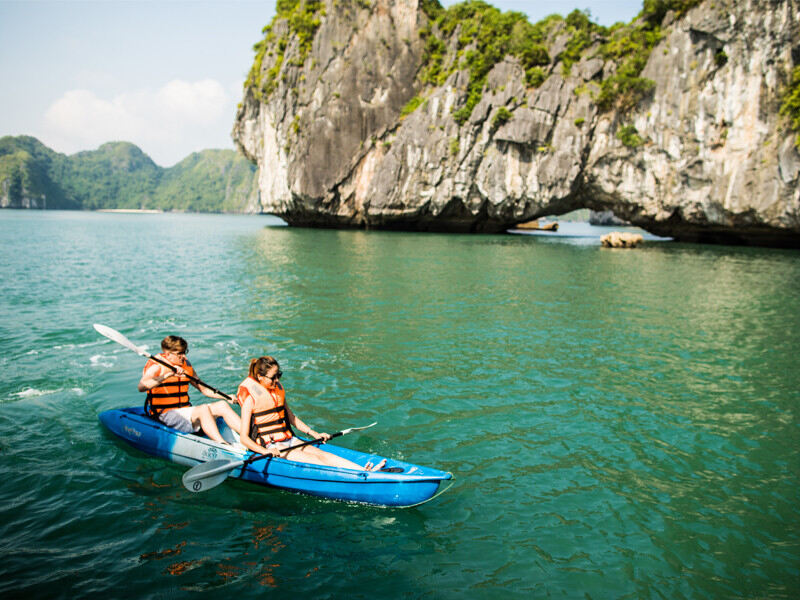
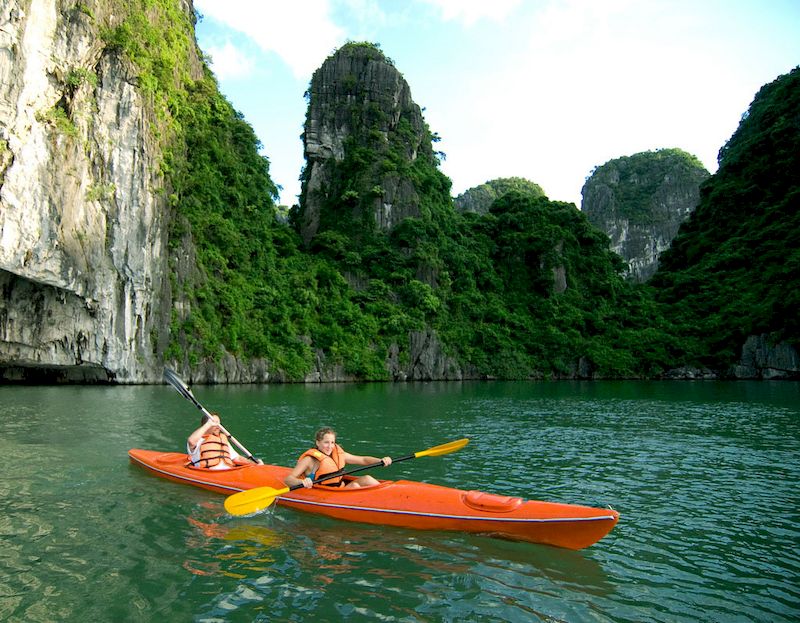
Kayaking through Luon Cave
Two days, one night
The most common choice. You get one evening and one morning on the water, usually a cave stop, a kayak session and one island landing. It is the point at which the bay stops being a sightseeing stop and starts being a place you stay.
Works if: you have two days and want the classic experience without a large budget.
Does not work if: you dislike a tight schedule. With 23 hours on board, activities run back to back and there is little idle time.
Three days, two nights
The second night is what buys you distance. Most one-night routes cover the same circuit, so the boats converge in the same places. On the second day a longer itinerary moves beyond that circuit, and the traffic thins out noticeably.
Works if: you want quiet, you are travelling for a special occasion, or you would rather sit on deck than tick off stops.
Does not work if: you bore easily. Several travellers found the third day repetitive, because the boat spends much of it at anchor.
Cave passages are reached by tender or bamboo boat, not by the main ship
One thing nobody tells you: on many two-night itineraries, the main ship returns to port on the second morning to swap passengers, and you are transferred to a separate day boat shared with day-trippers from other vessels. It is not a scam and the day boat often reaches places the big ship cannot, but it is not what most people picture. Ask before booking whether you stay on the same vessel throughout. Some boats do, and they say so.
5. Which cruise is best? The boats compared
Because the stars are not real, and neither are many of the reviews.
Vietnam has no enforced star classification for cruise vessels on the bay. The three, four, five and even six-star labels you see are set by the operators themselves, which is why a self-declared six-star boat can charge more than a five-star one and deliver less.
Review scores have a separate problem. Multiple travellers have independently described being pressured to post a five-star review before their trip was over: on the transfer bus back to Hanoi, at the final dinner with a staff member watching, or as a condition presented as "company policy". Some boats also use 3D renders rather than photographs in their listings. A boat with more than a hundred reviews, all of them five stars, is telling you something, and it is not what it appears to be telling you.
None of this means the good boats are not good. It means a ranked list would be giving you false confidence. So the table below names boats, but compares them on things you can verify instead: which bays they sail, how many nights they run, and how many cabins they carry. Cabin count is the single figure that changes the feel of a trip most, and almost nobody puts it in a comparison.
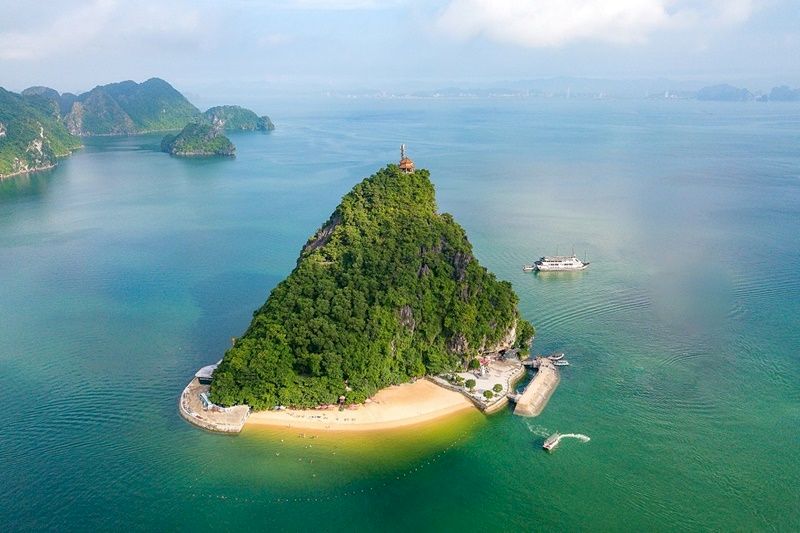
Ti Top island. Photo sourced online
Boat
Bays sailed
Lengths offered
Cabins
Worth knowing
Renea
Halong, Bai Tu Long
2D1N, 3D2N
Not published
The Bai Tu Long route is the quieter of its two
Garden Bay
Halong
Day, 2D1N, 3D2N
Not published
All three lengths include Hanoi transfers
Venezia
Halong, Lan Ha
Day, 2D1N, 3D2N
Not published
Runs a 3D2N Cat Ba version with one night on land, which helps if you are prone to seasickness
La Casta
Halong (Daily, Premier), Lan Ha (La Casta, Regal)
Day, overnight
Not published
Separate vessels for each bay, so check which one your booking is on
Peony
Halong, Lan Ha
2D1N, 3D2N
20
Two sister ships, 20 cabins each, both with private balconies
Lily
Halong, Bai Tu Long
2D1N, 3D2N, 4D3N
20
Runs packaged family and honeymoon itineraries that include Hanoi
Mon Chéri
Lan Ha
2D1N, 3D2N
18
Two sister ships, 18 cabins each, similar packaging to Peony and Lily
Orchid Premium
Halong, Lan Ha
2D1N, 3D2N
5
The smallest of the three Orchid vessels
Orchid Classique
Halong, Lan Ha
2D1N, 3D2N
14
Middle option of the three
Orchid Trendy
Halong, Lan Ha
2D1N, 3D2N
20
Largest of the three, so check which Orchid you are booking
Dragon Pearl
Bai Tu Long, Halong
Day, 2D1N, 3D2N
11
The 2D1N runs in Bai Tu Long, the 3D2N covers both bays
Scarlet Pearl
Lan Ha
2D1N, 3D2N
23
Stays in Lan Ha rather than the central circuit
Ambassador
Halong
2D1N, 3D2N
Not published
Cabins have private balconies
Taliya
Halong, Lan Ha
Day cruises only
Not applicable
Departs Tuan Chau. Useful if you want a good boat without an overnight
Compiled from operator information and our own trips, checked in 2026. Where a cabin count is not published we have left it blank rather than guess; ask the operator directly, and see section 7 for what else to ask.
Our two picks, and why we are telling you they are partners
Two boats are the ones we put our own guests on most often, and both are operators we work with directly. We are saying that up front because you should weigh it when you read what follows.
Bhaya Soul carries 20 cabins and anchors in the calmer parts of the bay rather than beside the main circuit. That is not the smallest boat on the water, but the routing is quieter than most vessels its size. It suits travellers who want a slower pace more than a long activity list.
Indochine Grand is the more classic choice, with generous cabins and an Indochina-era feel, sailing Lan Ha rather than the busiest stretch of Halong.
If neither fits what you want, everything in section 7 still applies, and we would rather you booked the right boat elsewhere than the wrong one with us.
If you want a luxury Halong Bay cruise
Luxury here is a price band, not a grade, and nobody audits the word. What genuinely changes at the top of the market is measurable: fewer cabins per boat, a private balcony on every cabin, a higher ratio of crew to guests, and routes that run away from the central circuit rather than along it. Expect roughly 230 to 320 USD per person for one night, and from 400 USD upwards for two.
What the extra money does not buy is a boat that sails more. Every vessel on the bay follows the same licensed routes and anchors in the same designated overnight coves. If what you want is distance from other boats, a second night on a quieter bay does more for you than a larger cabin on the busy one.
6. What a Halong Bay cruise costs, and what the fare covers
Budget roughly 130 to 250 USD per person for two days and one night, and 300 to 500 USD for three days and two nights, before drinks. Day cruises start lower. Below are the ranges travellers have reported paying, which give you a more honest picture than any single figure.
Type
Reported range, per person
Usually includes
Day cruise
30 to 100 USD
Transfer, lunch, one or two stops
2 days 1 night, simple boat
50 to 135 USD
Transfer, cabin, all meals, route fee, kayak
2 days 1 night, mid-range
170 to 235 USD
As above, better cabin and food, fewer passengers
2 days 1 night, premium
230 to 320 USD
As above, balcony cabin, more space on deck
3 days 2 nights
300 to 520 USD, higher on the top boats
As above, plus a second night and a longer route
These are ranges reported by travellers rather than published rates, gathered in 2025 and 2026. Treat them as orientation, not quotes. Prices move with season and with how far ahead you book.
Price depends on nights, cabin and how many passengers share the boat
A standard two day, one night fare covers more than most people expect and stops in a place most people do not expect. Below is what a typical overnight package includes, based on the boats we use and on itineraries travellers have shared. Use it as a checklist against whatever quote you are given, and ask about any line that is missing.
Usually included
Usually extra
Confirm in writing
Return transfer from central Hanoi, hotel pickup on many boats
All drinks, including soft drinks and bottled water on some boats
Whether pickup is at your hotel or a meeting point
Cabin with private bathroom for one night
Tips for crew and guide
Cabin category and deck, not just "deluxe"
All meals: lunch on arrival, dinner, breakfast, lunch before disembarking
Single supplement if you travel alone
Dietary requirements, vegetarian or halal, before departure
English-speaking guide on board
Spa, massage and any wellness treatments
Whether the guide stays with you for excursions
Bay route fee and cave entry fees
Travel insurance
That the route fee is included, not charged at the pier
Kayaking session on most boats
Kayaking on a minority of boats
Whether kayaking is in the fare or sold on board
Island or beach landing, and a cave stop
Extra excursions added on board
Which specific caves and islands, by name
Onboard activities: cooking demonstration, squid fishing, sunrise tai chi
Nothing, these are normally free
Nothing
A typical pattern rather than any one operator's terms. Packages vary, which is exactly why it is worth checking line by line.
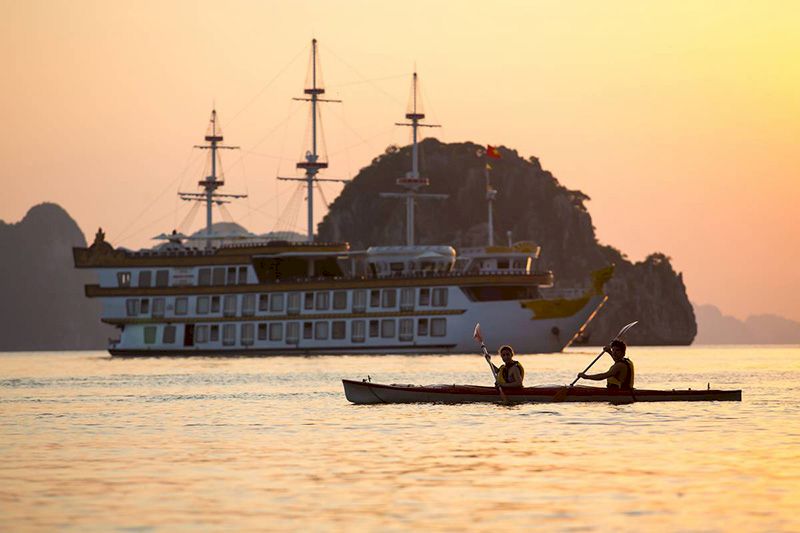
Late afternoon light on the bay
Three of those extras are worth putting numbers on. Drinks are the big one: bar prices are set for a captive audience, and one traveller who does not drink alcohol still ran up 80 USD over a single night. Tips run around 5 to 10 USD per guest per day for the crew, a little more for your guide. And solo travellers are often charged close to the double rate, so ask directly whether the single supplement can be waived, because on quieter dates it sometimes can.
One item that is normally included and that people do not realise they are paying: the Halong Bay route fee, charged by the management board per person and set by the province. A reputable operator builds it into the fare. If it appears as a surprise at the pier, that tells you something about the operator. The current official rates by route are listed in our Halong Bay guide, and for converting amounts see our note on Vietnam's money.
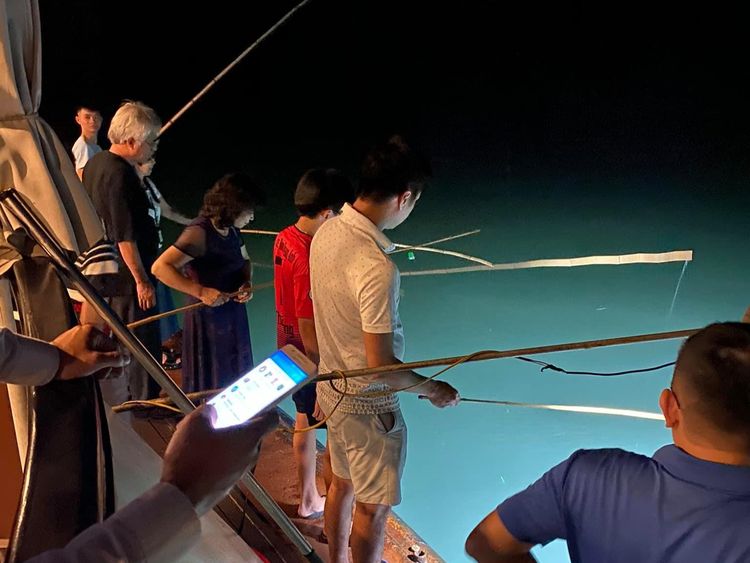
Squid fishing after dark
7. Before you book: what to check
Ask six questions and judge the answers. Not the brochure, not the star rating, and not the review score.
Here is why it matters. In July 2025, a sightseeing boat carrying 46 people capsized in a sudden squall near Ti Top island and 35 passengers died. In February 2026, a wooden-hulled overnight vessel caught fire mid-route; all 30 guests and 11 crew got off safely. Both boats held valid inspection certificates and had been cleared to leave port that day.
That last detail is the one worth sitting with. A licence proves a vessel met the standard on the day an inspector looked at it. It does not tell you what the hull is made of, whether the crew runs a safety briefing, or what happens when the weather turns.
Ask
Why it matters
Answer that should worry you
Is the hull steel or wood?
Steel resists fire and flooding better, and the province is pushing operators to move away from wood
Changing the subject, or "traditional wooden junk" with nothing further
When does the current inspection certificate expire?
It is a real document with a real date
Cannot give you a date
How many cabins does the boat have?
Decides whether you share the bay with 15 people or 60
Only adjectives: boutique, intimate, exclusive
Is there a safety briefing before departure, and where are the life jackets?
Wearing life jackets is not mandatory throughout the journey on sightseeing vessels, so the briefing is what prepares you
"The crew will handle it"
On day two, do I stay on this boat?
Many itineraries transfer you to a shared day boat
A vague answer, or one that changes when you ask twice
What happens if the authorities close the bay?
The decision is not the operator's, but the refund policy is
No written policy
Wooden junk or steel ship?
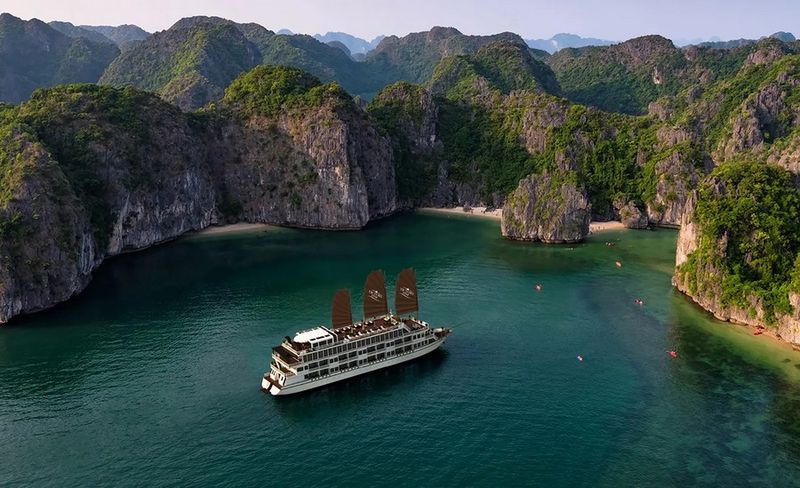
Steel is the safer hull, and Quang Ninh province is encouraging operators to replace wooden vessels with steel or equivalent materials, specifically to improve resistance to collision, sinking and fire. Wooden junks still have real appeal: smaller, quieter, fewer passengers, and they look the way people picture the bay. Plenty are well maintained. The point is that hull material is a question worth asking rather than an aesthetic detail.
What shapes your experience more than either is the number of cabins. A boat with 8 to 12 cabins feels completely different from one with 30, regardless of what it is built from or what it is called.
What happens if the weather closes the bay
The decision is not your operator's. When conditions are judged unsafe, the province closes the bay to navigation and every vessel stays in port, regardless of what you paid. Depending on timing, your trip may be shortened, rerouted, rescheduled or refunded under the operator's own policy.
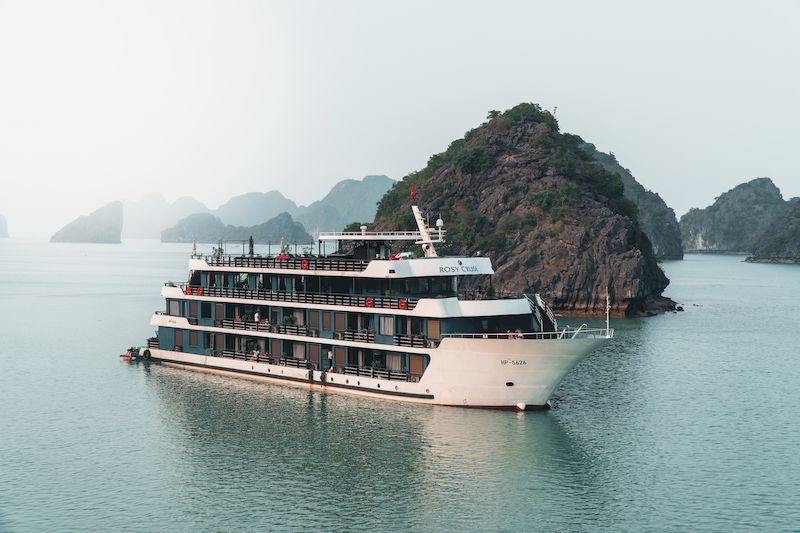
A three-cabin private boat, the Bhaya Legend
Three things to do before you pay:
Ask for the weather cancellation policy in writing, and check whether it covers a shortened trip as well as a cancelled one.
Leave a spare day in your itinerary if you are travelling between June and September, so a closure costs you a day rather than a connection.
Carry travel insurance. This is the one situation on the bay where it genuinely earns its cost.
8. Where to book, and what a good agency actually does
You have three routes: direct with the cruise line, through a booking platform, or through a travel agency. Each has a real trade-off.
Direct with the operator gives you the most detail and usually the best price, but you carry the checking yourself, and you should confirm the website is the real one. Travellers have been caught out by near-identical domains.
Booking platforms make comparison easy and give you cancellation terms in writing. The weakness is that the listing may not match the boat: several travellers have reported being shown one vessel's brochure and placed on another.
Tai chi at sunrise, the argument for staying a night
Through an agency, the value is not convenience, it is verification. Before we confirm a Halong Bay cruise for a guest, we check five things with the operator:
The itinerary, stop by stop, against what was advertised.
The actual passenger number against the boat's permitted maximum, so a vessel is not carrying more guests than its published capacity allows.
The menu, in advance, where a guest is vegetarian, halal or has another dietary requirement. This is far easier to arrange before departure than on a boat in the middle of the bay.
Travel insurance coverage for the sailing.
The safety systems on board.
That is the difference in practice. Not a better price, but somebody doing the checking before you are standing on the pier.
Four things I would tell a friend
Most crews on the bay work in English, so language is rarely an issue.
Wi-Fi is unreliable once you are away from the coast. Plan for it rather than complain about it.
Set an alarm for sunrise. It is the single best moment of the trip and it costs nothing.
If a specific cave matters to you, say so before booking. Routes are fixed and not every itinerary includes every stop.
The bay works for all four, but the boat you pick should change.
With young children: prioritise a boat with fewer cabins and a shorter itinerary. One night is usually plenty, and kayaking is generally open to children from around five with an adult. Ask about cabin configuration, since many rooms are set for two. See our family holidays.
On honeymoon: two nights beats one, and a balcony cabin is one of the few upgrades on this bay that genuinely earns its price, because you will spend real time in it. Quieter routes into Bai Tu Long or Lan Ha suit this better than the central circuit. See our honeymoon trips.
Travelling solo: ask about the single supplement before anything else, and ask whether it can be waived on your dates. Smaller boats tend to be more social, which matters more than the cabin does.
With limited mobility: the constraint is not the ship, it is the transfers. You board from a tender, and cave visits involve stone steps. Ti Top is around 400 steps. A boat that anchors rather than doing multiple landings is the better choice, and the itinerary needs checking stop by stop in advance. See our trips for senior travellers.
Planning the rest of your northern route
A cruise fits best inside a wider northern loop rather than as a standalone stop. Pairing the bay with Ninh Binh gives you the same limestone from the water and from a bicycle, and it takes the pressure off squeezing Halong into one day. That is how our 5-day North Vietnam itinerary is built.
If you already know the bay is on your list and you want the checks in section 7 done for you, tell us your dates and we will handle the rest.
✈️Explore other attractions in the north of Vietnam:
Planning your trip?
Save time and get expert advice for FREE!
✅ 15 years of local experience
✅ Save up to 40 hours of planning
✅ Travel stress-free from start to finish
Book your free consultation today!













 Our team
 Our team
 Our team
 Our team

.jpg)




 Other
Other Add us as a preferred source