Flights to Vietnam: Airlines, Direct Routes and Booking Options
Booking a flight to Vietnam may seem straightforward at first. In practice, the choice involves much more than comparing two prices on a screen.
A nonstop flight is usually the easiest option, but it may not be available from your nearest airport. A connecting itinerary can cost less or offer better departure times, although a long layover, limited baggage allowance or separate tickets can quickly reduce that advantage.
The international flights also shape the rest of your journey. Arriving in Hanoi and leaving from Ho Chi Minh City, for example, can save you from crossing the country twice. Choosing the wrong gateway may mean adding another domestic flight, an airport transfer and part of an extra travel day. Our Vietnam airport guide explains which gateway best suits each region.
This guide brings together the routes, airlines, journey times and fares we most often discuss with travelers planning a trip to Vietnam in 2026.
Written by Oliver PHUNG (Tour Guide)
Updated on Aug 05, 2026
0 comment
Oliver Phung is a Northern Vietnam-based tour guide and blogger. His favorite topics to write about include cuisine, culture, travel, and under-the-radar experiences. Oliver possesses a deep, detailed understanding of the region, from the indigenous culture of the Hmong in the Northwest to the highland lifestyle of the Tay in the Northeast. Whether he is exploring ancient architecture or geological landscapes, he is always eager to share his insights with his readers.
Beyond his work at Kampá Tour, he produces specialized travel content on platforms such as Reddit, Instagram, LinkedIn, and various other publications.
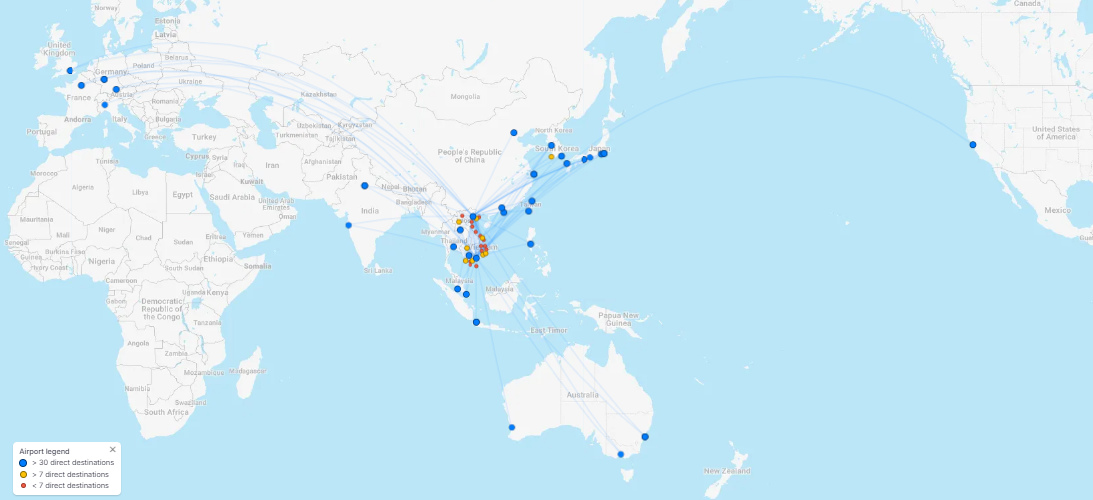
Nonstop services are available from San Francisco, London, Sydney, Melbourne and several major European cities. From most other departure points, you will need at least one connection.
Criterion
Nonstop flight
Connecting flight
Main operators
Vietnam Airlines and other carriers on selected routes
EVA Air, Turkish Airlines, Singapore Airlines, Cathay Pacific, Korean Air, Qatar Airways and others
Availability
Limited to selected cities in North America, Europe, Australia and Asia
Available from a much wider choice of airports
Typical long-haul journey
Around 9–16 hours
Usually 14–30 hours, depending on the layover
Indicative price
Often higher, especially where capacity is limited
Often lower, although extras can reduce the saving
Comfort
No aircraft change and a shorter overall journey
A longer journey that can be more tiring
Main drawback
Fewer schedules and departure cities
Delays can affect the onward flight
Indicative economy return fares
Kampá Tour uses the following ranges as a starting point when discussing international flights with clients. They are planning references rather than fixed quotations.
Departure market
Indicative return fare
United States
USD 900–1,500
United Kingdom
GBP 700–1,000
Australia
AUD 800–1,300
Canada
CAD 1,100–1,800
Continental Europe
EUR 750–1,300
Paris fare benchmark: Nonstop return fares to Vietnam generally range from EUR 1,000–1,500, compared with around EUR 700–1,100 for connecting flights. A connection can therefore save several hundred euros, while a nonstop service avoids the layover and shortens the overall journey.
This comparison applies to the Paris market. The difference may be smaller or larger from the United Kingdom, North America, Australia or another European gateway.
Selected fares displayed by airlines during our latest check started at around USD 1,074 from San Francisco, GBP 724 from London, AUD 869 from Melbourne, CAD 1,090 from Vancouver and EUR 756 from Amsterdam.
Kampá Tour’s advice:Look at the full journey, not just the ticket price. A cheaper fare is not always better once you add baggage, a long overnight connection or an extra flight within Vietnam.
2. Which airline should you choose?
There is no airline that is automatically the best choice for every journey. We usually look at four things first: where the passenger is departing from, the connection time, the arrival hour in Vietnam and what the fare actually includes.
The comments below reflect feedback from Kampá Tour travelers and our team’s experience reviewing flight options.
Extensive networks, although regional operations should be checked carefully
Vietnam Airlines
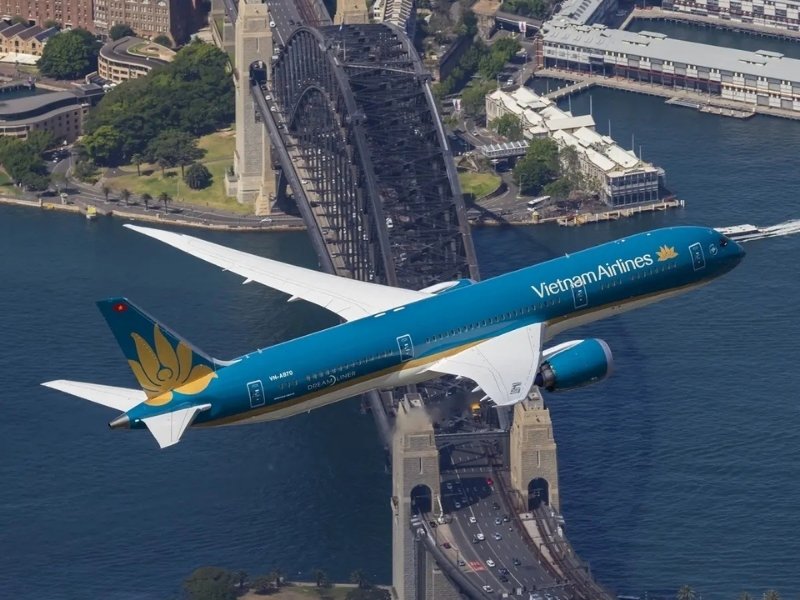
Vietnam Airlines is the country’s national carrier and operates much of Vietnam’s long-haul network.
It is often the first airline we check when a traveler needs:
A nonstop service.
An arrival in Hanoi and departure from Ho Chi Minh City, or the reverse.
A domestic connection within Vietnam.
Through check-in on an eligible itinerary.
Baggage and onboard services included in the selected fare.
The airline currently operates the only nonstop commercial route between the United States and Vietnam. It also offers up to seven direct flights per week from London and 12 nonstop routes between Vietnam and eight European cities. Check the latest schedules on the official Vietnam Airlines website.
Vietnam Airlines operates much of Vietnam’s long-haul network.
A good schedule can matter more than the airline name
It is easy to focus on airline rankings, but the actual flight schedule often has a greater effect on the trip.
A departure late in the evening may help a family settle into the long flight more easily. A morning arrival can give travelers time to rest before starting their tour. By contrast, landing after midnight may require an extra hotel night or a late transfer.
One family traveler told us that the overnight departure was more important for the children than the small differences between several well-regarded airlines. Our guide to traveling in Vietnam with children includes further advice on pacing, transfers and family-friendly itineraries.
For families, older passengers and anyone starting a program soon after arrival, we would usually choose the better schedule over a marginally higher airline rating.
3. Routes that avoid Gulf transit hubs
Doha, Dubai and Abu Dhabi have long been popular connection points between Europe, North America and Vietnam.
Passengers who prefer another routing can consider the following hubs:
Transit region
Main airport
Airlines
Turkey
Istanbul (IST)
Turkish Airlines
Singapore
Singapore Changi (SIN)
Singapore Airlines
South Korea
Seoul Incheon (ICN)
Korean Air, Asiana Airlines
Japan
Tokyo Narita or Haneda
Japan Airlines, ANA
Taiwan
Taipei Taoyuan (TPE)
EVA Air, China Airlines
Hong Kong
Hong Kong International (HKG)
Cathay Pacific
Malaysia
Kuala Lumpur (KUL)
Malaysia Airlines
China
Beijing, Shanghai or Guangzhou
Air China, China Eastern, China Southern
From the flight options recently reviewed by our team, Istanbul has been one of the more stable alternatives for passengers wishing to avoid the Gulf. Singapore, Seoul, Tokyo and Taipei also work well, especially for journeys from North America.
These routings may cost a little more or add a few hours to the trip, but they offer useful alternatives when operations elsewhere are uncertain.
Before departure: Check your flight status again, choose a flexible fare where possible and make sure the airline has your current phone number and email address.
4. Direct flights, journey times and options by market
The most useful route depends largely on where you are starting. The overview below brings together the main direct services, journey times and connection points for Kampá Tour’s principal English-speaking markets.
Departure market
Direct option
Approximate nonstop time
Useful one-stop hubs
Kampá Tour’s note
United States
San Francisco–Ho Chi Minh City
About 15h40
Tokyo, Seoul, Taipei, Hong Kong, Singapore
Adding a separate flight to San Francisco does not always create the shortest journey
United Kingdom
London–Hanoi and London–Ho Chi Minh City
About 11h45–12h30
Istanbul, Singapore, Doha, Dubai, Seoul
Compare a London connection with a one-stop itinerary from your nearest regional airport
Australia
Sydney and Melbourne to Hanoi or Ho Chi Minh City
About 8h50–10h
Singapore, Kuala Lumpur, Bangkok
A nonstop flight is usually worth considering when the price difference is reasonable
Canada
No regular nonstop service
Usually 18–25 hours with connections
Seoul, Tokyo, Taipei, Hong Kong
Vancouver generally offers simpler trans-Pacific routes than eastern Canada
Continental Europe
Selected services from Paris, Frankfurt, Munich, Milan, Copenhagen, Amsterdam and Moscow
Usually 11–14 hours
Istanbul, Paris, Frankfurt, Amsterdam and Asian hubs
Include the cost and time of reaching a distant European gateway
Flights from the United States
Vietnam Airlines operates the only current nonstop commercial service between the United States and Vietnam:
San Francisco (SFO) – Ho Chi Minh City (SGN)
The flight takes around 15 hours 40 minutes and operates three to four times per week. Check current dates and fares on the official San Francisco–Vietnam route page.
For passengers starting elsewhere in the United States, a one-stop journey through Tokyo, Seoul, Taipei or Hong Kong may be simpler than first taking a separate domestic flight to San Francisco.
The best comparison is always from your home airport to your final destination, not just from the nearest international hub.
Flights from the United Kingdom
Vietnam Airlines flies nonstop from London Heathrow to both Hanoi and Ho Chi Minh City.
The published schedule includes up to four weekly flights to Hanoi and three to Ho Chi Minh City. The journey takes approximately 11 hours 45 minutes to Hanoi and 12 hours 30 minutes to Ho Chi Minh City. Current schedules are available on the Vietnam Airlines UK route page.
Passengers from Manchester, Birmingham, Edinburgh, Dublin and other regional airports should compare two options:
A short connection through London followed by the nonstop service.
A one-stop international journey through Istanbul, Singapore or an Asian hub.
The second option is sometimes easier, even if it does not include a nonstop long-haul sector.
Flights from Australia and New Zealand
Vietnam Airlines operates daily nonstop services from Sydney and Melbourne to Ho Chi Minh City. The average flight time is around 8 hours 50 minutes. See the official Sydney–Ho Chi Minh City schedule.
Sydney–Hanoi and Melbourne–Hanoi services increased to four flights per week in each direction from April 2026. Updated Hanoi services can be checked on the Vietnam Airlines Australia website.
For travelers from New Zealand, the journey usually involves a connection in Australia or Asia. When comparing prices, remember to include the trans-Tasman sector, baggage allowance and connection time.
Flights from Canada
There is currently no regular nonstop passenger service between Canada and Vietnam.
Vancouver usually offers the most straightforward trans-Pacific connections. Passengers from Toronto and Montreal may face a longer journey or need an additional domestic sector before continuing to Asia.
Air Canada currently displays fares to Vietnam from approximately CAD 1,090 from Vancouver. Check its official Vancouver–Vietnam fare page for current availability.
Flights from continental Europe
Vietnam Airlines currently operates 12 nonstop routes between Vietnam and eight European cities:
Paris.
Frankfurt.
Munich.
London.
Moscow.
Milan.
Copenhagen.
Amsterdam.
Vietnam Airlines mainly uses its Airbus A350 and Boeing 787 Dreamliner wide-body fleet on European services. The aircraft assigned to a particular flight can still change according to the route and operating conditions.
From Paris, Air France is another useful option for Ho Chi Minh City. Hanoi itineraries may also be sold under an Air France flight number but operated by its partner Vietnam Airlines, so check the operating carrier and baggage conditions shown during booking.
When considering a nonstop flight from another country, calculate the full cost of reaching the gateway. A train, regional flight, airport hotel and additional transfer can sometimes make a one-stop journey from your home city more attractive.
New in 2026: Vietnam Airlines launched the first nonstop Hanoi–Amsterdam service on June 16, 2026. It operates three return flights per week, on Tuesdays, Thursdays and Saturdays, using Airbus A350 aircraft. See the official route announcement.
Amsterdam is also a practical gateway for travelers from neighboring countries. A direct Eurostar journey from Brussels to Amsterdam takes about 1 hour 52 minutes; from Amsterdam Centraal, travelers can continue by local train to Schiphol. Passengers from Switzerland, western Germany and other nearby markets can compare this rail option with a short regional flight. Schiphol’s railway station is located directly below the airport terminal.
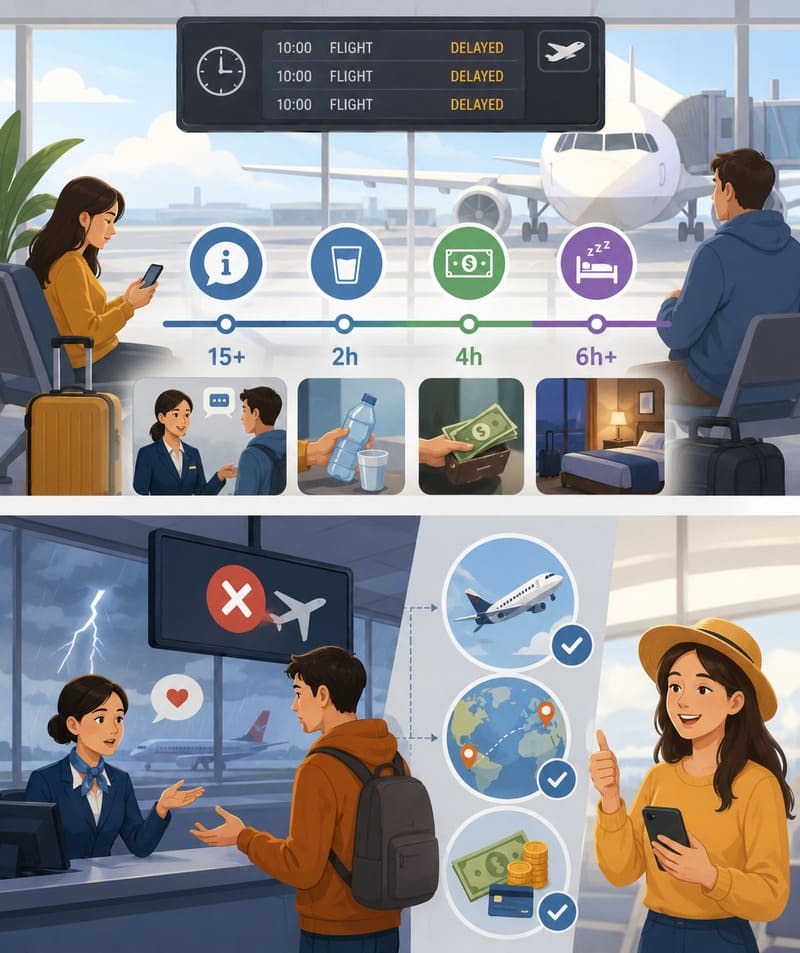
Information, an explanation and a new estimated departure time, updated at least every 30 minutes.
Delay of 2 hours or more
Drinking water or equivalent assistance for eligible passengers present at the airport.
Delay of 3 hours or more
Food or a meal appropriate to the time of day under the applicable passenger-service standards.
Delay of 4 hours or more
Free rebooking or rerouting within the carrier’s service where available. If the passenger declines, the airline must refund the full ticket or the unused portion; advance compensation may apply when the delay is attributable to the carrier.
Delay of 6 hours or more, daytime
A suitable place to rest when the delay falls between 07:00 and 22:00.
Delay of 6 hours or more, overnight
Suitable sleeping accommodation, or an alternative solution agreed with the passenger, when the delay falls between 22:00 and 07:00.
Flight cancellation
Prompt information and a choice, depending on the circumstances, between rerouting, a change of itinerary or a full or partial refund, with compensation where applicable.
A flight is considered delayed when it departs more than 15 minutes after the reference time.
6. Should you book a round trip or an open-jaw ticket?
Vietnam stretches over 1,600 kilometers from north to south. For a trip covering several regions, flying into and out of the same city is not always the most efficient choice.
An open-jaw or multi-city ticket allows you to:
Arrive in Hanoi and leave from Ho Chi Minh City
or:
Arrive in Ho Chi Minh City and leave from Hanoi
This structure avoids having to return to your original international airport at the end of the trip.
What we usually recommend
For a nationwide Vietnam itinerary, our team most often recommends arriving through one main gateway and leaving through the other.
A return ticket through the same city may look cheaper during the initial search. Once you add a Hanoi–Ho Chi Minh City flight, baggage, airport transfers and part of an extra travel day, the saving can become much smaller.
On the fares monitored by Kampá Tour, a one-way Hanoi–Ho Chi Minh City domestic flight commonly adds around USD 65–80 per person, before optional baggage and airport transfers. During Tết, summer holidays and other peak periods, the fare can be higher.
We regularly see travelers compare a cheaper Hanoi return with an open-jaw ticket, only to find that the domestic repositioning flight removes much of the difference.
Route direction by traveler profile
Travelers from Canada: our team sometimes finds better fares when the trip starts in Ho Chi Minh City and ends in Hanoi, especially when the trans-Pacific connection works more smoothly through Vancouver or an East Asian hub.
Multi-country journeys: for Vietnam combined with Laos, Cambodia or Thailand, the direction should be decided only after checking the onward regional flights. In some cases, a same-city international return is more practical because the neighboring-country segment already returns the traveler to that gateway.
Travelers focusing on one region: a same-city return remains sensible when the trip stays mainly in northern or southern Vietnam.
A same-city return can still make sense when:
You are visiting only northern or southern Vietnam.
The fare difference is substantial.
You are using airline miles.
Your preferred airline serves only one Vietnamese gateway.
Vietnam is part of a wider journey using the same Asian hub.
Itineraries that work well with different gateways
These private itineraries show how an open-jaw route can work in practice. Starting prices were checked by Kampá Tour in August 2026 and may vary according to the season, group size and selected services.
Thẻ tour 4821, 4851, 10313
7. How much does a flight to Vietnam cost?
There is no single standard fare. Prices depend on the country of departure, airline, season, cabin class and ticket conditions. For accommodation, transport and daily spending beyond airfare, see our detailed guide to Vietnam travel costs.
Recent fare examples
The following economy return fares appeared on airline websites while this guide was being prepared:
Route
Travel dates shown
Fare
Paris–Hanoi
October 23–November 5, 2026
From EUR 946
Paris–Ho Chi Minh City
November 22–December 6, 2026
From EUR 867
San Francisco–Ho Chi Minh City
October 14–November 12, 2026
From USD 1,074
London–Hanoi
November 22–December 8, 2026
From GBP 727
London–Ho Chi Minh City
December 3–17, 2026
From GBP 724
Sydney–Ho Chi Minh City
Selected September 2026 dates
From AUD 890
Melbourne–Ho Chi Minh City
Selected August–November 2026 dates
From AUD 869
Vancouver–Vietnam
Selected 2026 dates
From CAD 1,090
Amsterdam–Hanoi
September 3–October 3, 2026
From EUR 756
Frankfurt–Hanoi
Selected November–December 2026 dates
From EUR 892
Indicative economy return fares observed while preparing this guide. Availability and fare conditions may change.
These fares are indicative. Availability and prices may change between the search and the final booking.
Prices are generally higher around:
Christmas and New Year.
Vietnam’s Lunar New Year, known as Tết.
July and August holidays.
Easter and school breaks.
Major public holidays in the country of departure.
From the fares monitored by our team, September to November often brings some of the more attractive long-haul prices, particularly outside school holidays and major events. It is also a useful period for travelers who can remain flexible by a few days.
Look beyond the headline fare
Before paying, check exactly what the ticket includes:
Checked baggage.
Cabin baggage.
Seat selection.
Meals.
Payment fees.
Change and cancellation conditions.
Whether the complete journey is issued under one booking.
Some passengers only discover at the airport that their fare does not include the baggage allowance they expected. The resulting charge can be substantial.
For this reason, a slightly higher full-service fare may offer better value than a basic ticket once all the necessary extras are added.
8. When should you book?
For most long-haul trips, we recommend starting to monitor fares around four to six months before departure.
It is worth booking earlier when traveling during:
Christmas or New Year.
Tết.
School holidays.
A major festival or public holiday.
A period with limited nonstop capacity.
Families and larger groups should also start earlier. Even when seats remain available, it becomes harder to find several places at the same fare as the aircraft fills.
Is there a better day to book?
From the fares followed by Kampá Tour, Wednesday and Thursday are generally the most favorable days to complete a booking. Midweek fare adjustments can create better opportunities than those seen over the weekend.
This is a useful observation rather than a rule that works for every route. The actual price trend for your dates remains more important.
A simple approach is to:
Search several nearby departure dates.
Learn the normal fare range for the route.
Set a price alert.
Compare the fare again on Wednesday or Thursday.
Check baggage and ticket conditions.
Book once a suitable flight reaches a price you are comfortable with.
The goal is not to find the lowest fare ever recorded. It is to secure a good itinerary at a fair price before the most convenient flights fill up.
Google Flights works well for flexible dates, price graphs and fare alerts.
Skyscanner is useful when comparing nearby airports or less obvious route combinations.
Trip.com combines comparison tools with booking options.
Google Flights separates its results into two main categories:
Best: flights that balance price, journey time and convenience.
Cheapest: lower fares that may involve separate tickets, self-transfers or airport changes.
Pay particular attention to self-transfer itineraries. You may need to collect your baggage, clear immigration and check in again. If the first flight is late, the next airline may have no obligation to rebook you.
Use a comparison platform to identify the best routes.
Open the same itinerary on the operating airline’s website.
Compare the final price and baggage allowance.
Read the change and cancellation rules.
Check the travel dates and airport codes carefully.
Confirm whether all flights are protected under one booking.
Booking directly with the airline can make communication easier if the schedule changes, particularly on a long and complex journey.
Conclusion
The best flight to Vietnam is not always the cheapest one.
A good choice should also offer a reasonable journey time, a manageable connection, suitable baggage conditions and arrival and departure cities that work with your route through Vietnam.
For a journey covering several regions, compare an open-jaw ticket before booking a traditional return through the same city. It can save both time and an unnecessary domestic flight.
Already booked your international flights?
Send Kampá Tour your arrival airport, departure airport and travel dates. Our local team will use them to build the most practical private itinerary through Vietnam.
About this guide
This guide draws on:
Official airline schedules and fare pages.
Information from the Civil Aviation Authority of Vietnam.
Fares monitored by Kampá Tour.
Questions and booking issues raised by international travelers.
Our team’s experience designing private journeys across Vietnam.
Routes, fares and operating conditions can change. Check the final details with the operating airline before making payment. Before departure, also review the latest Vietnam e-visa requirements and, where applicable, the Vietnam pre-arrival form.
Planning your trip?
Save time and get expert advice for FREE!
✅ 15 years of local experience
✅ Save up to 40 hours of planning
✅ Travel stress-free from start to finish
Book your free consultation today!





















 Our team
 Our team
 Our team
 Our team












 Other
Other Add us as a preferred source