Best Sapa Trekking Routes: 6 Trails, Villages and Tips
Sapa trekking takes you along rice terraces, bamboo forest and mountain trails to the villages of the Black Hmong, Red Dao and Giay people, in the far north of Vietnam. Routes range from an easy half-day walk near town to a two-day climb of Fansipan, the highest peak in Indochina.
This guide covers how many days to plan, the villages and routes worth walking, what a trek costs, when to go and whether you need a guide, so you can choose the trek that matches your pace.
Written by Oliver PHUNG (Tour Guide)
Updated on Nov 17, 2026
0 comment
Oliver Phung is a Northern Vietnam-based tour guide and blogger. His favorite topics to write about include cuisine, culture, travel, and under-the-radar experiences. Oliver possesses a deep, detailed understanding of the region, from the indigenous culture of the Hmong in the Northwest to the highland lifestyle of the Tay in the Northeast. Whether he is exploring ancient architecture or geological landscapes, he is always eager to share his insights with his readers.
Beyond his work at Kampá Tour, he produces specialized travel content on platforms such as Reddit, Instagram, LinkedIn, and various other publications.
Two to four days suits most Sapa treks. One day lets you walk to a village near town, two days add a homestay night in Muong Hoa Valley, and three or four days take you to quieter villages such as Ta Phin, Ta Giang Phinh and Ban Ho. Four days is the best length if you want to reach the remote villages without rushing.
If I were you, I could spend a whole day admiring landscapes like this.
Treks around Sapa range from easy to challenging, with two to six hours of walking a day. On a longer trek, you sleep in village homestays, which is the simplest way to see daily life in the mountains.
A one-day trek is possible, but it is tiring once you add the journey from Hanoi, about five to six hours by road. A two-day trek gives a better balance: you walk without rushing and spend the night in the valley. With three or four days, you reach villages that day visitors rarely see. Read our guide to getting from Hanoi to Sapa to plan the transfer.
If you want to visit a weekly market, build your dates around it: Can Cau (Saturday), Bac Ha (Sunday), Coc Ly (Tuesday), Sin Cheng (Wednesday) and Muong Hum (Sunday).
Best Sapa Trekking Villages and Areas
Most treks start from Sapa town and head into one of three areas: Muong Hoa Valley to the southeast, Ma Tra and Ta Phin to the northeast, or the Cat Cat and Sin Chai side just below town. Bac Ha, further east, is a separate trip with its own markets and villages.
Muong Hoa Valley
Muong Hoa Valley runs southeast of Sapa town, below the Hoang Lien Son range. It is home to the villages of Y Linh Ho, Lao Chai, Ta Van and Hau Thao, and most of it now falls within Ta Van commune, created in July 2025 when the Hoang Lien, Muong Hoa and Ta Van communes were merged. A trek here combines rice terraces with time in Black Hmong and Giay villages.
The trail to Y Linh Ho starts with a descent along a footpath or across a suspension bridge. The village is spread over the mountainside, with small houses surrounded by terraced rice fields. Most homes can only be reached on foot, which makes Y Linh Ho one of the best stops on a Sapa trek.
Y Linh Ho is a Black Hmong village. You will see women in indigo-dyed clothing, dark blue to almost black, working in the fields, along with green cornfields in summer and golden terraces before the harvest.
You will always remember this smell
Lao Chai Village
Lao Chai, about 7 to 8 km from Sapa town, follows Y Linh Ho on the classic valley trek. The Black Hmong families here grow rice, corn and cassava, and from the trail their houses look like small dots scattered across the terraces. A valley entrance ticket has long been collected at the checkpoint on the road to Lao Chai and Ta Van.
Sapa scenery during persimmon season
Ta Van Village
Ta Van lies about 4 km beyond Lao Chai, on the valley floor. It is a Giay village: while the Hmong usually live on the steep slopes, the Giay build their houses and farm on the lower ground. Between Lao Chai and Ta Van, you pass the field of carved ancient stones, and Ta Van has the widest choice of homestays in the valley.
Giang Ta Chai lies beyond Ta Van, further down the valley, and the two villages are easy to combine on a Lao Chai, Ta Van and Giang Ta Chai route, one of the most popular multi-day treks in Sapa.
Giang Ta Chai is a Red Dao village. Women wear dark clothing with embroidered cuffs and collars, and red headscarves. The walk here takes you past rice terraces, through a bamboo forest and to a waterfall.
Trekking through the villages around Sapa
Ma Tra and Ta Phin Villages
Ma Tra and Ta Phin lie northeast of Sapa town. Ma Tra is a Black Hmong village, while Ta Phin is known for its Red Dao community, its embroidery and the herbal baths made from local plants. The walk of about 7 km from Ma Tra to Ta Phin passes rice terraces and orchards of peach, pear and plum trees.
Scenes of everyday village life along the trail
Bac Ha
Bac Ha lies more than two hours by road from Sapa, on the other side of Lao Cai city. It is quieter than Sapa, with fewer trekkers on its trails, and is best known for its Sunday market.
Several ethnic groups live around Bac Ha, including the Flower Hmong, Phu La and Tay. You can meet Flower Hmong families in Lau Thi Ngai and Ta Van Chu, the Phu La in Lung Phinh, and the Tay in Thai Giang Pho and Na Lo.
Walking between these villages, you see farmers at work in the cornfields. A night in a local home lets you share a meal with a family and learn how they make corn liquor. For a trip that includes Bac Ha, see The Best of Northern Vietnam in 7 Days: All-Inclusive.
You can also reach the Flower Hmong village of Ngai Thau by horse cart, then walk up through the cornfields and plum gardens and visit homes where women still weave and dye their own cloth.
Bac Ha Weekly Markets
Weekly markets are part of life in the northern mountains. The Bac Ha Sunday market is one of the largest in the region, with one area for food, embroidered clothing, bags, traditional medicine and honey, and another for buffalo, horses, pigs and poultry. A buffalo market is also held in Bac Ha on Saturdays.
The Bac Ha Sunday market
Coc Ly market, held on Tuesdays beside the Chay River, is smaller and draws Hmong, Dao and Nung villagers from the surrounding hills.
In the center of Bac Ha stands the Hoang A Tuong Palace, often called the palace of the Hmong King. It was built between 1914 and 1921 for Hoang Yen Chao and his son Hoang A Tuong, Tay lords who ruled a region where most of the population was Hmong, under French colonial rule.
The building mixes French and Asian styles and was designed with the help of a French and a Chinese architect. It is worth a short visit if you are in Bac Ha for the Sunday market.
Sapa town itself is good for short walks. The stone church from the French colonial period, the market and the lanes around the lake are all easy to explore on foot, and many treks start in front of the church.
Other Weekly Markets
Besides Bac Ha and Coc Ly, the markets at Can Cau (Saturday), Sin Cheng (Wednesday) and Muong Hum (Sunday) are smaller and see fewer tourists. Villagers come to trade farm tools, food, poultry and livestock, and to meet friends from other villages.
The weekly market Can Cau
Fansipan Mountain
Fansipan is the highest peak in Vietnam and Indochina, at about 3,147 m (older sources give 3,143 m). The trek to the summit takes one to three days depending on the route, on steep and often muddy trails. Climbing Fansipan on foot requires a licensed guide and a permit from Hoang Lien National Park. If you would rather not climb, a cable car runs to the summit area. You may also like: What to do in Sapa.
Sapa Trekking Routes at a Glance
This table compares the six routes described below, from the easiest to the most demanding. Distances and times are approximate and change with the start point, detours and trail conditions.
Route
Duration
Distance
Difficulty
Guide
Sapa, Cat Cat, Sin Chai
1 day (half a day possible)
About 7 km
Easy
Not needed
Sapa, Y Linh Ho, Lao Chai, Ta Van
1 to 2 days
About 10 to 12 km
Moderate
Recommended
Su Pan, Ban Ho, Nam Toong
1 day, or the end of a 2 to 3 day trek
About 8 to 10 km
Moderate
Recommended
Sapa, Sa Seng, Hang Da, Hau Thao
1 to 2 days
About 12 to 15 km
Moderate to challenging
Recommended
Sapa, Ma Tra, Ta Phin, Ta Giang Phinh
3 days, 2 nights
About 42 km
Moderate to challenging
Recommended
Tram Ton Pass to Fansipan
2 days, 1 night
About 11 km to the summit
Challenging
Required, with a park permit
Best Trekking Routes in Sapa
1. Sapa, Cat Cat Village and Sin Chai Village
Duration: 1 day (or half a day)
Distance: about 7 kilometers
Difficulty: easy
Start at Sapa church and walk down to Cat Cat, a Black Hmong village about 2 to 3 km from town. An entrance ticket is required, at 150,000 VND (about US$6) for adults. The path through the village is paved, with a waterfall, weaving and silverwork workshops, and many souvenir stalls.
From Cat Cat, follow the trail uphill for about 3 km to Sin Chai, a larger Black Hmong village at the foot of the Hoang Lien Son range. It is much quieter than Cat Cat and gives a better sense of daily life. This is the easiest trek to do on your own. The map below shows this Sapa trekking route.
Please click on the "[ ]" at the top right for better visibility.
2. Sapa, Y Linh Ho, Lao Chai and Ta Van
Duration: 1 day, or 2 days with a homestay night
Distance: about 10 to 12 kilometers
Difficulty: moderate
This is the classic Muong Hoa Valley trek. From the road above the valley, a steep descent leads down to Y Linh Ho, then a trail through the terraces continues to Lao Chai. From there, an easier path along the valley floor reaches Ta Van, passing the field of carved stones.
Allow five to six hours with stops. Most trekkers spend the night in a homestay in Ta Van and continue the next day toward Giang Ta Chai, or return to Sapa by car. If you only want the easy part, start at Lao Chai and walk the 3 to 4 km to Ta Van.
3. Su Pan, Ban Ho and Nam Toong
Duration: 1 day with car transfers, or the last day of a 2 to 3 day valley trek
Distance: about 8 to 10 kilometers on a day trek
Difficulty: moderate
Ban Ho lies further down Muong Hoa Valley than the classic villages and sees the fewest trekkers of the valley routes. On a day trek, a car takes you to Su Pan, and from there the trail descends through rice terraces to Ban Ho, a Tay village.
From Ban Ho, a walk of about 3 km leads to Nam Toong, a Red Dao village. Many multi-day treks finish this way: you walk from Ta Van or Giang Ta Chai through Su Pan, spend the night in a homestay in Ban Ho, and visit Nam Toong the next morning before the drive back to Sapa.
4. Sapa, Sa Seng, Hang Da and Hau Thao
Duration: 1 day, or 2 days with a homestay night
Distance: about 12 to 15 kilometers
Difficulty: moderate to challenging
This route climbs onto the hills above Muong Hoa Valley and is much quieter than the classic trek. After a short transfer or walk out of town, the first one to two hours are a steady climb to Sa Seng, where the view opens over Fansipan and the valley. The trail then descends gently to Hang Da and Hau Thao, two Black Hmong villages, and continues through the terraces to Giang Ta Chai, where a car usually takes you back to Sapa.
Allow five to seven hours with stops. The opening climb makes this route harder than the classic trek, but it is a good choice if you have already walked Lao Chai and Ta Van or want trails with fewer trekkers. Paths are unmarked, so go with a local guide.
5. Sapa, Ma Tra, Ta Phin and Ta Giang Phinh
Itinerary: Suoi Ho, Ma Tra, Ta Phin, Phin Ho, Lu Khau, Suoi Thau, Kim Ngan, Ta Giang Phinh
Duration: 3 days and 2 nights
Distance: about 42 kilometers
Day 1: Sapa, Ma Tra and Ta Phin (15 km)
Set off from Sapa church around 9:30 am toward Ma Tra. The trail crosses rice terraces, which turn gold before the harvest. Stop in Ma Tra for lunch and a rest before continuing to Ta Phin, where you spend the night with a Red Dao family.
Ta Phin - Sapa
Day 2: Ta Phin, Phin Ho, Lu Khau and Suoi Thau (18 km)
After breakfast, around 7:00 am, walk for about three hours to Phin Ho, a village close to Ta Phin and Ban Khoang, through mountains, valleys and rice terraces. Have lunch in Phin Ho, then continue to Lu Khau.
Along the way, you pass Red Dao and Hmong communities and a few local trout farms. In the afternoon, a paved road leads to Suoi Thau, where you spend the night.
Linen manufacturing among the H'mong allows for the production of unique linen fabrics.
Day 3: Suoi Thau, Kim Ngan, Ta Giang Phinh and back to Sapa (13 km)
In the morning, walk through Suoi Thau and see the daily life of its Red Dao families, then continue toward Kim Ngan.
Around midday, a short climb of about an hour takes you to Ta Giang Phinh, where you can visit a traditional Hmong house. From there, return to Sapa by car or motorbike taxi if your legs need a rest.
Tả Giàng Phình Sapa - The valley of the centuries-old Hmong
6. Tram Ton Pass to Fansipan
Duration: 2 days and 1 night
Distance: about 11 kilometers to the summit
Difficulty: challenging; licensed guide and park permit required
Day 1: Tram Ton Pass to the camp at 2,800 meters
The trail starts near Tram Ton Pass, at around 1,900 meters, and climbs through forest and bamboo with views over the surrounding peaks. By late afternoon, you reach the camp at about 2,800 meters, where you have dinner and spend the night.
Groups of tourists go on a journey of discovery
Day 2: Camp to the summit of Fansipan, then the descent
Start early to watch the sunrise from the ridge, then walk for about an hour and a half to the summit. After time at the top, begin the descent and keep some energy for the steep sections. Some treks return by the cable car instead of walking down, with a separate ticket.
Do You Need a Guide to Trek in Sapa?
Not for the short walks. You can visit Sapa town, Cat Cat, Sin Chai and the main path from Lao Chai to Ta Van on your own in good weather. For remote villages, multi-day routes, rain or fog, a local guide is strongly advised, and on Fansipan a licensed guide and park permit are required.
Village trails around Sapa are not marked, they split often, and they change after storms or farm work. A local guide knows which paths are passable, arranges the homestay and can translate when you want to talk with families. Many guides are Hmong or Dao women from the villages, so your fee also goes straight to the community.
Whatever the route, you need to be in good physical shape: the paths are uneven and steep in places, especially on the climbs and descents. If you want help with your bag, you can hire a local porter for about 500,000 to 600,000 VND (US$19 to 23) a day.
Preparing dinner with a host family in the village
📌 Trekking responsibly in Sapa villages
Ask before you photograph people, especially children and older villagers.
Do not give sweets or money to children. If you want to help, support a homestay, a guide or a local cooperative instead.
Walk on paths and field edges, and avoid stepping on terrace walls during the growing season.
Some vendors may walk with you for a long stretch hoping you will buy. A polite "no, thank you" is enough, and if you do buy, agree on the price first.
Carry your rubbish back to town: villages have very limited waste collection.
Sapa Trekking Costs and Entrance Fees
A self-guided day trek near Sapa costs little more than an entrance ticket. A guided trek with a homestay night costs more, but includes the guide, meals and the bed. These are the main costs to plan for.
Item
Typical price
Good to know
Cat Cat village ticket
150,000 VND (about US$6) per adult
Reduced price for children
Lao Chai and Ta Van area ticket
About 75,000 VND (about US$3) per adult
Collected at a checkpoint; not always staffed
Local trekking guide
About 500,000 to 700,000 VND (US$20 to 27) a day
Usually arranged through a homestay or agency
Porter
About 500,000 to 600,000 VND (US$19 to 23) a day
Agree on the load and route first
Fansipan trek
Park permit and fee required
Normally included in a guided trek price
Prices checked on November 17, 2026 (US$1 is about 25,900 VND). Ticket prices and guide rates change, so confirm them locally before you set off. Homestays, guides and village stalls usually take cash only, and ATMs are only in Sapa town.
When Is the Best Time for Sapa Trekking?
September to November and March to May are the best months for trekking in Sapa. The trails are drier and the air is cool. The rice terraces turn gold from late August to late September, while May and June bring the season when fields are flooded and planted.
In October and November, most fields have been harvested, but the weather is often dry and clear, which suits longer treks. From December to February, Sapa is cold and often foggy, with frost on some nights. From January to March, peach and plum trees flower in the villages, and many festivals are held around Tet, the Lunar New Year.
Our travelers on a trekking trip in Sapa
The rainy season, roughly from May to August, is the hardest time to trek. Frequent rain makes the paths slippery and sometimes dangerous, and landslides can close roads. If you travel then, choose shorter routes and keep a spare day in your plan.
Sapa weather can change within a day, so dress in layers and plan for rain whatever the season.
Shoes: hiking shoes or trail runners with good grip. Paths are muddy for much of the year.
Clothing: long trousers, a light fleece or sweater and a rain jacket. In winter, from December to February, bring a warm coat, gloves and a hat, as temperatures can fall below 5°C.
Summer: light, breathable clothes, a rain jacket and a change of socks.
Daypack: water, snacks, sunscreen, insect repellent, a small first aid kit and a power bank.
Cash: enough Vietnamese dong for tickets, homestays and drinks along the way.
FAQ: Sapa Trekking
When is the best time to visit Sapa?
Sapa sits at about 1,500 m and has four distinct seasons, with an average yearly temperature of around 15°C. Spring and autumn are the most comfortable for trekking, summer is the rainy season and winter nights can drop close to freezing.
Winter (December to February): cold, often foggy, rice fields left fallow.
Spring (March to May): mild weather, flowering trees and the start of planting.
Summer (June to August): warm days and the heaviest rain, mainly in July and August.
Autumn (September to November): golden terraces in September, then dry, clear weather after the harvest.
Where can you see rice terraces in Sapa?
The best-known rice terraces are in Muong Hoa Valley, around Y Linh Ho, Lao Chai, Ta Van and Hau Thao. Cat Cat and Ta Phin, closer to town, also have terraced fields, while Ban Ho and Nam Cang are quieter options further away.
Muong Hoa Valley: Lao Chai, Ta Van, Y Linh Ho and Hau Thao, with terraces as far as you can see.
Cat Cat: about 3 km from Sapa, a Hmong village set among terraced fields.
Ta Phin: a Red Dao village known for its herbal baths and embroidery.
Ban Ho: a quieter valley further from town, away from the main trekking routes.
Nam Cang: about 36 km from Sapa, with terraces that see few visitors.
Is Sapa trekking hard?
Most village treks in Sapa are moderate rather than technical. The challenge comes from long descents and climbs, uneven stone steps and mud after rain. Anyone used to walking four to six hours a day can manage the valley routes; Fansipan is a different level of effort.
How do you get from Sapa to Laos?
The usual overland route goes through Dien Bien Phu and the Tay Trang border crossing. Take a sleeper bus from Sapa to Dien Bien Phu (about 9 hours, mostly overnight), then a cross-border bus to Muang Khua in Laos, and continue by boat or bus to Nong Khiaw and Luang Prabang.
Sapa to Dien Bien Phu: sleeper buses take about 9 hours on mountain roads and usually leave in the evening.
Dien Bien Phu to Muang Khua: a daily bus crosses the Tay Trang border and reaches Muang Khua after a few hours. Get your Lao visa in advance: visas on arrival and e-visas are not issued at this crossing.
Muang Khua to Luang Prabang: continue by boat down the Nam Ou River or by bus to Nong Khiaw, then about 3 to 4 hours by bus or shared van to Luang Prabang.
How do you get around Sapa?
In Sapa town, walking is the easiest way to get around. To reach villages and trailheads, you can take a motorbike taxi (xe ôm), a taxi or ride-hailing car, or rent a motorbike if you are an experienced rider. Many treks also include a car transfer back to town.
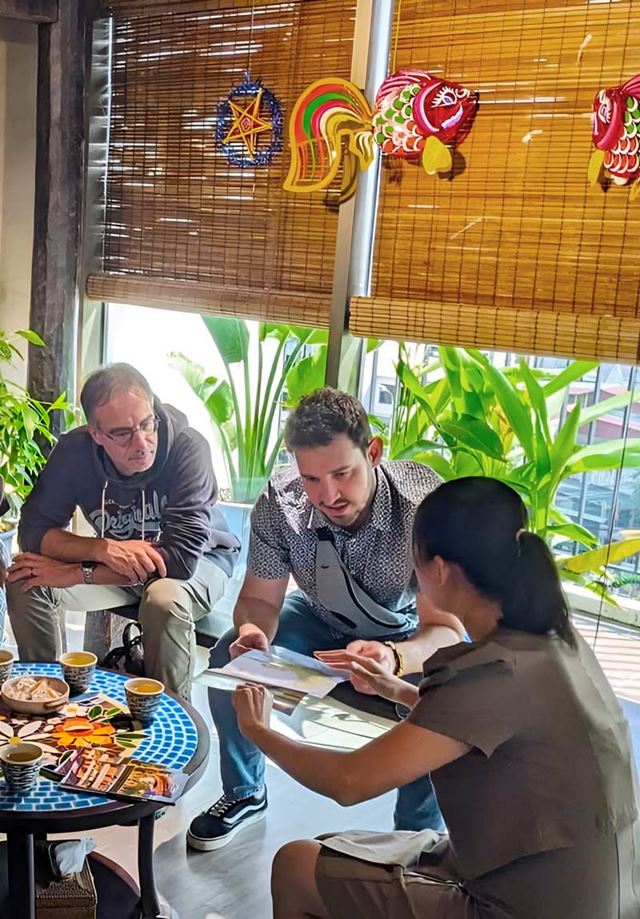
Planning Sapa as part of a trip to northern Vietnam? Our team in Hanoi, working with you in English, Italian or Spanish, can build a private itinerary with a local trekking guide and a homestay night that suits your pace. Request a free quote to start planning.
Planning your trip?
Save time and get expert advice for FREE!
✅ 15 years of local experience
✅ Save up to 40 hours of planning
✅ Travel stress-free from start to finish
Book your free consultation today!
















 Our team

 Our team

 Our team

 Our team




 Other
 Add us as a preferred source