Getting there and getting around
Arrival is the easiest part of the trip, because Noi Bai International Airport publishes accessibility details for both terminals, including wheelchair routes, lifts, accessible restrooms and ramped shuttles between the terminals. You should ask your airline for wheelchair assistance when you book, confirm it again at check-in, and give them your chair's dimensions, weight and battery details so that they can prepare properly.
The airport's help stops at the pickup area and does not guarantee that your onward car is adapted or that your hotel entrance is step-free, so I always confirm both of those separately. After that, transport is the weakest link in the journey, and adapted vehicles are not always easy to confirm, so I would get every claim about a vehicle in writing before you rely on it.
.jpg)
|
Option
|
What to expect
|
What I would check
|
|
Private car with driver
|
This is the most practical choice for most travelers, with prices ranging from about $30-50 a day to about $60-100 (1.5-2.5 million VND).
|
I would ask for a written quote, because the gap may reflect vehicle type and inclusions, and I would remember that a standard sedan is not wheelchair-adapted.
|
|
Adapted or ramped van
|
Some specialist operators advertise adapted vehicles, although availability is hard to verify in advance.
|
I would ask for the vehicle model, the boarding method (ramp or lift) and the way an occupied chair is secured.
|
|
Grab ride-hailing
|
Grab works in Hanoi and offers car or van choices in the app.
|
Drivers do not help with transfers, so you need to transfer independently or bring a companion, and street taxis are mostly not accessible either.
|
|
Metro Line 2A (Cat Linh-Ha Dong)
|
The line is accessible, with lifts.
|
Coverage is limited and no station sits inside the Old Quarter, so I would confirm the lifts at both ends on the day, since the sidewalk at each end still matters.
|
If you are connecting to other Vietnamese cities, I would fly, because trains and sleeper buses are not wheelchair-friendly.
Sidewalks and the Old Quarter
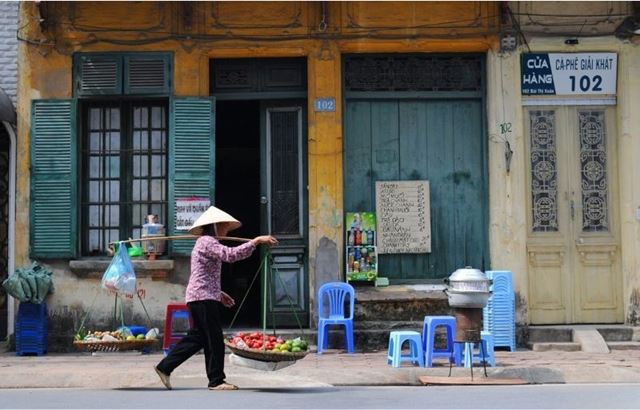
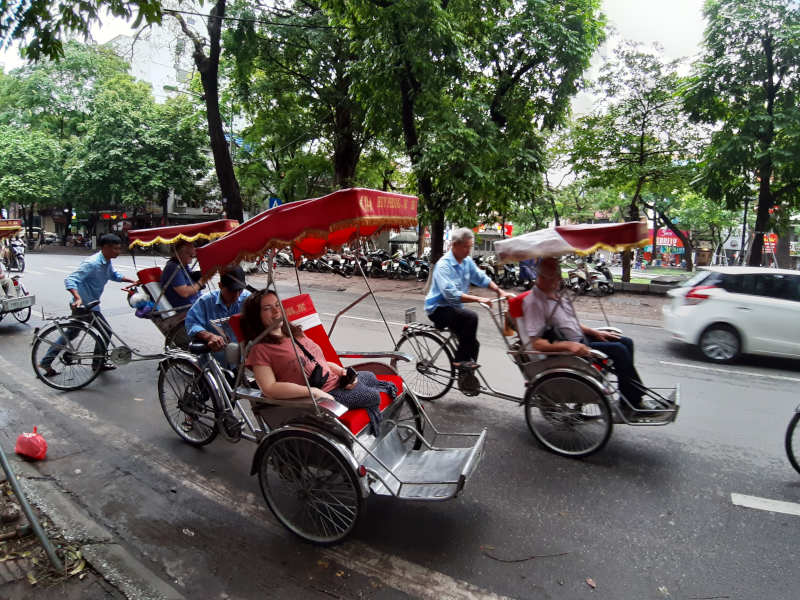
The Old Quarter is flat, which fools many people, but flat is not the same as accessible, because the terrain is rarely the problem while the traffic and the obstruction are. Motorbikes park on the sidewalks and vendors use whatever space is left, so pedestrians end up walking in the road while the scooters flow around them.
People describe the same streets very differently: some call the Old Quarter navigable if you accept sharing the road with motorbikes and travel with a companion, while others call it the hardest area of the city, with nearly unusable sidewalks and no system of curb ramps. Most shops and restaurants there have a step at the entrance and tight space inside, and my own advice sits closer to the cautious end, which is to go in with a plan instead of on a whim.
Newer areas are easier to manage. Tay Ho (West Lake), north of the Old Quarter, has wider and less cluttered sidewalks, although still short of ADA standards, and the French Quarter around the Opera House and the path along West Lake are also described as flatter and less crowded, so I like them for slower-paced afternoons.
These are my rules for the streets:
- Go with a companion or guide, especially when crossing roads, and cross at a steady pace without stopping, because traffic flows around moving pedestrians.
- Check each block before you commit to it, and when the route ends, move by car instead of treating the traffic lane as a path.
- Agree on one precise pickup point on a street the car can legally reach, since narrow lanes and pedestrian zones can block vehicles.
- Do not trust old photos or maps, because street works and clearances can change conditions from one week to the next.
Hotels: confirm the room, not the category
I start with newer, international-chain hotels, because four- and five-star properties generally have ramps, lifts and accessible bathrooms, although they have very few accessible rooms (a 300-room hotel might have only two), so you should book early and confirm directly with the hotel instead of through a booking site. Budget hotels and guesthouses rarely have accessible rooms at all.
Hotels commonly listed as wheelchair accessible in Hanoi include Splendid Star Hotel, Mercure Hanoi La Gare Hotel, Sheraton Hanoi and Skylark Hotel, but I would use that as a starting list and not as a guarantee, and I would verify the specific room, because a room labeled accessible can still sit behind a stepped lobby, a narrow lift or a shower threshold, which matters just as much for an older traveler who walks slowly as for a wheelchair user.
Location is a trade-off, since an Old Quarter address cuts driving time to central sights but narrow streets may stop a car from reaching the door, while a hotel farther out means more driving but often a simpler path from the street to the room.
Before booking, I ask the hotel to confirm the following in writing for the actual room assigned:
- Is there a step-free path from the car drop-off to the entrance and to the lift?
- What are the clear widths of the entrance, the lift, the room door and the bathroom door?
- Is the shower roll-in or does it have a tub or threshold, and are the grab bars on the correct side?
- Can the chair reach the bed and the toilet from the side you transfer from, and is the bed height workable for you?
- What is the evacuation plan if you cannot use the stairs?
I also ask for current photos, measurements or a short video of any doorway, lift or bathroom that matters to you.
Sights and attractions
Several of Hanoi's best-known sights are workable, but each one has a catch, so I move between them by car, because the walking links between the sights are the problem and not the sights themselves.
|
Place
|
What to expect
|
What I would check first
|
|
Hoan Kiem Lake promenade
|
The path around the whole lake is wide, flat and paved, with no steps.
|
Getting to it means crossing busy roads, so I would pick a drop-off and a pickup point in advance.
|
|
Weekend walking street (lake area)
|
The streets around the lake close to traffic on Friday to Sunday evenings, so the road works as a sidewalk, and the hours are reported as 7 pm-2 am in summer and 6 pm-2 am in winter.
|
Hours can change and the crowds are larger, and the pickup boundary also moves, so I would agree on a meeting point before you go.
|
|
Ngoc Son Temple and Huc Bridge
|
The bridge and the temple grounds are accessible for a small entrance fee.
|
A large step sits to the right on the approach, so you backtrack when leaving, and the interior rooms have stairs.
|
|
Temple of Literature
|
Reports are mixed, with some describing flat courtyards with thresholds and others describing steps at every gate.
|
I would ask which gate suits a wheelchair, whether the exit can match your pickup point, and where the accessible toilet is.
|
|
Ho Chi Minh Mausoleum complex
|
The plaza is flat, interior access varies, and the gardens and One Pillar Pagoda grounds are partly accessible.
|
The complex has several separate parts, so I would confirm the entrance, the security and the queue arrangements for your date.
|
|
Tran Quoc Pagoda
|
It has a barrier-free entrance and an accessible path around the grounds.
|
The indoor part is not accessible, although you can see it from the outside.
|
|
Vietnam Museum of Ethnology
|
It is reported to have ramps and is described as one of the few accessible attractions in the city.
|
I would confirm the route to the toilet and the access to any special exhibits.
|
|
Water Puppet Theatre
|
It is reported to be flat, with accessible seating.
|
I would book ahead and confirm the seating position.
|
|
Ta Hien Corner
|
It is wheelable by day, but at night people and tables fill the street.
|
I would arrive and leave by car, because scooter traffic is heavy and the tables are very low.
|
Train Street
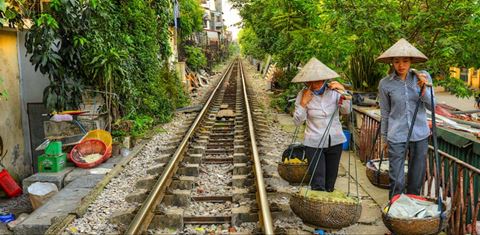
Train Street is on everyone's list, but you cannot roll along the tracks because of the loose rocks and uneven ground, so the workable plan is to watch from a corner beside a cafe on a busy intersection, where you have a clear view of the crossing, and to allow plenty of time. Visiting is free, and staff with whistles and barricades clear the tracks before each train.
Train Street has been closed and reopened more than once since 2019, so you should check its current status before you plan around it, and you should remember that the cafe seats beside the tracks are for paying customers.
Day trips from Hanoi
I would be cautious with Ha Long Bay and Sapa or Ninh Binh, because cruise boarding often means a floating dock and steep stairs; two operators, Bhaya and Paradise, are reported to offer one accessible cabin on selected boats, which must be booked months ahead and confirmed directly, whereas Sapa's terraces and village paths are not feasible by wheelchair.
Toilets, food and everyday logistics
Accessible toilets are the hardest everyday need to meet, and you should not count on finding one in the Old Quarter, so I plan breaks around the hotel and around malls and upscale apartment complexes, which often have shops and accessible restrooms on their lower floors. Carrying a portable urinal as a backup is also sensible for longer outings.
For meals, lakeside street vendors and streetside restaurant seating are easier than most Old Quarter restaurants, where the entrances have steps and the interiors are tight. Many street stalls can fit a wheelchair at the table or curb, but low plastic furniture is the norm, so you should check the height before you commit, and malls and new developments usually have step-free entrances and lifts.
- Cash: Carry plenty of it, because street vendors and small restaurants take cash only, and ATMs dispense roughly 2-5 million VND ($80-200) per transaction.
- Heat and pace: Summer is hot and humid, so carry water, plan indoor activities from about 11 am to 3 pm, and build in rest stops, which matter most for older travelers.
- Season: October to December and March to May are the more comfortable windows, and summer is best avoided.
- Medical care: Public hospitals are crowded and not accessible, whereas private international hospitals such as Vinmec in Hanoi have better facilities and English-speaking staff, and travel insurance is essential.
How I would plan your days
I build each day around its weakest link and not around its most attractive stop, because a confirmed room, car, curb, entrance, toilet and pickup all have to work together, and if one of them cannot be confirmed I shorten or replace that outing.
Here is a low-risk sample day that you can adapt and verify for your own dates:
- Start with a private car from a confirmed level pickup point at your hotel.
- Visit one place with a verified entrance and route, such as the Vietnam Museum of Ethnology or Tran Quoc Pagoda.
- Eat at a mall or at a lakeside spot where the entrance and the restroom are confirmed.
- Rest at the hotel in the afternoon so that you have energy for the evening.
- On a Friday, Saturday or Sunday evening, take a short stroll around Hoan Kiem Lake on the closed-off streets, with a car waiting at a set pickup point.
It also helps to send every hotel, driver and venue the same short brief, which should include your device type (manual or power) with its dimensions and weight, whether you can transfer into a car seat, how many steps or how far you can manage, and whether an accessible toilet or frequent rest stops are essential, and then to ask them to confirm the vehicle, the entrances, the inaccessible sections, the toilet and the return pickup in writing.
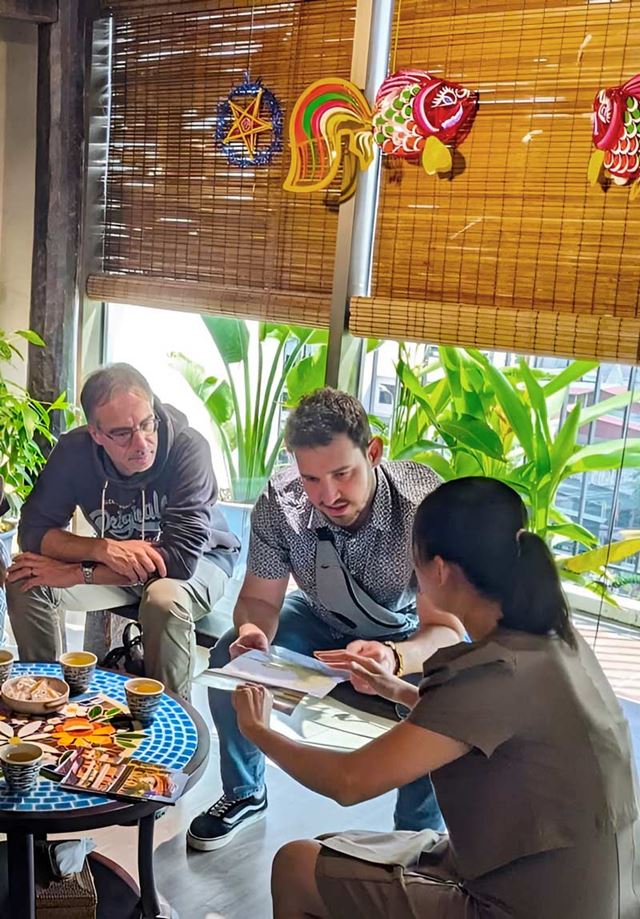
A tailored private trip can fix several weak links at once, because a local planner can check the vehicle, the pace, the stops and the pickup chain before you commit, cut the stops that fail and arrange backups. A private tour does not mean an accessible tour on its own, though, so you should not book until the vehicle and the whole route are confirmed for your chair or your parent's pace, and a shared group tour is a poor default if you need flexible rest breaks or route changes.
Before you go
Access conditions change without notice, with lifts going out of service, entrances being rerouted during works and opening hours shifting by season, so for anything your trip depends on you should call ahead and get written confirmation from the hotel, driver or venue.




 Our team
 Our team
 Our team
 Our team












 Other
Other Add us as a preferred source