Bich Dong Pagoda: Serenity Among the Karsts of Tam Coc
Alright, so if you find yourself exploring Vietnam's "Ha Long Bay on Land," one thing you absolutely have to do is visit the Bich Dong Pagoda.
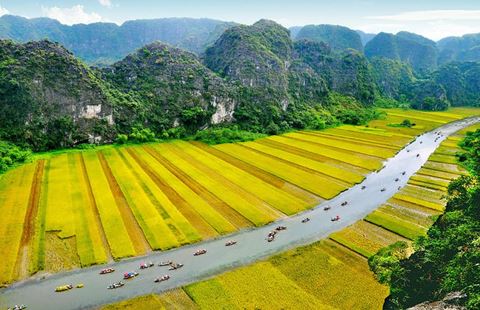
Honestly, the journey to get there is half the adventure. Just rent a bike in Tam Coc and cruise through the countryside. You'll pedal past these incredible green rice fields and through tiny villages, getting a real peek into the quiet, everyday life of the locals. The whole vibe is just so peaceful and authentic. Trust me, between its fascinating history and magical setting, the pagoda itself will completely take your breath away.
Written by Oliver PHUNG (Tour Guide)
Updated on Aug 21, 2026
0 comment
Oliver Phung is a Northern Vietnam-based tour guide and blogger. His favorite topics to write about include cuisine, culture, travel, and under-the-radar experiences. Oliver possesses a deep, detailed understanding of the region, from the indigenous culture of the Hmong in the Northwest to the highland lifestyle of the Tay in the Northeast. Whether he is exploring ancient architecture or geological landscapes, he is always eager to share his insights with his readers.
Beyond his work at Kampá Tour, he produces specialized travel content on platforms such as Reddit, Instagram, LinkedIn, and various other publications.
Entry: direct entry to Bich Dong Pagoda is free. Official Tam Coc–Bich Dong sightseeing packages are separate and may be ticketed. Do not pay an unofficial “pagoda entrance fee” to someone approaching you at the gate.
Parking: 5,000 to 10,000 VND for a bicycle or motorbike. Not 50,000.
Opening hours: 7:30 AM to 4:30 PM daily.
Time needed: 45 minutes to an hour on site; about two hours round trip by bicycle from Tam Coc.
The climb: about 120 stone steps from Ha Pagoda to Trung Pagoda, then roughly 40 more to Thuong Pagoda; the old stone can be slippery after rain.
Best months: February and March for the red kapok blossom, May to July for lotus on the pond.
Is Bich Dong Pagoda worth visiting?
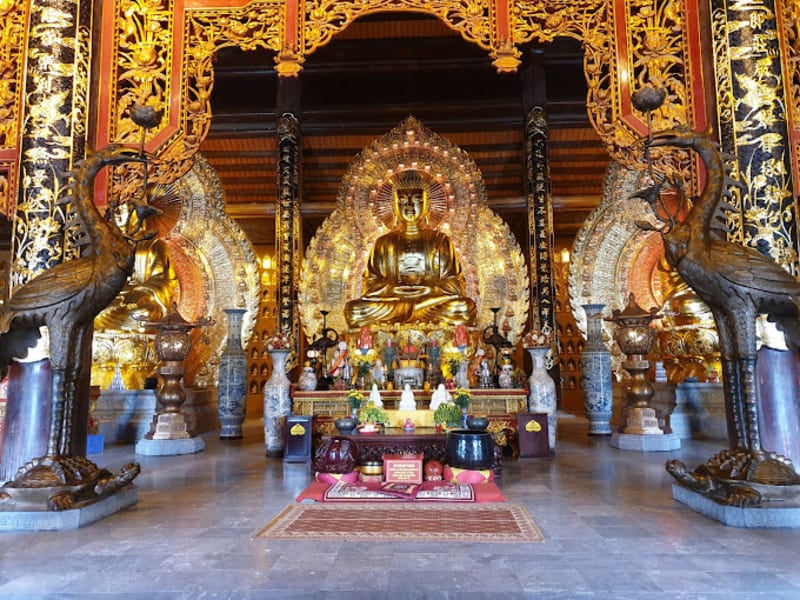
Yes, and the reason is not the architecture. Bich Dong is small, plain and unrestored in a way that most Vietnamese pagodas no longer are: no gilding, no giant statues, just three modest halls built into a mountain that has been eaten into by water and time. Travelers who arrive after Bai Dinh often say this is the one that stayed with them.
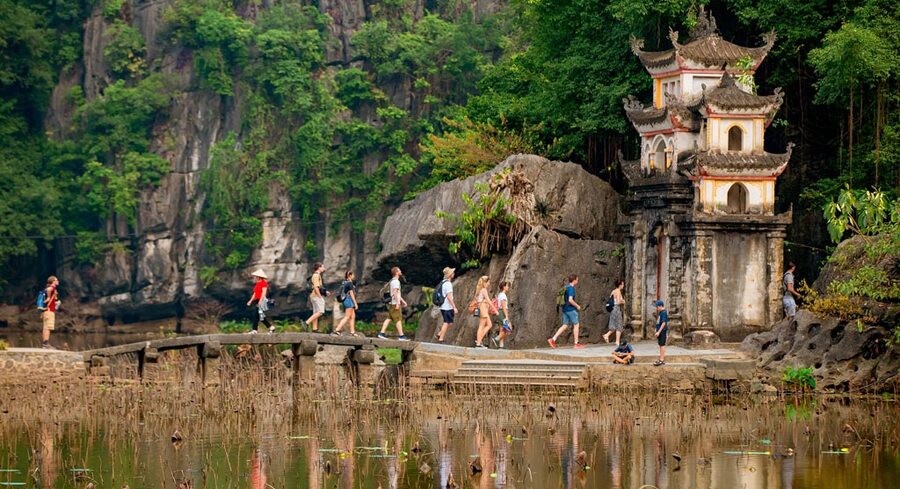
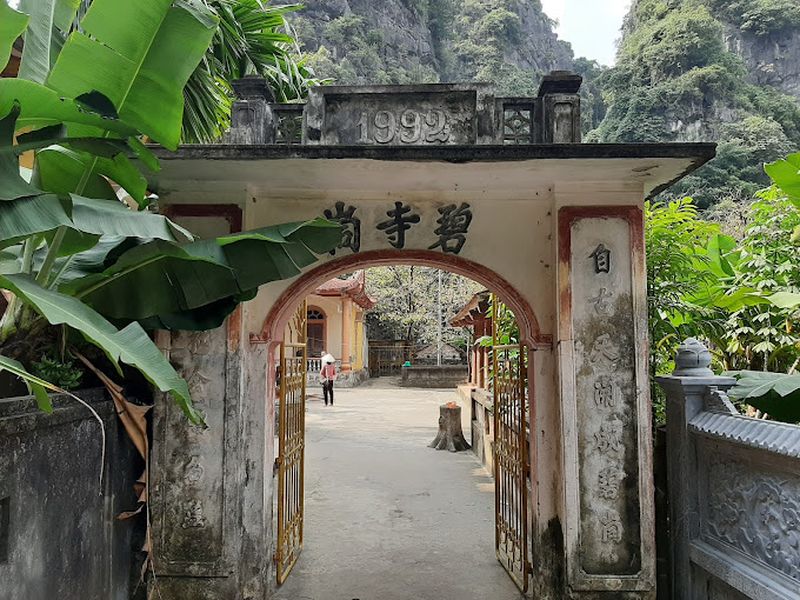
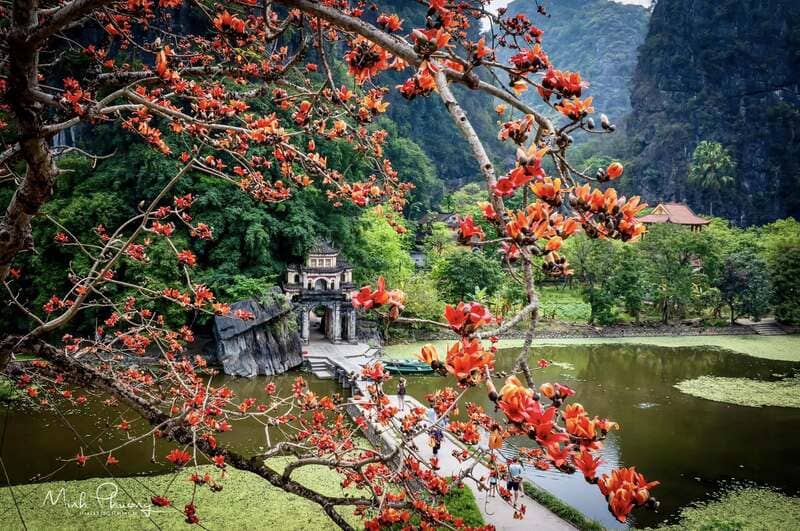
The entrance to Bích Động Pagoda is worthy of a painting.
It also asks very little of you. It is free, it is a short flat ride from Tam Coc, the climb is modest, and an hour covers it. In a province where the headline sights each want half a day, that matters.
Two honest caveats. First, this is a stop on the tour-bus circuit, so between about 10 AM and 3 PM the entrance bridge fills up with groups and photo shoots. Second, there is almost no interpretation on site: a few signs about cause and effect, and nothing explaining what you are looking at. Come early, or come with someone who can tell you the story.
The parking, and how not to overpay
This is the part no guidebook mentions and almost every recent visitor does. Get it right and Bich Dong costs you five thousand dong.
Direct entry to Bich Dong Pagoda is free. Official Tam Coc–Bich Dong sightseeing packages are separate and may be ticketed, but there is no standalone admission ticket for entering the pagoda itself. The only legitimate charge at the pagoda is parking, and it runs 5,000 to 10,000 VND for a bicycle or motorbike.
>>> What visitors report:
People in uniform-looking clothing with armbands waving riders into a parking spot and then asking for 50,000 VND, roughly ten times the going rate.
An unofficial “pagoda entrance fee” being collected at the gate. Direct entry to the pagoda itself is free.
Handwritten tickets sold for 10,000 VND that are not issued by the site.
Someone waiting on the far side of the lake with a torch, offering to take you into a cave for a fee. This is not an official service either.
None of this is dangerous and nobody will chase you. The fix is simply knowing the number before you arrive: agree the price before you hand over the bike, pay 5,000 to 10,000 VND, and decline anything else. If you would rather avoid the conversation entirely, park about 100 metres before the entrance and walk the last stretch.
Coming with a driver or a guide removes the problem completely, which is one of the few places in Ninh Binh where that is true.
Three pagodas, one mountain
The complex is laid out to echo the character 三, tam, meaning three: three halls rising one above the other up the mountainside, each with its own character.
Ha Pagoda, the lower one, sits on flat ground at the foot of the mountain and is the first thing you reach after the stone bridge. Wooden pillars, five bays, and the busiest of the three.
Entrance to the Lower Pagoda
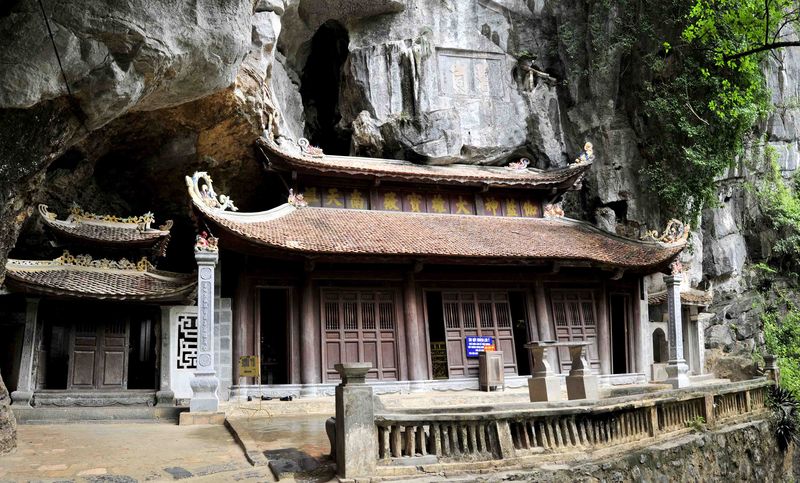
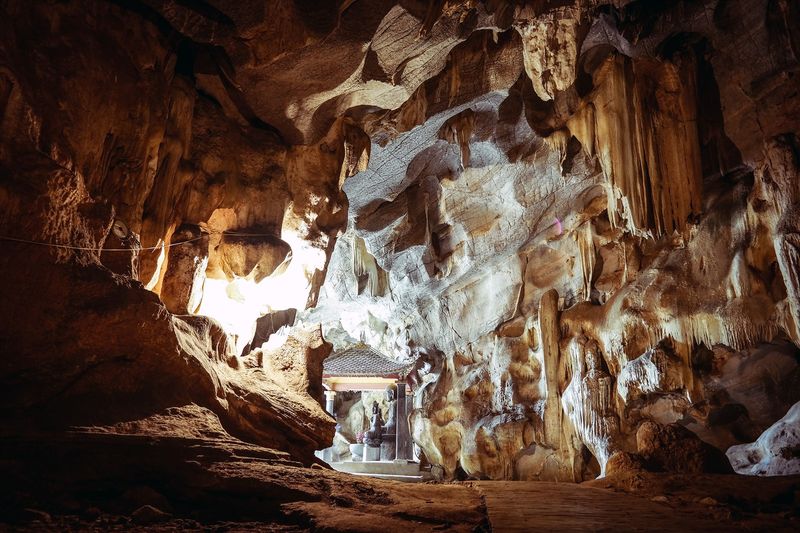
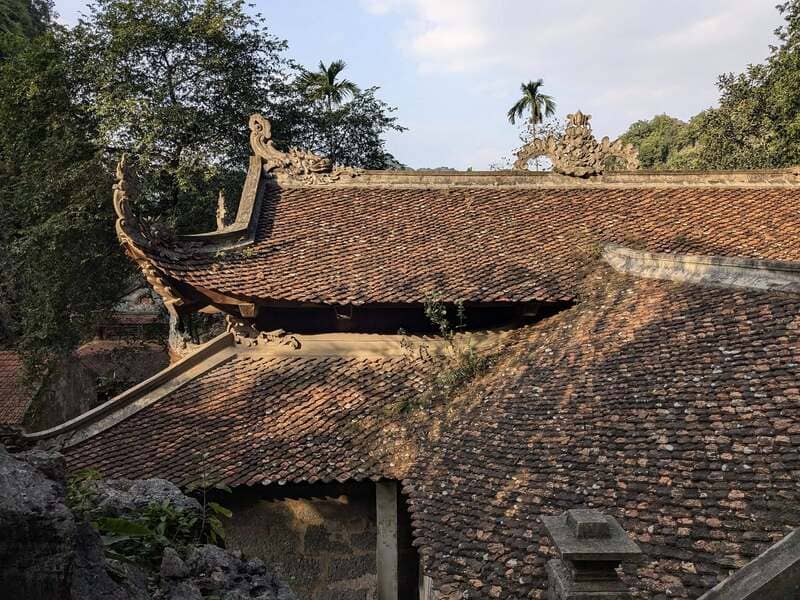
Trung Pagoda, the middle one, is built half into a natural cave partway up the slope. Half the hall is masonry and half is rock, and it is the most atmospheric of the three. The bell cast in 1707 hangs in the dark chamber behind it, along with a colony of bats you will hear before you see.
The Central Pagoda or Chua Trung
A cave between the Central Pagoda and the Upper Pagoda
Thuong Pagoda, the upper one, is about 40 stone steps above the middle hall, and the smallest of the three. The reason to go up is what is behind it: an open view over the rice fields and karst towards Tam Coc, usually with nobody else on it.
View from the Upper Pagoda
The single most common mistake here is stopping at the lower pagoda, photographing the gate and leaving. Most of what makes Bich Dong worth the trip is above and behind that first courtyard.
How Bich Dong got its name
The pagoda was founded in 1428, at the start of the Later Le dynasty, as a single small temple on the mountainside. It carried a longer, older name then: Bach Ngoc Thach Son Dong, roughly "the white jade temple in the stone mountain".
It became what you see today because of two monks. In 1705, Tri Kien and Tri The came across the site, were taken by it, and stayed to rebuild it across three levels. They cast the large bronze bell in 1707, which still hangs in the Dark Cave, and had a commemorative stone stele engraved in 1709.
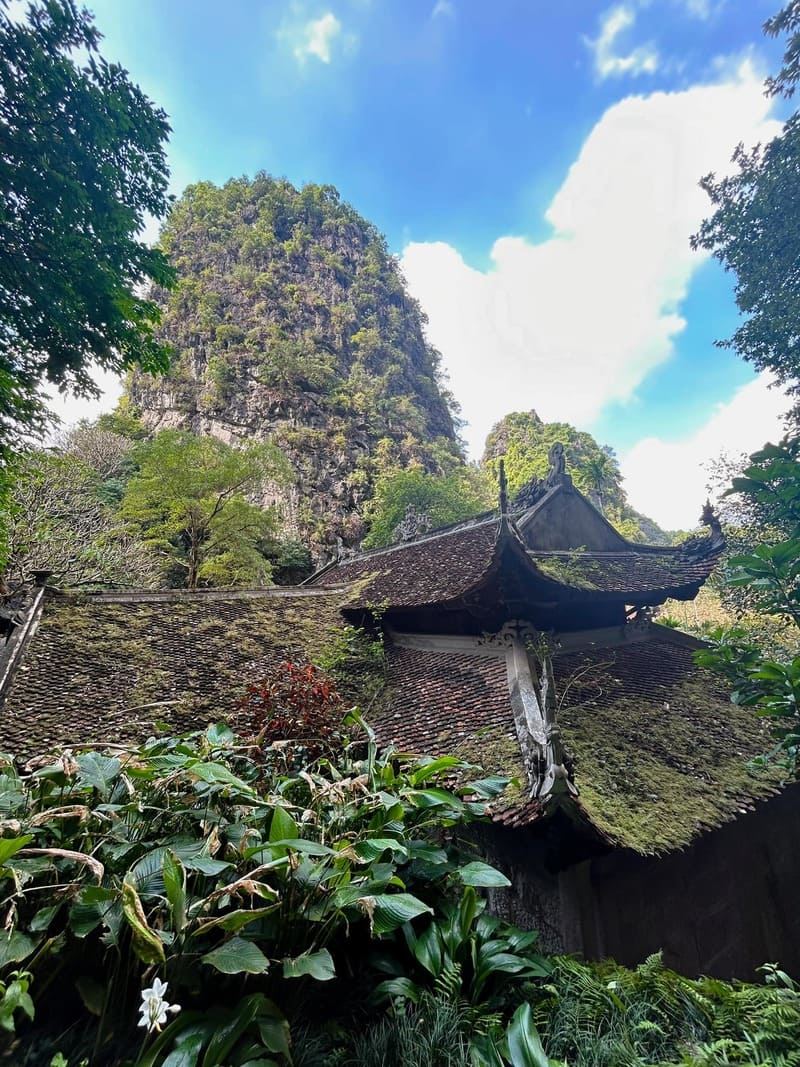
The pagoda's moss-covered portal bears witness to centuries of history
The name arrived later still. In 1774, Lord Trinh Sam visited, was struck by the green of the mountain against the water, and renamed it Bich Dong, the jade or emerald grotto. He also gave it the title it is still known by in Vietnamese: Nam thien de nhi dong, the second most beautiful cave under the southern sky, ranked behind only Huong Tich near Hanoi.
The pagoda is now around 600 years old, sits inside the Trang An Landscape Complex inscribed by UNESCO in 2014, and is classed as a special national relic. Almost none of that is explained on site, which is why it reads as a pretty gate to visitors who arrive without the story.
Opening hours, steps and how long to allow
Opening hours: 7:30 AM to 4:30 PM daily.
Entrance: free. Parking 5,000 to 10,000 VND.
Steps: about 120 stone steps from Ha Pagoda to Trung Pagoda, then roughly 40 more from Trung Pagoda to Thuong Pagoda.
Time on site: 45 minutes to an hour to see all three levels without rushing.
Round trip from Tam Coc: about two hours by bicycle, including the visit.
Quietest hour: before 10 AM, before the coaches arrive.
The steps are the thing to know about. There are not many of them, but they are old stone, uneven, and have no handrail. Dry, they are easy for anyone reasonably steady on their feet. Wet, they are genuinely slippery, and after heavy rain the sensible choice is to see the lower two levels and skip the top.
The path around the lake
Most visitors cross the stone bridge, go up through the pagodas and come back the same way. There is a second option that almost nobody takes.
Follow the path to the right of the bridge instead, past the bicycle parking and around the edge of the lotus pond. It climbs a short rise and drops into a quiet valley on the far side, with a small body of water and a cave mouth, and it is usually empty even when the pagoda courtyard is full.
Two things to be clear about. This is a walking path, not an organised attraction: there is no ticket office, no signage and no marked route. And there is no official boat service or cave tour operating here, whatever you may be offered at the far side. Treat any such offer the way you treat the parking touts at the entrance.
When to come, and what the seasons change
Bich Dong is open all year and the pagoda itself looks the same in every month. What changes is the frame around it, and that is worth timing if photographs matter to you.
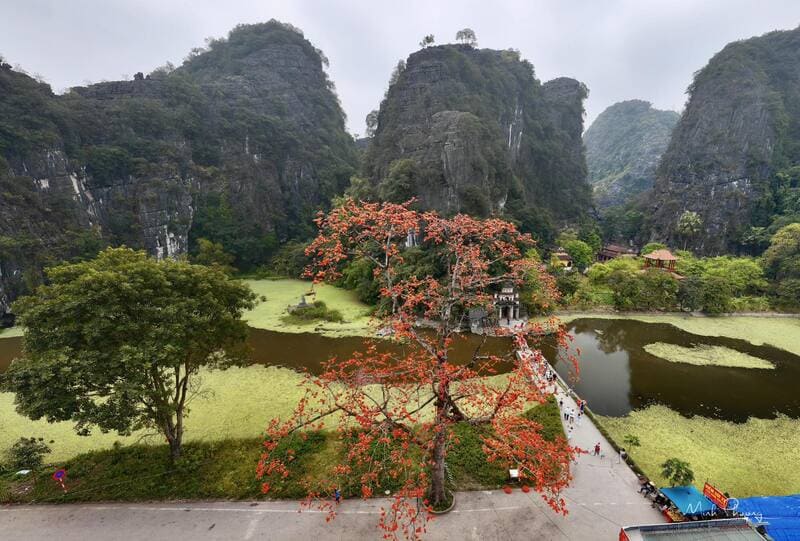
February and March: the kapok trees at the entrance come into flower, bright red against the grey gate and the green mountain. This is the shot the pagoda is known for.
May to July: lotus fills the pond in front of the bridge. The best hour is early morning, when the flowers are fully open.
September: the rice in the surrounding fields turns gold, which makes the ride out from Tam Coc as good as the destination.
December: mist, few visitors, and the quietest version of the place.
In February and March, the kapok trees in bloom set the entrance to the Bích Động Pagoda ablaze bright red.
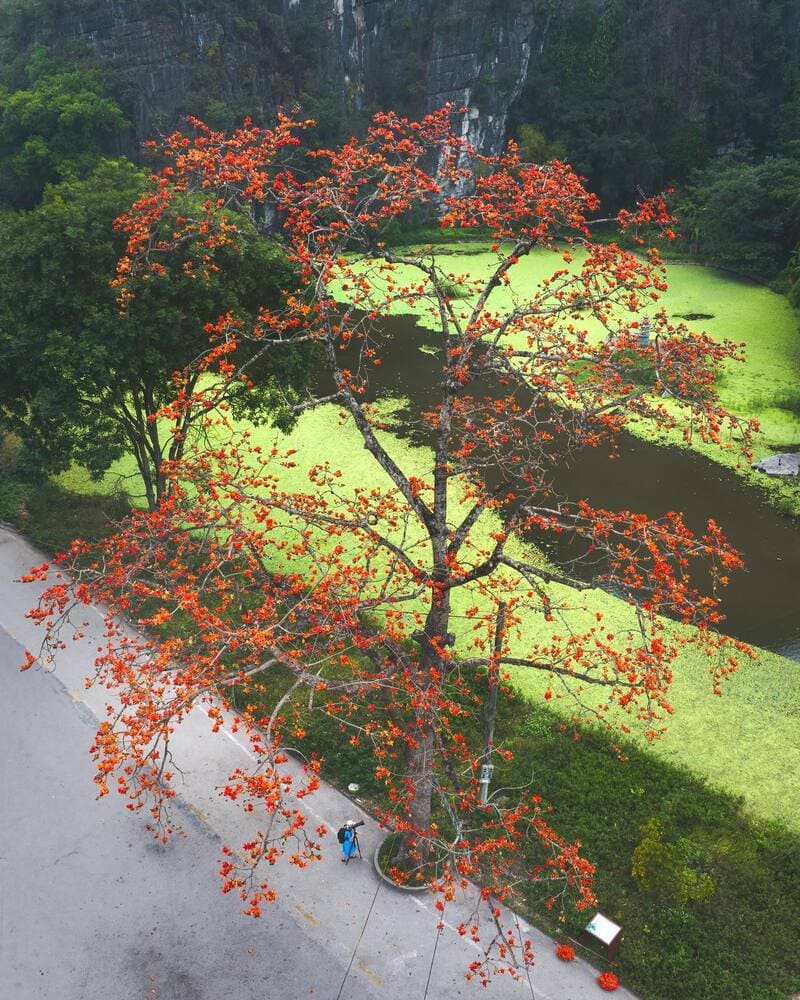
With its bright red flowers, the kapok tree is one of the typical images of spring in northern Vietnam.
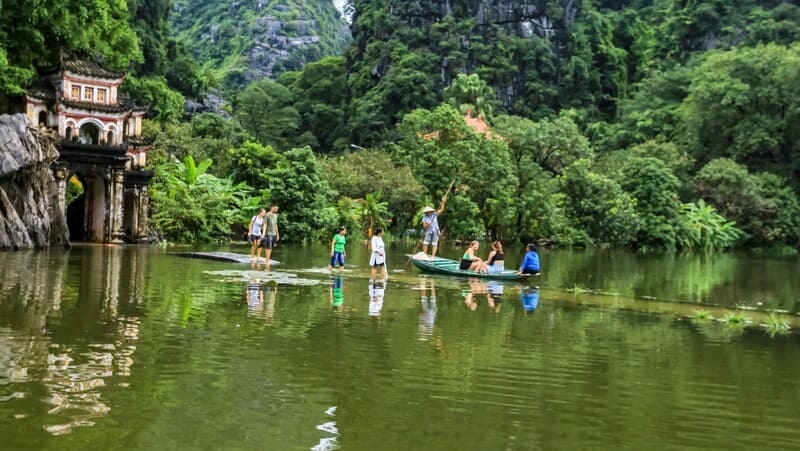
👉 A helpful tip: In the rainy months, usually June and July, the water in front of the pagoda can rise enough to flood the entrance path. It is not a problem so much as a bonus: when it happens, you reach the gate by small boat, which is the version of Bich Dong that ends up on people's walls.
Unusual entrance to Bích Động during the rainy season.
What to wear
Cover shoulders and knees. You should know that in practice the rule is barely enforced here, and you will see visitors in vests and short shorts with nobody saying anything. That is not permission. Bich Dong is a working pagoda where people come to burn incense and pray, and it is a small enough space that dressing carelessly is noticeable.
On footwear, be practical rather than respectful: the stone is uneven and often damp, so trainers beat sandals. Bring cash in small notes for parking and incense, and nothing else is needed.
Getting there from Tam Coc
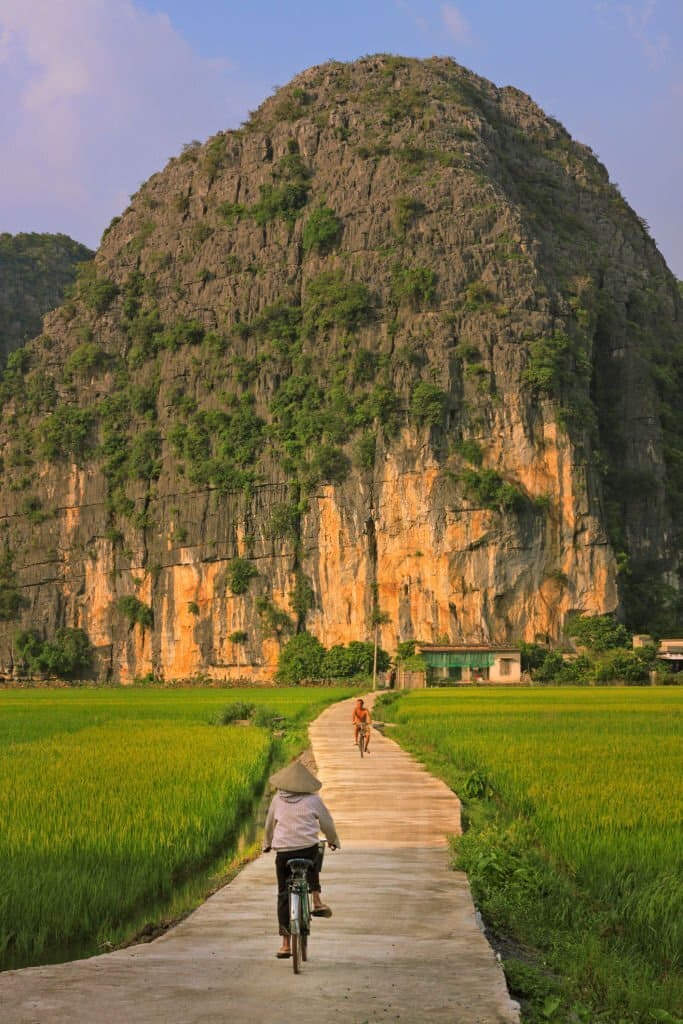
Bich Dong sits 2 km from the centre of Tam Coc, on a flat, signposted road through rice fields. It is one of the nicest short rides in Ninh Binh.
By bicycle: 10 to 15 minutes, and the standard choice. Most homestays in Tam Coc lend or rent bikes.
On foot: around 30 minutes. Pleasant in the cool hours, hard work at midday.
By taxi or motorbike: a few minutes, and the right call if you are combining it with somewhere further out.
On the bike route to the Bích Động Pagoda, you come across peaceful and enchanting landscapes like this one.
Explore more of our popular tours!
What to combine with Bich Dong
Bich Dong takes an hour, so it is a half of something rather than a day in itself. Everything below is within 10 km.
Tam Coc: the obvious pairing, 2 km back down the road. Boat ride in the morning, pagoda afterwards, or the reverse if you want the pagoda empty.
Hang Mua: about 8 km away, 486 steps to the widest view in the province. The two make a good contrast: one short climb for a temple, one long climb for a panorama.
Thai Vi Temple: roughly 7 km, dedicated to the Tran dynasty kings and set against the limestone. Quiet, quick, and rarely busy.
Thung Nham Bird Garden: 6 km, best in the late afternoon when the birds come back to roost.
For a full picture of how these fit into one or two days, see our Ninh Binh guide.
Roughly "bick dong", written Bích Động in Vietnamese. It means jade or emerald grotto, and the older Vietnamese title for it, Nam thien de nhi dong, means the second most beautiful cave under the southern sky.
Is Bich Dong suitable for young children?
Yes, with an eye on the steps. The lower pagoda and the courtyard are flat and easy, and the climb is short. The stone is uneven and there is no handrail on the upper flight, so hold hands on the way to Thuong Pagoda and skip it entirely if the steps are wet.
Can you visit with limited mobility?
Partly. The bridge, the courtyard and Ha Pagoda at the bottom are reachable on level ground, and that is a pleasant visit in itself. The middle and upper pagodas are not: uneven stone steps, no rails, and no alternative route. There is no wheelchair access above the lower level.
Are there toilets and places to buy water?
Yes to both, near the entrance and the parking area, along with a handful of stalls selling incense, souvenirs and Buddhist articles. There is nothing once you start climbing, so drink before you go up.
What is the best spot for photographs?
The stone bridge and the entrance gate seen across the pond, ideally before 10 AM when the light is soft and the bridge is empty. The second is the terrace behind Thuong Pagoda, looking out over the fields. In February and March the kapok blossom does most of the work for you.
Planning your visit
Ride out from Tam Coc early, pay five thousand dong for the bike, and go all the way to the top rather than stopping at the gate. Bich Dong gives back roughly what you put into it, and an hour is all it asks.









 Our team
 Our team
 Our team
 Our team

.jpg)



 Other
Other Add us as a preferred source