How to Travel to Vietnam: 3 Ways In by Air, Road or Sea
Most travelers reach Vietnam by plane, landing in Hanoi, Ho Chi Minh City or Da Nang. You can also cross by land from Cambodia, Laos or China, or arrive on a cruise ship at a few seaports. Whichever way you choose, you need a visa exemption or an e-visa before you arrive.
This guide is about getting to Vietnam. Once you have landed, our guide to getting around Vietnam covers trains, buses and domestic flights, and our Vietnam travel guide helps you plan a first trip.
Written by Thom DOAN (Travel Consultant Manager & Director)
Updated on Oct 19, 2026
0 comment
Thom DOAN leads the travel consulting team at Kampá Tour and serves as the agency's director. She works with travellers in both French and English, and her career has taken her across multiple countries in Asia.
On this blog she writes about the destinations she knows first-hand, mostly in Vietnam and Cambodia: what a place is actually like, who it suits, and the practical details that decide whether a trip works. If you have a question about anything she covers here, leave it in the comments and she will answer you directly.
Almost every visitor, and the only practical option from outside Asia
Hanoi (HAN), Ho Chi Minh City (SGN), Da Nang (DAD), also Nha Trang and Phu Quoc
Visa exemption or e-visa, plus the pre-arrival declaration
By road or rail
Overland trips between Cambodia, Laos, China and Vietnam
Moc Bai, Tinh Bien and Ha Tien from Cambodia; Nam Can, Cau Treo and Lao Bao from Laos; Huu Nghi, Lao Cai and Mong Cai from China
Visa exemption or an e-visa that names the crossing; no visa on arrival
By sea
Cruise passengers
Ha Long, Da Nang, Nha Trang, Phu My (for Ho Chi Minh City) and Phu Quoc
Visa exemption or e-visa; confirm the port with your cruise line
Welcome to Vietnam
Traveling to Vietnam by Air
Vietnam has three main international airports: Noi Bai in Hanoi (HAN), Tan Son Nhat in Ho Chi Minh City (SGN) and Da Nang (DAD). Cam Ranh, for Nha Trang, and Phu Quoc also handle international flights. Hanoi and Ho Chi Minh City have by far the most routes, while Da Nang has fewer international links, mostly within Asia.
How to Travel to Vietnam from the USA (and from California)
The only nonstop flight from the United States is Vietnam Airlines from San Francisco to Ho Chi Minh City, four times a week, about 15 hours. From every other US airport you connect, usually through East Asia, the Middle East or Europe, and the whole trip takes roughly 19 to 22 hours.
Vietnam Airlines' own website, which we checked on 19 October 2026, lists departures on Wednesdays, Thursdays, Saturdays and Sundays. Travelers elsewhere in California can reach San Francisco on a domestic flight or choose a one-stop itinerary, so compare total travel time as well as price. Schedules change, so confirm the days before you book.
Flying from Europe, Australia and Elsewhere in Asia
Europe has the widest choice of nonstop flights. Vietnam Airlines added Hanoi to Amsterdam on 16 June 2026, flying three times a week in about 12 hours, and it also runs nonstop services to cities such as Paris, London, Frankfurt, Munich, Milan and Copenhagen. From Australia, airlines add and drop nonstop routes from season to season, so check current schedules instead of relying on an older list.
Vietnam is also a short hop from its neighbors. You can fly directly from Thailand, Cambodia, China, Laos, Singapore, Malaysia and the Philippines, with airlines such as Vietnam Airlines, Scoot, AirAsia, Vietjet and Jetstar.
Best Websites to Check Flights
Compare several tools before you book, because each one shows a different set of airlines and fares:
Skyscanner: searches many airlines and booking sites at once.
Google Flights: easy to use, with strong filters.
Momondo: pulls data from many airlines and travel sites.
Expedia: combines flights with hotels and car rentals.
CheapOair: focuses on budget-friendly fares.
A Vietnam Airlines Airbus parked at the terminal of Tan Son Nhat Airport
>>> Advice for Finding the Best Deals
A nonstop flight is not always the cheapest. A connecting flight through Bangkok, Hong Kong, Kuala Lumpur, Seoul or Singapore can cost less, as long as you leave at least three hours between flights in case the first one is late.
Hanoi or Ho Chi Minh City: Which Airport Fits Your Route?
Fly into the airport nearest the start of your route: Hanoi if you are heading south, Ho Chi Minh City if you are heading north. Both have the most international flights, and arriving in one city and leaving from the other saves you backtracking.
Tan Son Nhat sits inside Ho Chi Minh City. Long Thanh International Airport, built outside the city to ease pressure on it, has not opened to passengers yet. The Civil Aviation Authority of Vietnam has agreed to a proposal from the airport operator, ACV, to start commercial operations on 1 December 2026 (Dan Tri International, 30 September 2026). Under the transfer plan reported, airlines are encouraged to start international flights there from that date, all long-haul international flights would move from 28 March 2027, and most remaining international flights from 30 October 2027. Dates in a staged plan can shift, so check the airport on your ticket, especially if you fly to Ho Chi Minh City after December 2026.
You can enter Vietnam by land from Cambodia, Laos and China. The government has approved 27 land crossings for e-visa holders, and the ones travelers use most are listed below. There is no visa on arrival at a land border, so get your e-visa first or check that you are exempt.
Before you set out, note that land crossings keep set daily hours, and the smaller ones generally close in the late afternoon, so confirm opening times before you book onward transport. Your e-visa application asks for an intended entry checkpoint, so decide which crossing you will use before you apply. Official notices so far describe the pre-arrival declaration for airports, and we found no notice extending it to land crossings.
From Cambodia to Vietnam
Five crossings see regular tourist traffic. These three are the most practical for most itineraries:
Crossing (Vietnam / Cambodia)
Connects
Good to know
Moc Bai / Bavet
Ho Chi Minh City and Phnom Penh
About 80 km from Ho Chi Minh City
Tinh Bien / Phnom Den
Chau Doc and Phnom Penh
About 2.5 hours by road from Phnom Penh; a natural stop on a Mekong Delta route
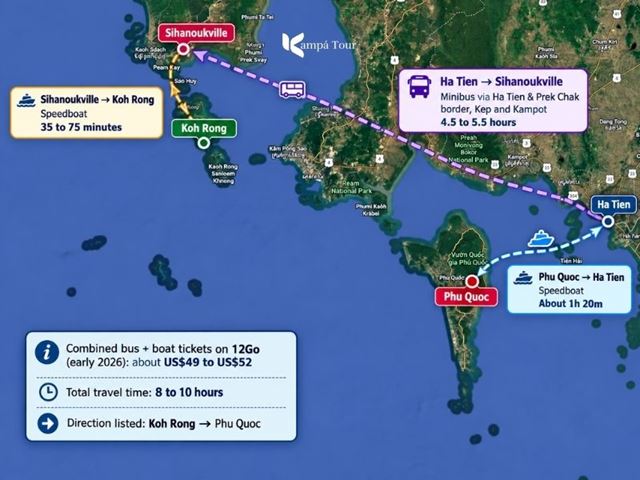
Ha Tien (also written Xa Xia) / Prek Chak
Ha Tien and the Cambodian coast
Close to Kampot and Kep on the Cambodian side
Xa Mat, north of Moc Bai, and Le Thanh, used by travelers coming from Pleiku or Kon Tum, complete the five. Hours and facilities differ from one crossing to the next, so check them before you commit.
Moc Bai border gate
From Laos to Vietnam
Laos has several approved crossings. Nam Can and Cau Treo, in the Nghe An and Ha Tinh area, and Lao Bao, on the road toward central Vietnam, are widely used by overland travelers. Cau Treo links Vientiane with Vinh. Tay Trang, in the northwest, links Luang Prabang with Dien Bien Phu, which suits a loop through the northern mountains.
From China to Vietnam, by Road or Rail
The Huu Nghi crossing (the Friendship Pass) and Mong Cai handle road traffic in the northeast, while Lao Cai, opposite Hekou in Yunnan, serves the route toward Sapa. There is also a daily international train between Nanning and Hanoi's Gia Lam station, which resumed in May 2025. The train runs overnight in each direction, taking roughly 11 to 13 hours, and immigration is handled at the border stations of Dong Dang and Pingxiang. Service has been paused briefly for weather, including heavy rain in early July 2026, so check the status before you travel.
Traveling to Vietnam by Sea
Arriving by sea means a cruise ship. International cruises call at the Ha Long International Cruise Port for Ha Long Bay, Tien Sa in Da Nang, Cam Ranh International Port near Nha Trang, Phu My for Ho Chi Minh City, and Phu Quoc, often as part of a longer Southeast Asia itinerary.
You can sail to Vietnam on a cruise ship and dock at some of the ports that welcome foreign visitors
Visa rules still apply on a ship. Visa on arrival is not offered to cruise passengers, according to a private visa service, so travelers who are not exempt need an e-visa, and the port on that e-visa should match the port on your itinerary. Ask your cruise line which port it has on file. Some exemptions last only 14 to 45 days, which can be shorter than a long cruise itinerary.
What Do You Need to Enter Vietnam?
You need a passport valid for at least six months beyond your arrival date and an entry permit, which is either a visa exemption for your nationality or an e-visa. Visitors arriving by air are also asked to complete an online pre-arrival declaration up to three days before landing and keep its QR code.
The requirements below apply however you arrive. Rules change, so check the official portals before you travel. We last reviewed this section on 19 October 2026.
Do You Need a Visa for Vietnam?
That depends on your passport. There are four ways in:
Route
Who it is for
Stay and cost
Visa exemption
Citizens of Germany, France, Italy, Spain, the United Kingdom, Russia, Japan, South Korea, Denmark, Sweden, Norway and Finland, among others
45 days for those 12 countries, under a resolution valid until 14 March 2028. Twelve more European countries, including Belgium, the Netherlands, Poland and Switzerland, also get 45 days until 14 August 2028; other exempt nationalities have different limits
E-visa
Most other nationalities, including U.S. citizens
US$25 for single entry, US$50 for multiple entry, up to 90 days; applications on the government portal, evisa.gov.vn
Phu Quoc exemption
Any nationality, if you arrive from abroad
30 days, valid for Phu Quoc island only; reaching the mainland needs a separate visa
Visa on arrival
Limited cases, with an approval letter arranged in advance
Airports only, with a stamping fee; not a general option
Sources: the Vietnam National Authority of Tourism (exemption), the US State Department (e-visa and Phu Quoc) and the official e-visa portal (fee, validity and designated entry gates, checked on 19 October 2026). Fees and country lists change, so confirm on the portal before you pay.
Yes, U.S. citizens need a visa for the Vietnamese mainland. The simplest route is an e-visa from the government portal, which usually takes three to five working days. Your passport must be valid for at least six months, and Vietnam may not accept the 12-page U.S. emergency passport.
The US State Department's country page says a visa must be obtained before travel, with one exception: stays of 30 days or less on Phu Quoc. It also advises that the information on your e-visa match your passport exactly, and notes that Vietnam usually grants only the period you requested, so choose dates that cover your whole stay. No vaccinations are required for entry, according to the same page.
Can U.S. Citizens Get a Visa on Arrival?
Not at the counter on the day. Where visa on arrival is still offered, it needs an approval letter arranged beforehand through a licensed agency, works only at international airports and adds a stamping fee. For most U.S. travelers the e-visa is the simpler route.
Sources disagree on how widely visa on arrival is still used, and the US State Department's page does not mention it. That is another reason we suggest the e-visa, which is documented on official sites. Visa on arrival never works at a land border.
Pre-Arrival Declaration for Air Travelers
Foreign visitors arriving by air are asked to fill in an online pre-arrival declaration at prearrival.immigration.gov.vn, up to three days before landing, and show the QR code at immigration. It became mandatory at Tan Son Nhat on 15 April 2026 and has since reached other airports.
Official wording varies. Some of the notices we reviewed describe the declaration as encouraged for foreign arrivals at the major airports, while others say travelers arriving by air must complete it, no earlier than three days before arrival. Do it either way. Use the official portal only, because the Ministry of Public Security has warned about fake sites that ask for card payment. Our page on the Vietnam pre-arrival form follows the current rules.
The pre-arrival declaration is not a health declaration. On 1 July 2026 the Ministry of Health said, as reported by Viet Nam News, that health declarations are not a blanket requirement for all travelers and will be called for only when a specific disease makes them necessary. Check the official notices again shortly before you fly.
Is It Safe to Travel to Vietnam Right Now?
Yes, for most travelers. The US State Department rates Vietnam Level 1, "exercise normal precautions", in its advisory dated 24 June 2026, with no region rated higher. The risks it lists are practical ones: petty theft in tourist areas, unmarked unexploded ordnance at construction sites, and road accidents.
Safety deserves more than a paragraph, so our guide to whether Vietnam is safe to travel goes through scams, traffic and health in detail.
Frequently Asked Questions About Getting to Vietnam
How early should I apply for a Vietnam e-visa?
Official processing usually takes three to five working days, so we suggest applying at least two weeks before you fly. That leaves room to correct a mistake or wait for a delayed decision. Apply only on the government portal, evisa.gov.vn, because lookalike agencies charge extra for the same document.
How long does immigration take when I land in Vietnam?
It varies with the flight and the season. Travelers report waits of about 45 minutes at Hanoi in the low season and up to an hour at Ho Chi Minh City. Allow at least an hour between landing and any pickup or connecting transport you book, and more at peak times.
Can I travel overland from Thailand to Vietnam?
Not directly, because Thailand and Vietnam do not share a border. Overland travelers go through Laos or Cambodia and enter Vietnam at one of the crossings listed in the road section above, holding a visa or exemption that suits that crossing.
Can I fly into one Vietnamese city and leave from another?
Yes. Many travelers land in Hanoi and fly home from Ho Chi Minh City, or the reverse, to avoid retracing their route. Compare the fare with a normal return ticket, because the price difference varies by airline and date.
>>> Are you planning to travel to this beautiful country? Do not miss out:
Planning your trip?
Save time and get expert advice for FREE!
✅ 15 years of local experience
✅ Save up to 40 hours of planning
✅ Travel stress-free from start to finish
Book your free consultation today!


















 Our team

 Our team

 Our team

 Our team



 Other
 Add us as a preferred source