Mid-Autumn Festival in Vietnam: All About Tet Trung Thu 2027!
It is no surprise that lunar worship has been practiced worldwide for thousands of years. In Eastern countries like Vietnam, the Mid-Autumn Festival (or Moon Festival) has evolved from the concept of moon worship. This festival, known as Tet Trung Thu in Vietnamese, takes place annually on the 15th day of the 8th month of the lunar calendar, falling in September or October. It is always celebrated during a full moon night, earning it the nickname of the Moon Festival or Harvest Moon Festival.
Read our article to learn more about the origin, significance, and celebration of one of Vietnam's largest festivals!
Written by Jade NGUYEN, (local expert)
Updated on Oct 01, 2026
4 comments
Jade NGUYEN, also known as "Jade", has worked as a tourist guide and local expert for several years in Vietnam and the former Indochina countries (Thailand, Cambodia, Laos). It is in high demand and appreciated by our travelers, accompanying hundreds of them each year. With her experience in the field, particularly in the north and its mountains, she likes to share her knowledge with you through her articles on this blog. If you have any questions, don't hesitate to ask them in the comments below, she will be happy to answer you directly.
When? The next Mid-Autumn Festival falls on Wednesday, September 15, 2027. In 2026 it was celebrated on Friday, September 25.
What is it? The Mid-Autumn Festival (Tet Trung Thu) is a traditional harvest celebration centered on the full moon, symbolizing reunion, prosperity, and children’s joy.
What to do? Lantern processions, lion dances, mooncake tasting, family gatherings, and vibrant street festivities.
Where to experience it? Hoi An, Hanoi Old Quarter, Cho Lon in Ho Chi Minh City, and northern highland regions such as Sa Pa.
1. What is the Date of the Moon Festival in 2027?
The Mid-Autumn Festival is celebrated on the 15th day of the 8th lunar month, the night of the full moon, in many Asian countries. In 2027, the Moon Festival falls on Wednesday, September 15. In 2026, it was celebrated on Friday, September 25. Because it follows the lunar calendar, the date moves each year, usually landing in September and sometimes in early October.
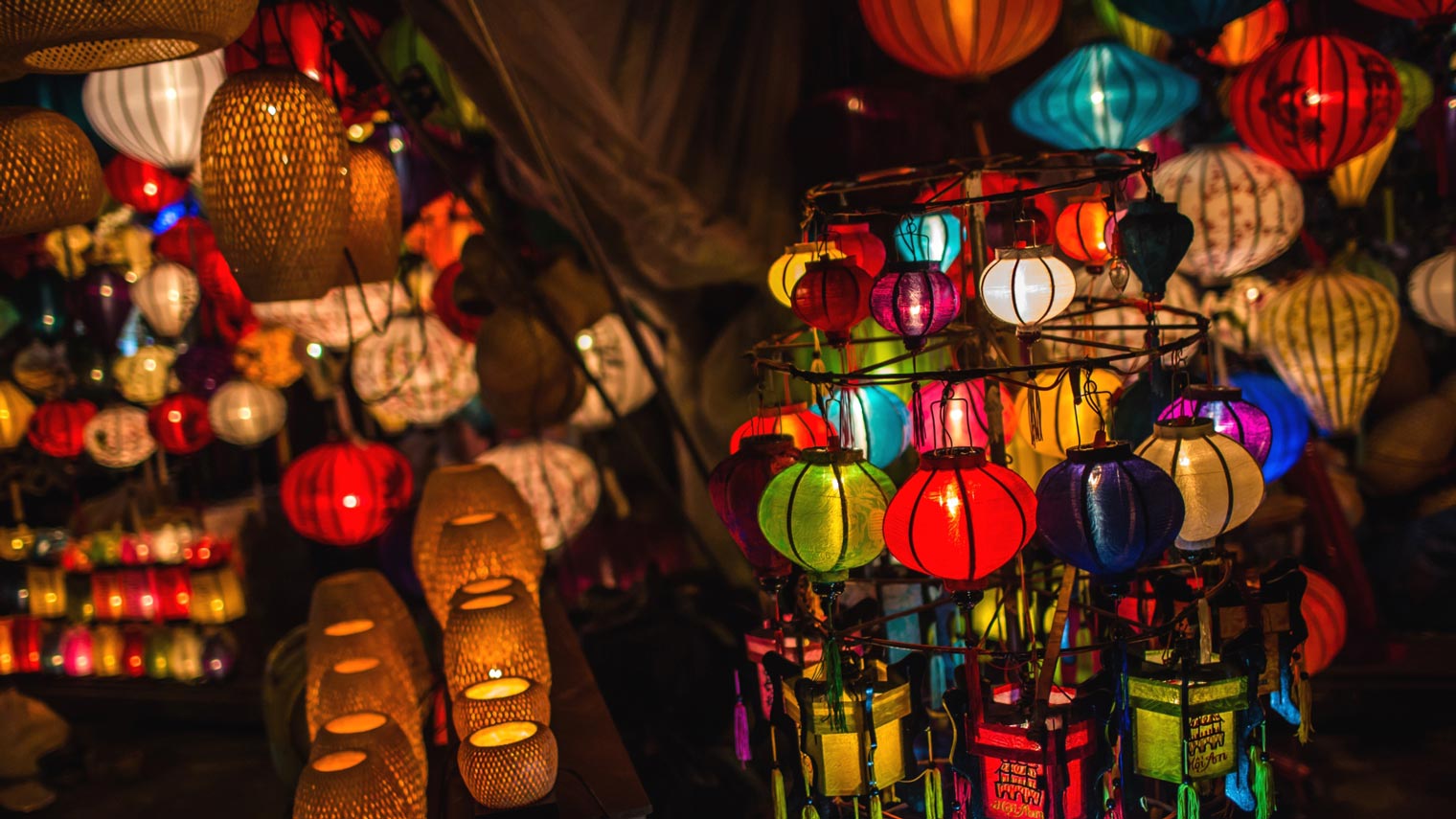
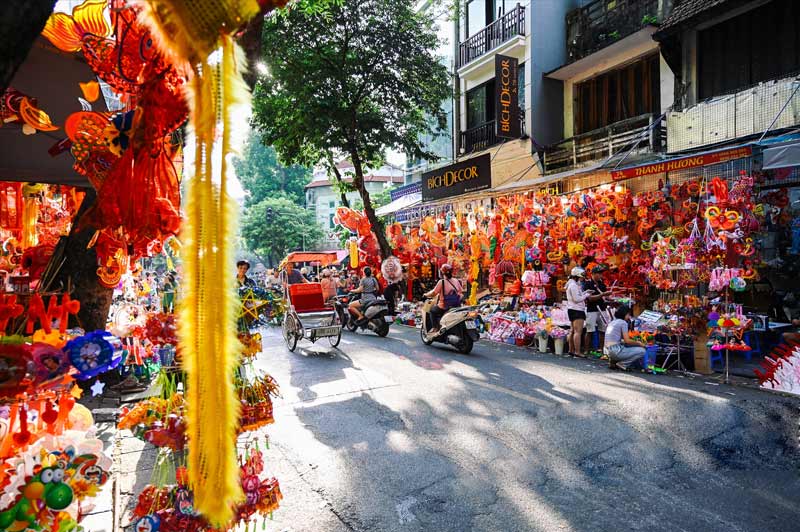
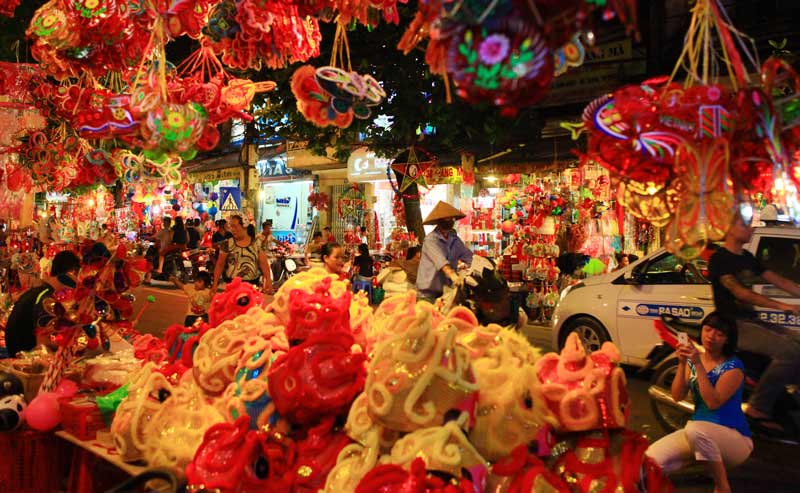
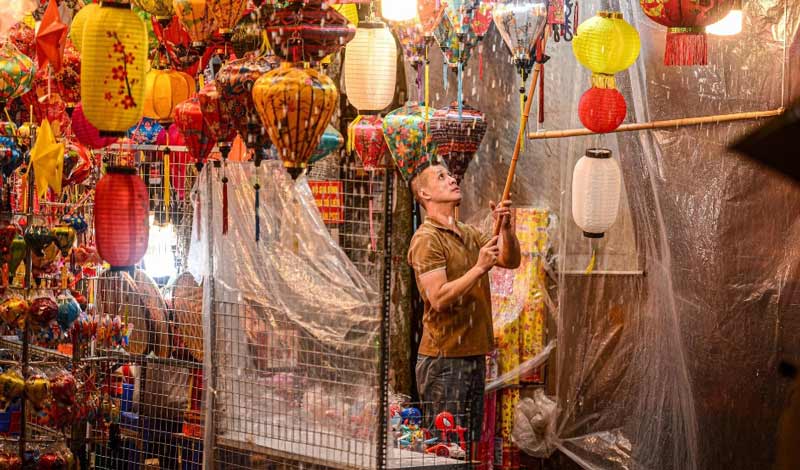
To see the festival atmosphere, plan to be in Vietnam during the one to two weeks before the full moon. During this season, streets and shops are adorned with bright red and yellow decorations, lanterns, and joyful markets. The atmosphere is exciting, with lion dances, cultural performances, and an abundance of mooncakes to savor.
Decorations sold for the Mid-Autumn Festival
2. The history of the moon festival in Vietnam
With a civilization built on rice farming for thousands of years, the Vietnamese hold various festivals following the lunar calendar to celebrate harvest prosperity.
Tet Trung Thu, family reunion festival
The largest Vietnamese festival, Tet or the Lunar New Year, is tied to the start of the farming year, when fields were prepared for the new rice season.
A good harvest allowed farmers to avoid food shortages and have a stable financial situation. To celebrate rice and its nourishing and commercial virtues, the Vietnamese created the Harvest Festival, Tet Trung Thu.
You might wonder, what is the connection between the autumn full moon and rice harvests? Unlike the sun, the moon changes its face throughout the month and can even change shape from day to day. In Vietnamese tradition, the full moon is a symbol of unity and togetherness, which is why the festival is so closely linked to family reunion.
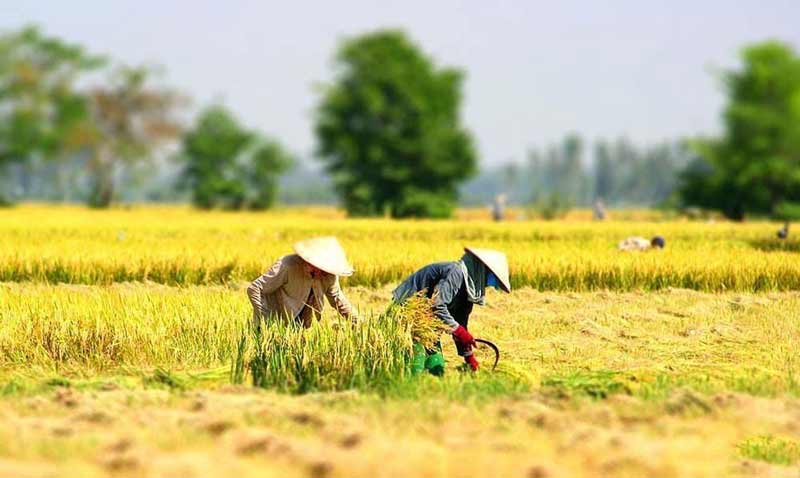
The beautiful rice paddy field in Vietnam in harvest season
The bright full moon in mid-autumn, traditionally considered the brightest of the year, has even more significance as it represents the concept of completeness. Thus, the Mid-Autumn Festival is a perfect occasion to gather family members and celebrate a good agricultural harvest.
Good to know 🌕✨
The Mid-Autumn Festival is also called the Reunion Festival (family gathering), Children’s Festival (joyful celebrations), Moon Watching Festival (admiring the full moon), and Lantern Festival (floating lanterns with wishes).
Cuội, a woodcutter, discovered a magical tree that could revive the dead and used it to save many lives, later marrying a woman he brought back to life. In one popular version, after she was killed, his loyal dog gave up its own entrails to bring her back to life, but she became forgetful. One day, forgetting his warning to water the tree only with clean water, she used dirty water on it, causing it to fly into the sky, carrying Cuội to the moon where he has lived ever since.
3. Tet Trung Thu, the Children’s Festival in Vietnam
Observing the Mid-Autumn Festival in other Asian countries, the traditions and rituals seem quite similar. However, notable differences exist in Vietnam as Tet Trung Thu is both a reunion event and a festival dedicated to children.
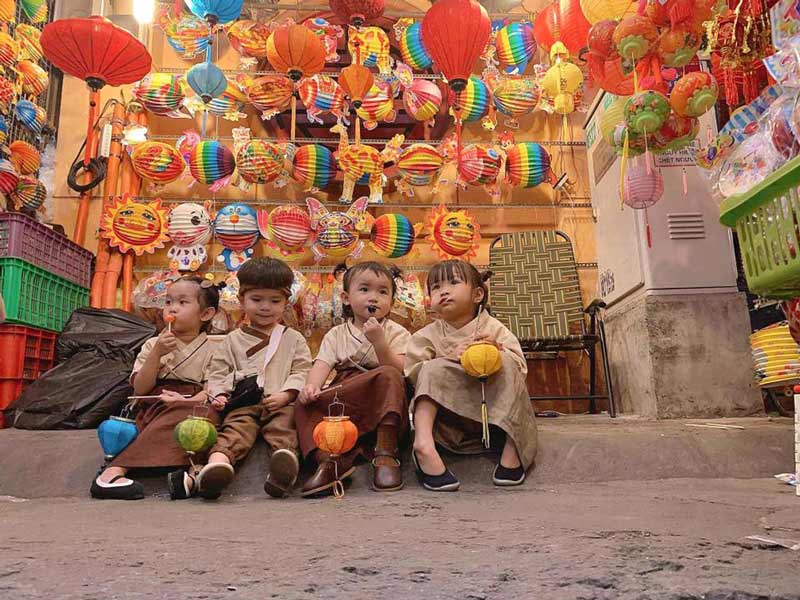
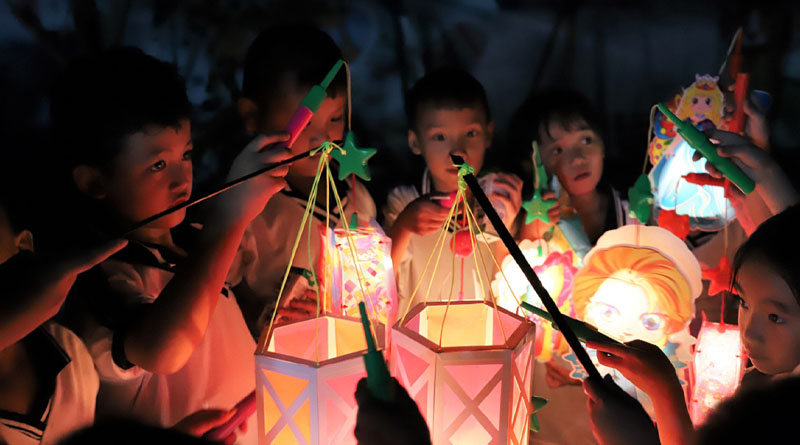
Tet Trung Thu, children's day in Vietnam
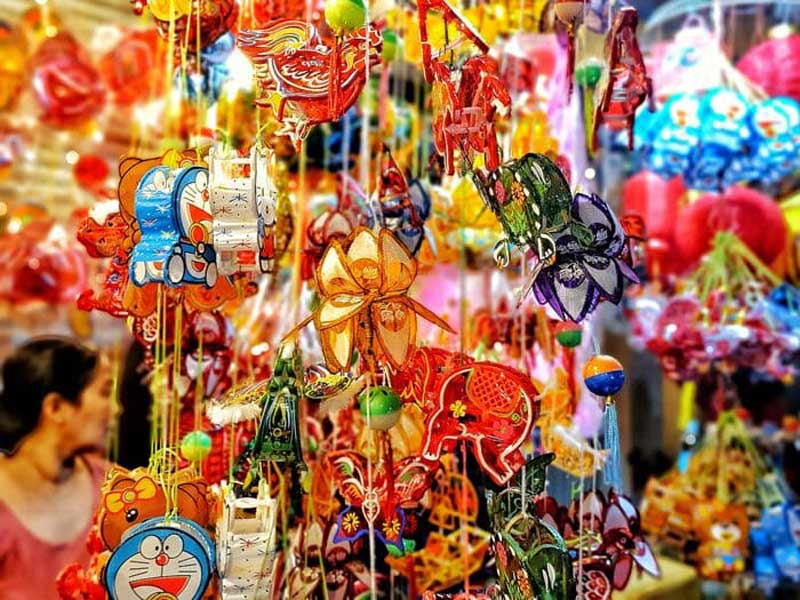
Indeed, this day can remind us of Children’s Day because kids receive lovely gifts or new clothes from their parents. In the evening, under a shining moon, children parade through the streets singing and carrying colorful lanterns of various sizes and shapes, such as star, butterfly, or fish-shaped lanterns. The five-pointed star lantern (đèn ông sao), usually red, is the best-known symbol of the festival.
Colorful lanterns of different sizes and shapes
Good to know: The Mid-Autumn Festival usually falls in September, sometimes early October, a pleasant time to visit much of northern Vietnam.
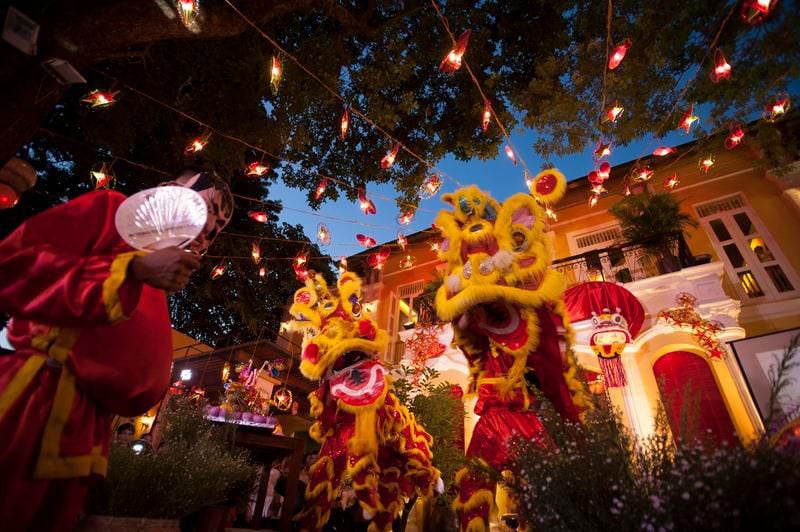
The traditional lion dance (múa lân) is a Mid-Autumn highlight. Acrobatic dancers bring the lion to life with drumbeats, its big head and bulging eyes looking both playful and a little scary under the full moon. In the parade, a masked dancer as Ông Địa (the Earth God) entertains the crowd, especially children. >>> Read More: Vietnamese Lion Dance
Lion Dance in Vietnam
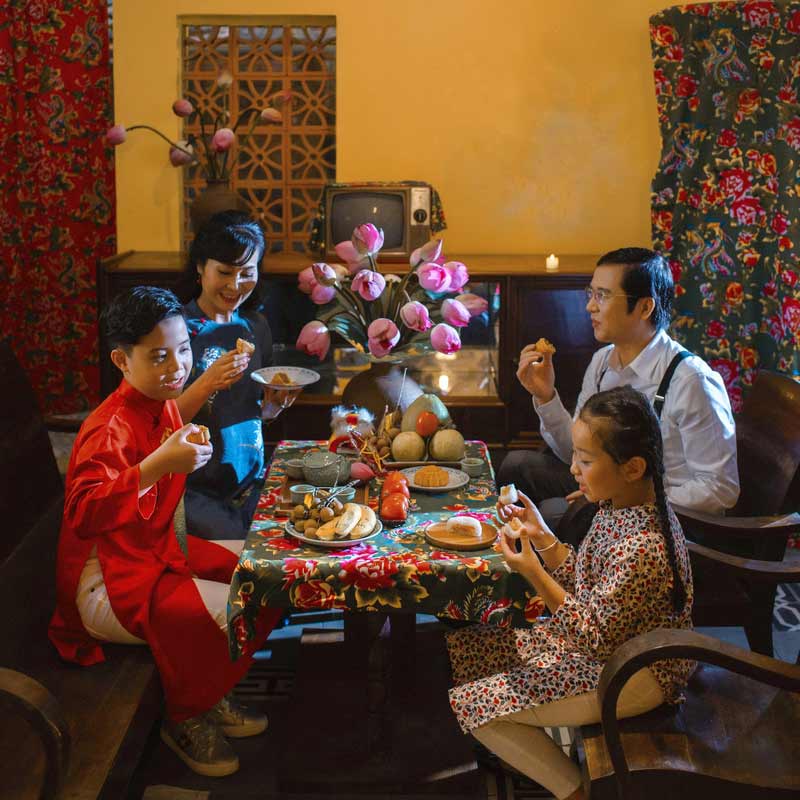
Afterward, families share a festive banquet of fruits, sweets, and, of course, mooncakes: the stars of the Mid-Autumn Festival.
4. The Moon Cake Festival
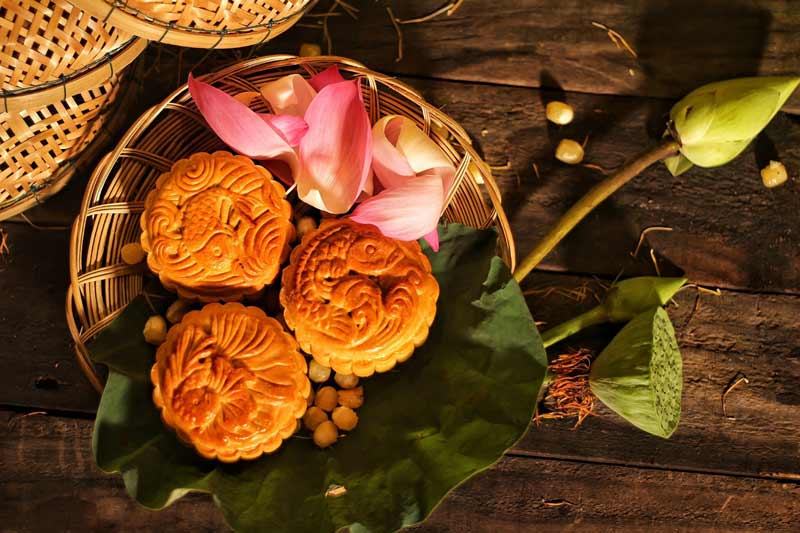
Moon cakes, known as “Bánh Trung Thu” in Vietnamese, are directly associated with the Mid-Autumn Festival in Vietnam. Across the country, families celebrate Tet Trung Thu by placing fruit and moon cakes on the ancestral altar to express their gratitude.
Mooncakes sold in Vietnam before the festival
The two most popular moon cakes are Bánh Dẻo (soft, sticky cakes with a glutinous rice crust) and Bánh Nướng (baked cakes with a golden crust). Shaped into rounds or squares, they feature intricate designs like flowers, carp, or geometric patterns. The fillings of Bánh Trung Thu come in a variety of sweet and savory options.
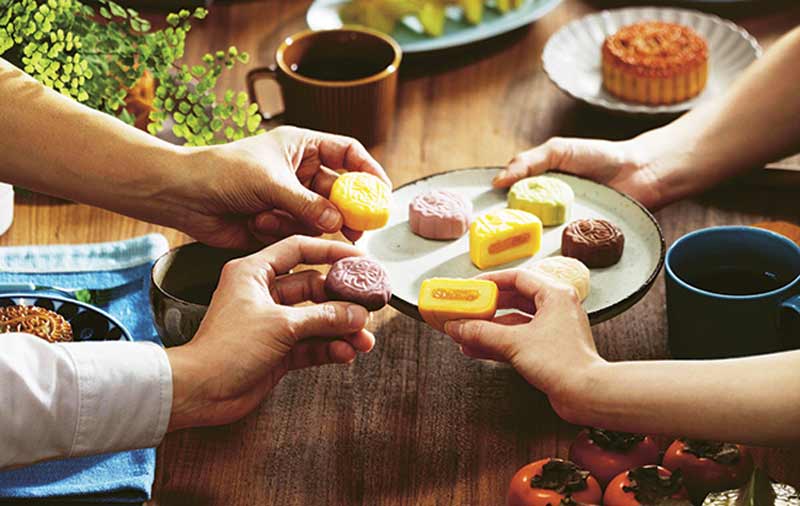
The savory moon cake recipe is more complex than the sweet one, consisting of a dozen ingredients such as pork fat, sausages, jams, and various types of seeds and nuts. The sweet filling, on the other hand, is typically based on a single main ingredient, such as mung bean paste or lotus seed paste. The moon cake is usually cut into small pieces and shared among family members. This sweet cake is traditionally accompanied by a hot cup of green tea.
Mooncakes are traditionally served with a hot cup of green tea
During the Mid-Autumn Festival in Vietnam, moon cakes are generally given as gifts to family and friends. However, the Vietnamese also exchange moon cakes between clients and colleagues to demonstrate loyalty, sincerity, and commitment.
5. Where to Visit in Vietnam During Tet Trung Thu?
Hoi An Ancient Town
Hoi An, now administratively part of Da Nang city, is already known as the city of lanterns, with silk lanterns hanging along the streets of the Old Town all year round. At Mid-Autumn, lantern stalls, lion dances and children's parades add to the scene.
Mid Autumn Festival in Hoi An
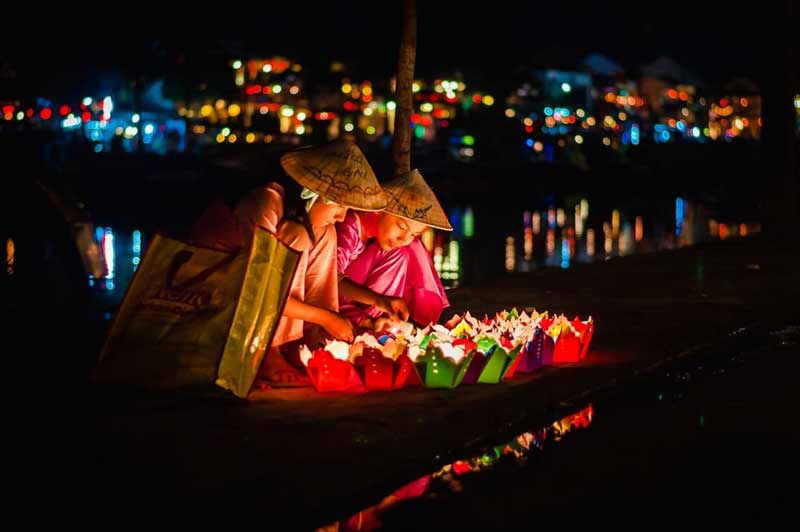
Hoi An also holds a lantern night in the Old Town on the 14th day of every lunar month, the eve of the full moon, when electric lights are dimmed, houses and shops are lit by lanterns and visitors release floating paper lamps on the Hoai River. Floating lanterns are also sold every evening along the river, but the atmosphere is at its most magical on full-moon nights.
Around the Mid-Autumn full moon, the riverside streets are especially busy, and many visitors release floating lanterns on the water. Also, discover the craftsmanship of Vietnamese lantern-making and its secrets during your visit to Hoi An.
Hanoi Old Quarter
As the millennial capital of Vietnam, Hanoi is one of the best places to see the traditions of the Mid-Autumn Festival in Vietnam.
Hanoi's Old Quarter during the Mid-Autumn Festival
During this period, you can experience the joyful ambiance of this festival in the Old Quarter, particularly on Hang Ma Street. This bustling street, renowned for selling all kinds of traditional decorations, lights up with numerous lanterns in various shapes.
Chinatown (Cho Lon), Ho Chi Minh City
Like Hang Ma Street in Hanoi, Luong Nhu Hoc Street, known as the lantern street, in the Chinatown (Cho Lon) of Ho Chi Minh City is one of the busiest places during the Trung Thu Festival.
Lantern stalls in Cho Lon, Ho Chi Minh City, during the Trung Thu Festival
For more than 50 years, the street has been the city’s best-known place to buy lanterns. Today the lantern shops are mostly concentrated in a short alley off Luong Nhu Hoc Street, but in the evenings before the full moon the whole area is packed with families and young people, creating a very lively and colorful atmosphere.
With streets adorned with colorful lanterns, the vibrant lion dances are also an interesting aspect of the festival.
The Northern mountainous regions
In years when the festival falls in September, it coincides with the rice harvest in the northern mountains. Terraced fields turn golden, the air is filled with the smell of ripe rice, and villages celebrate under the full moon.
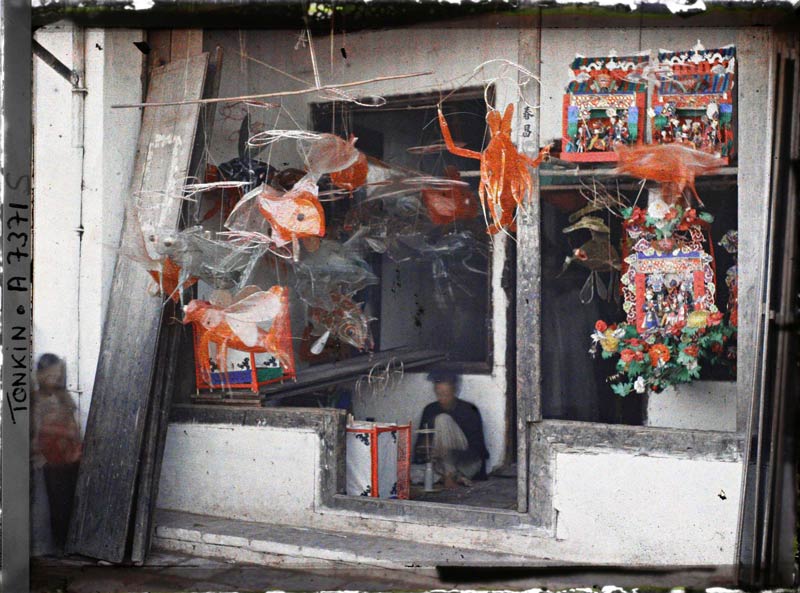
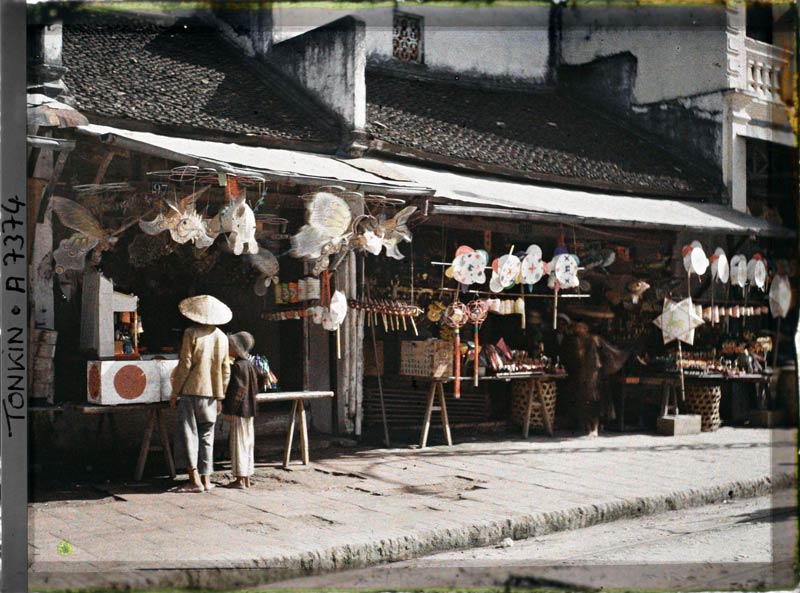
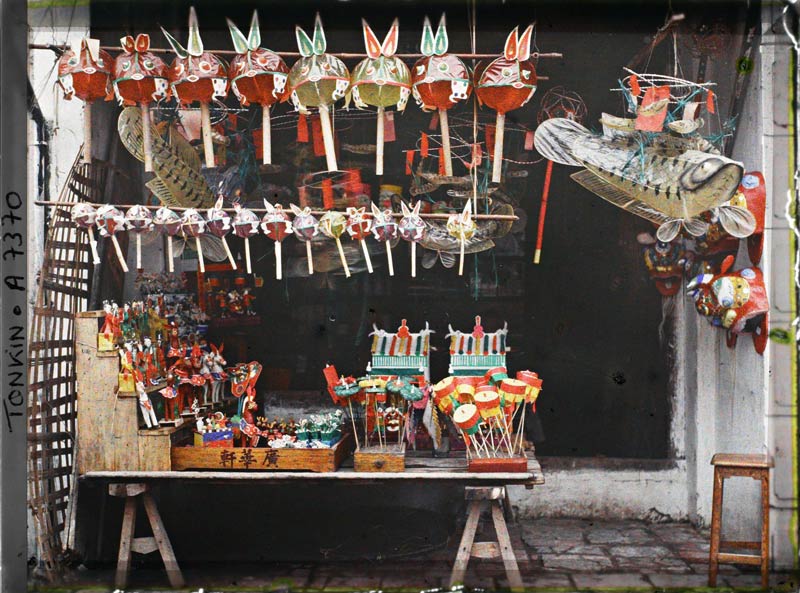
Color photographs of Mid-Autumn toys on sale on Hang Gai Street in Hanoi, taken around 1915 by the French photographer Léon Busy, show what the festival looked like more than a century ago.
Mid-Autumn toys on Hang Gai Street, Hanoi in 1915
The Mid-Autumn toys, entirely handmade by Vietnamese ancestors, were intricate and aesthetically pleasing.
Besides the series on Mid-Autumn toys, Léon Busy also captured scenes of Hang Chen, Hang Thiec, Long Bien Bridge, Tran Vu Pagoda gate, the Temple of Literature, and Ngoc Son Temple. These autochromes are among the earliest color photographs of Hanoi.
The Mid-Autumn toys, entirely handmade by Vietnamese ancestors, were intricate and aesthetically pleasing.
Today, around 1,360 photographs and films taken by Léon Busy in Indochina are preserved at the Albert-Kahn Museum in Boulogne-Billancourt, near Paris, which made the collection available online in 2022.
Albert Kahn, a French banker passionate about color photography for its vivid representation of life, funded equipment and hired photographers to capture color images from around the world for his project “Archives of the Planet”. Léon Busy photographed Indochina for this project between 1914 and 1921, documenting daily life in Northern Vietnam and giving us the chance to see ancient Vietnam.
Léon Busy's photographs of Vietnam are preserved at the Albert-Kahn Museum in France
Closing Remarks
For unique experiences rich in Asian culture, visit Vietnam during this period to see children carrying lanterns, taste delicious moon cakes, and buy lanterns or beautiful traditional decorations. It is a particularly good time to travel with children.
If you want to introduce this famous festival to your children, check out our best family trips for ideas, and feel free to contact us if you have any questions!
>>> See more about things to do in Vietnam by month:
My mom, my aunt, and I will be visiting Vietnam in March 2026 for 10 days. After doing tons of research, my head is spinning. I initially tried to plan for all three regions of Vietnam, but it quickly felt like too much for such a short trip.
After reading your posts, I’m leaning toward focusing on just two regions for a more relaxed and enjoyable experience. I’d like to minimize travel time within Vietnam as much as possible, especially since my mom and aunt are both over 50 and may not be up for long car or bus rides.
0Reply
K
Kampá Tour14 Aug 2025
Thank you for your question! Your itinerary looks great, but one day in Hanoi might feel a bit tight. You'll be able to see the main sights like the Old Quarter, Hoan Kiem Lake, the Temple of Literature, and the Ho Chi Minh Mausoleum, but it will be a busy day.
If you’d like a bit more time to enjoy the city, we can help you tweak the schedule:
You could take one day from Da Nang/Hoi An or shorten the Ha Long Bay cruise to one night, giving you more time in Hanoi.
In Da Nang/Hoi An, consider adding day trips like Ba Na Hills or My Son Sanctuary to fill those extra days.
For the Mekong Delta, an overnight stay in Can Tho or Ben Tre could make the experience even better.
Kampá Tour would be happy to help you organize your trip and make it as smooth as possible! Feel free to check out more details on our 10-day Vietnam itinerary here.
0Reply
A
Alys09 Sep 2024
I'm planning to do the Ha Giang loop on September 9/10. Could be dangerous with the rains? any advice?
0Reply
Kampá Tour12 Sep 2024
Thanks for the question, buddy!
With Typhoon Yagi recently passing through and the rainy season in full swing, the Ha Giang Loop could be a bit tricky around September 9-10. The rains can lead to landslides and make the roads pretty slippery, especially in the mountains.
I'd say it’s worth checking the weather and road conditions before you head out. If it looks rainy, maybe keep your plans flexible or consider postponing. But if you go for it, make sure your bike’s in great shape and maybe ride with some experienced folks or a local guide.
Planning your trip?
Save time and get expert advice for FREE!
✅ 15 years of local experience
✅ Save up to 40 hours of planning
✅ Travel stress-free from start to finish
Book your free consultation today!







 Our team
 Our team
 Our team
 Our team

.jpg)


 Other
Other Add us as a preferred source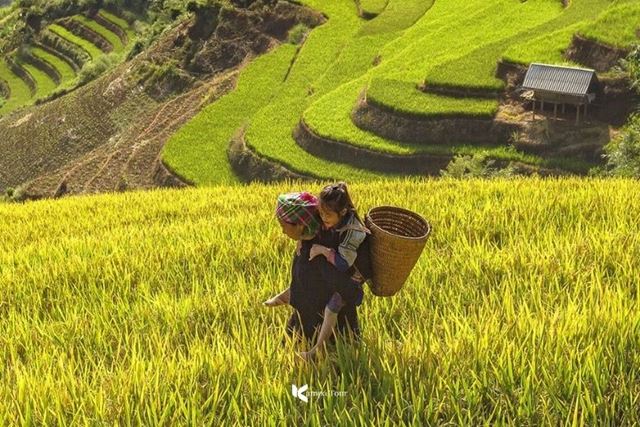







Thank you for your question! Your itinerary looks great, but one day in Hanoi might feel a bit tight. You'll be able to see the main sights like the Old Quarter, Hoan Kiem Lake, the Temple of Literature, and the Ho Chi Minh Mausoleum, but it will be a busy day.
If you’d like a bit more time to enjoy the city, we can help you tweak the schedule:
You could take one day from Da Nang/Hoi An or shorten the Ha Long Bay cruise to one night, giving you more time in Hanoi.
In Da Nang/Hoi An, consider adding day trips like Ba Na Hills or My Son Sanctuary to fill those extra days.
For the Mekong Delta, an overnight stay in Can Tho or Ben Tre could make the experience even better.
Kampá Tour would be happy to help you organize your trip and make it as smooth as possible! Feel free to check out more details on our 10-day Vietnam itinerary here.
Thanks for the question, buddy!
With Typhoon Yagi recently passing through and the rainy season in full swing, the Ha Giang Loop could be a bit tricky around September 9-10. The rains can lead to landslides and make the roads pretty slippery, especially in the mountains.
I'd say it’s worth checking the weather and road conditions before you head out. If it looks rainy, maybe keep your plans flexible or consider postponing. But if you go for it, make sure your bike’s in great shape and maybe ride with some experienced folks or a local guide.
Stay safe and have a blast!