Vietnam in November: Weather by Region and Where to Go?
Vietnam in November rewards travelers who plan by region. Is it a good time to go? For most of the country, yes. The north is dry and comfortable, the south is moving into its dry season, and the highlands are cool and calm. The one region that needs care is the central coast, which is in the wettest weeks of its year.
As a Kampá travel consultant, I will walk you through the weather in each region, where to go and what to keep flexible, the festivals on in November 2026, what to wear and a two-week route that works with the season.
Written by Thom DOAN (Travel Consultant Manager & Director)
Updated on Nov 02, 2026
0 comment
Thom DOAN leads the travel consulting team at Kampá Tour and serves as the agency's director. She works with travellers in both French and English, and her career has taken her across multiple countries in Asia.
On this blog she writes about the destinations she knows first-hand, mostly in Vietnam and Cambodia: what a place is actually like, who it suits, and the practical details that decide whether a trip works. If you have a question about anything she covers here, leave it in the comments and she will answer you directly.
Yes, Vietnam in November is a good choice if you plan by region. The north is dry and comfortable, with Hanoi averaging highs of about 27°C, and the south is moving into its dry season. The exception is the central coast, from Hue to Nha Trang, which is in its wettest weeks.
If you ask me, the simplest November trip is north plus south: start in Hanoi and the northern mountains, then fly over the central coast to Ho Chi Minh City, the Mekong Delta or Phu Quoc. With only a week, I would not try to cover both ends. Pick the north for cool air and scenery, or the south for beaches and food.
🔖 Good to know:
You will read online that November is typhoon season. That is true mainly for the central coast (more on this below). If your route includes the center, keep those days flexible and check the forecast a few days before you travel.
Vietnam weather in November by region
Vietnam stretches a long way from north to south, and in November the three regions feel like three different countries: late autumn in the north, the peak of the rainy season on the central coast, and the end of the rainy season in the south.
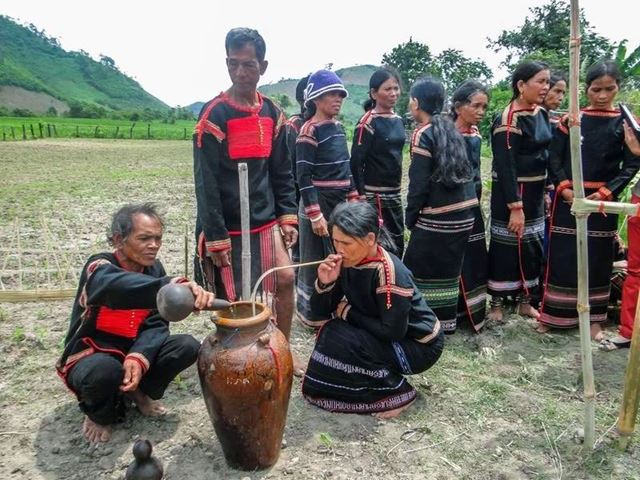
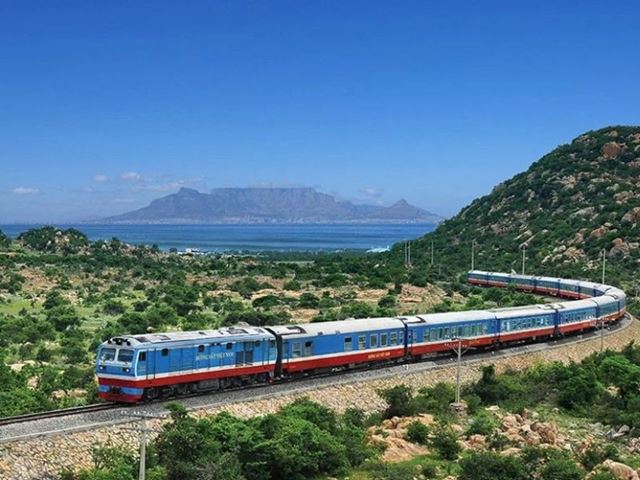
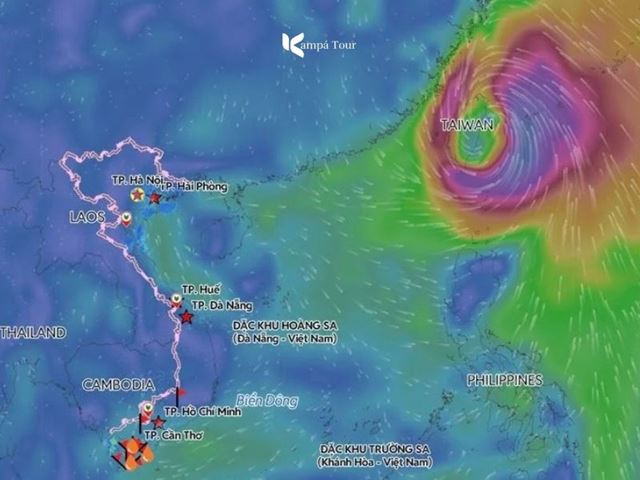
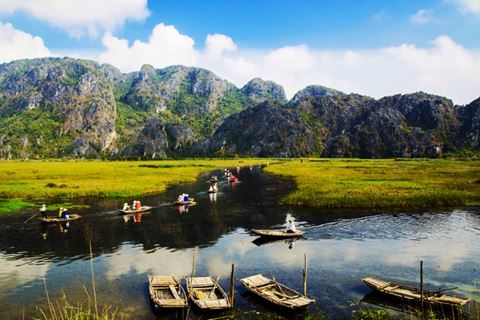
Vietnam is divided into three distinct regions: the North, the Center, and the South.
Sources: climate normals from the Vietnam Institute for Building Science and Technology and the World Meteorological Organization (Hanoi: Láng station, 1991 to 2020), as published on Wikipedia. Figures are rounded.
Northern Vietnam
In the north, November is late autumn. Hanoi averages about 27°C by day and only about 61 mm of rain over eight rainy days, against 155 mm in October, so it is one of the most comfortable months for walking the city. Halong Bay and Ninh Binh share the dry spell. The mountains are a different story. In Sapa town, at about 1,500 m, typical November figures are roughly 16°C by day and 9 to 11°C at night, according to tourism weather sites, and the Ha Giang plateau is also much colder than Hanoi after dark. For a month-by-month view of the region, see our guide to the best time to visit North Vietnam.
Central Vietnam
This is the region to plan carefully. On average, Hue receives about 642 mm of rain in November over 21 rainy days, and Da Nang about 448 mm. Hue only becomes clearly drier from February, when its average falls to about 63 mm. Further south, November is the wettest month of the year in Nha Trang. Inland, the highlands around Da Lat are much drier, with about 94 mm in November.
Last year was an exceptional one. From mid-October to early December 2025, central Vietnam went through two long waves of flooding. In late October, the Bach Ma station near Hue recorded 1,739.6 mm of rain in 24 hours, reported as a national record, Typhoon Kalmaegi reached the central coast in early November, and from 15 November the flooding moved south to Dak Lak and Khanh Hoa. At least 219 people were killed or missing in the whole episode. The outlook for this year is calmer. On 1 November 2026, Vietnam’s National Center for Hydro-Meteorological Forecasting said that storms and tropical depressions are expected to be fewer than average this November and that rainfall on most of the central coast should be below the usual level, although local heavy rain, flash floods and landslides are still possible. I will update this page if the outlook changes. For the wet months in general, see our guide to the Vietnam rain season and our overview of Central Vietnam, and for real-time advice on your dates, contact the Kampá Tour team.
If Hue or Hoi An is a must for you, I would book it as a short stop with a free day on either side, rather than as the centerpiece of the trip. That way, a rainy spell costs you a change of plan, not the whole visit.
Southern Vietnam
The south is leaving its rainy season behind. Ho Chi Minh City averages about 128 mm of rain in November, compared with about 340 mm in October and 41 mm in December, so showers become shorter and less frequent as the month goes on. Phu Quoc follows the same pattern, with about 164 mm in November and its driest months from December to April. It is also a good month for boat trips in the Mekong Delta. For more on the region, read our guide to Southern Vietnam.
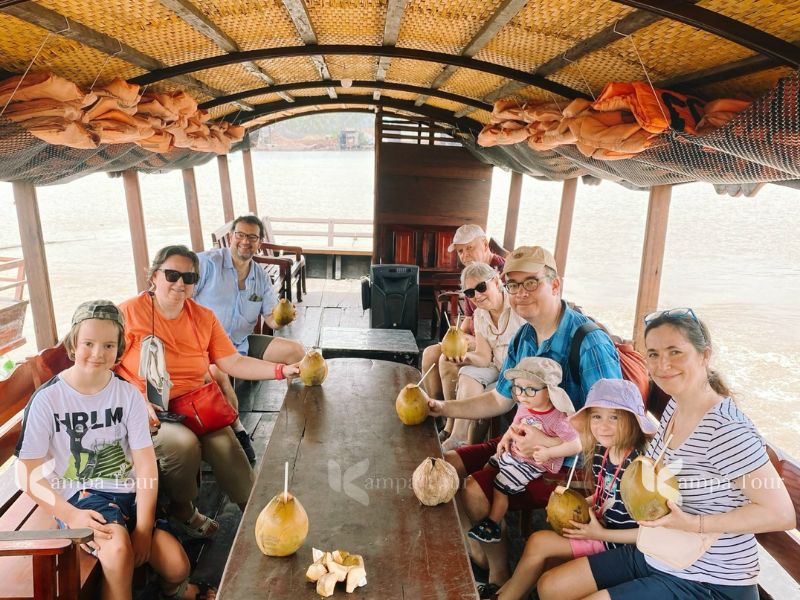
Kampa Tour travelers on a tour of the Mekong Delta in November
The best places to visit in Vietnam in November are in the north and the south: Hanoi, Halong Bay, Ninh Binh and the northern mountains for cool, dry weather, then Da Lat, the Mekong Delta and Phu Quoc further south. Here is what each place offers at this time of year.
Hanoi: the thousand-year-old capital
Hanoi is the capital of Vietnam and the natural starting point for trips to the north. November is a good time to discover the city: the summer heat is gone, the trees along the boulevards turn yellow, and street vendors sell bunches of white daisies (cúc họa mi), a seasonal flower of late autumn in Hanoi.
Take your time for walks around Hoan Kiem Lake and the Old Quarter, and stop for an egg coffee. If Hanoi Train Street is on your list, check the current access rules in our guide before you go.
The poetic charm of autumn in Hanoi
The gardens of the Temple of Literature are pleasant in the softer November light, and the Vietnam Museum of Ethnology is a good choice for an afternoon indoors, with collections on the many ethnic groups of the country. Cooler evenings also suit a bowl of Vietnamese pho or bun cha, grilled pork with rice noodles, before a water puppet show and a last walk around the lake.
Trains pass through narrow streets on "Train Street" in Hanoi
Halong Bay and Lan Ha Bay
November is one of the better months for a cruise in the north. The summer storm season is over, rain is light, and the karst scenery of Halong Bay, one of the New7Wonders of Nature and a UNESCO World Heritage Site, can be seen from the deck on clear days. It is a good month for kayaking and short walks on the islands. Cruises can still be suspended when strong winds or a storm are forecast, so check your operator’s weather policy when you book.
Lan Ha Bay, right next door, has the same kind of scenery with fewer boats, and works just as well for an overnight cruise.
Often called “Halong Bay on land”, Ninh Binh lies about two hours by road south of Hanoi. Since the 2025 provincial merger, the province also includes the former Nam Dinh and Ha Nam. Its limestone peaks stay green all year, and in November the dry, mild weather is good for cycling between the villages and the boat docks.
The highlight is a boat ride along rivers lined with limestone cliffs and rice paddies, in Tam Coc, Trang An or along the Thung Nang River. If you have already cruised Halong Bay, the river trip still feels different: quieter, and much closer to the cliffs and the paddies.
Boat ride on the Thung Nang River, the land-based Halong Bay
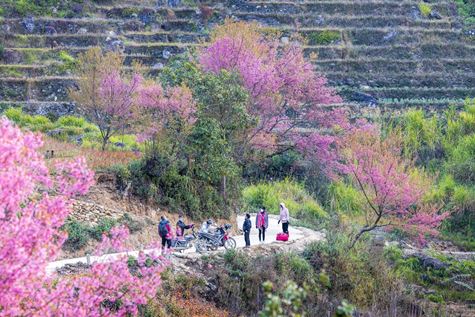
If you have more time, the far north is at its best in November: dry weather, clear views and the buckwheat flowers in bloom on the Dong Van karst plateau. The region still goes by the name Ha Giang for travelers, although it has been part of Tuyen Quang province since the 2025 merger. It is known for the motorbike loop in Ha Giang, for the many ethnic minority communities who live there and for the terraced valleys of Hoang Su Phi.
Nights on the plateau are cold in November, even when Hanoi still feels warm. I would pack a proper warm layer and gloves if you plan to ride or start early in the morning.
There are many hiking options in the area, from half-day walks to treks of several days. Whatever the length, you will walk past terraced rice fields, bamboo and palm forests and old tea trees tended by the local communities, and meet the ethnic groups who live in these valleys.
The landscape of Hoang Su Phi
Da Lat
Da Lat, in the Central Highlands, is the easiest way to add cool air to a trip in the southern half of the country. Its average November high is about 22°C with lows of about 15°C, and it gets around 94 mm of rain, a fraction of what falls on the coast. Da Lat is my pick if you want a break from the heat of Ho Chi Minh City without flying north: think pine hills, lakes, coffee farms and a quieter pace.
Mekong Delta
The Mekong rises on the Tibetan Plateau and flows through China, Myanmar, Laos, Thailand and Cambodia before it reaches Vietnam, where it splits into many branches and empties into the sea. In the far south of the country, it has built up a vast, fertile delta of rivers, canals, orchards and rice fields.
In November, as the rains ease, the delta is a good addition to a trip that ends in Ho Chi Minh City or Phu Quoc. It brings a very different landscape from the mountains of the north.
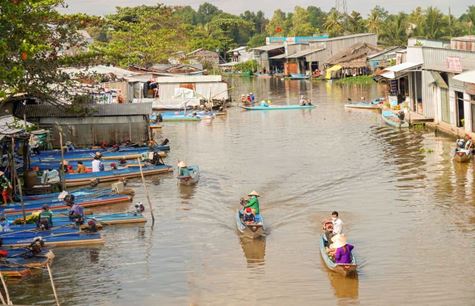
Unlike the mountainous regions of the North, the Mekong Delta in the South is a blend of waterways and lush greenery
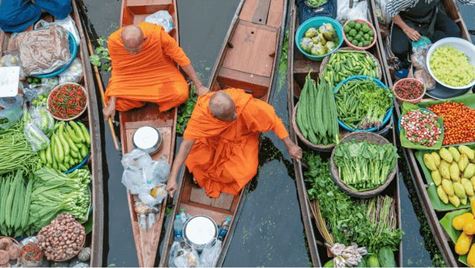
Take a boat through the narrow, palm-lined canals, or join a cycling tour to see daily life in the villages. Ben Tre, known for its coconut groves and now part of Vinh Long province, is one of the easiest areas to reach from Ho Chi Minh City. Another highlight is a floating market: early in the morning, boats gather to trade fruit, vegetables and all kinds of goods.
Phu Quoc Island, known in Vietnamese as Đảo Ngọc (often translated as Pearl Island), lies in the Gulf of Thailand and is the largest island in Vietnam. Since 2025, it has been a special administrative zone of An Giang province. Phu Quoc National Park is part of the Kien Giang Biosphere Reserve, recognized in 2006.
Beyond its beaches, the island is known for pearls, pepper and fish sauce (nuoc mam), and some farms and workshops can be visited.
A quiet beach on Phu Quoc
In November, the weather on Phu Quoc improves week by week. It still averages about 164 mm of rain over 14 rainy days, against about 59 mm in December, so late November is a safer bet than early November for a beach stay or a snorkeling trip around the An Thoi islands.
The 12th Buckwheat Flower Festival opened on 25 October 2026 at Thanh Nien Square in Dong Van, and its cultural, sports, food and tourism activities run until the end of December. About 400 hectares of buckwheat were sown in several rounds, so the pink and white flowers can be seen from October to December 2026 at spots such as Lung Cu, the Nho Que River and the Tham Ma slope.
Ok Om Bok Festival in the Mekong Delta
The Khmer community of southern Vietnam celebrates Ok Om Bok (also written Ooc Om Bok) on the full moon of the tenth lunar month, to thank the Moon for the harvest. The best-known event is the Ngo boat race in Can Tho, in the former Soc Trang province. In 2026, the race opens at noon on 23 November and the finals take place on 24 November, on the Maspero River in Soc Trang ward.
Hoi An Lantern Festival
The monthly lantern night in the old town of Hoi An falls on 22 November 2026. After dark, the streets are lit with colorful lanterns and small candles float on the Hoai River, and the best way to see it is on foot or from a boat. In a wet November, heavy rain or high water on the river can disrupt the evening, so check the situation in Hoi An a day or two before you go.
What to wear in Vietnam in November
Pack for three climates. The north needs layers, the south needs light clothes and sun protection, and the central coast needs proper rain gear.
North: light clothes for the day in Hanoi, Halong Bay, Ninh Binh and Pu Luong, plus a light jacket or sweater for the evenings. For Sapa, Ha Giang and Mu Cang Chai, where Sapa nights typically fall to 9 to 11°C, bring a warm coat, a hat, gloves and good walking shoes for the trails.
Central coast: a waterproof jacket, quick-drying clothes and sandals or shoes that can get wet. An umbrella alone is not enough for the heavy downpours.
South: light, breathable clothing, sunscreen, a hat and sunglasses. With highs of about 32°C in Ho Chi Minh City, a light rain jacket for the remaining showers is all you need.
Temples and pagodas: keep shoulders and knees covered, so a light scarf or long trousers are useful in every region.
Crowds, prices and when to book in Vietnam in November
Vietnam gets busier in November, because the month marks the start of the winter high season. International visitors arrive in larger numbers, and the pressure is highest where the weather is best: Halong Bay, Hanoi, Ho Chi Minh City and the southern beaches such as Phu Quoc.
Prices follow the same pattern. Airfares to Vietnam are still reasonable in November, but airfares and hotel rates rise sharply in December, so November is the better month if budget matters. Phu Quoc is where hotel rates usually start to climb, as the dry season begins.
If you ask me, book hotels in Hanoi, Ho Chi Minh City and Phu Quoc, and any Halong Bay cruise, as soon as your dates are fixed. For Phu Quoc and Ho Chi Minh City I would treat three weeks ahead as the minimum.
The central coast is the quiet exception. Fewer travelers go there because of the rain, so rooms in Hue, Da Nang and Hoi An are easier to find.
A 2-week Vietnam itinerary for November
Here is an example of a two-week route from north to south. The north and the south offer the most reliable weather in November, while the central stop can be rainy.
Vietnam travel itinerary for November, 2 weeks
Days 1 to 2: Arrival in Hanoi, exploring the capital.
Day 3: Ninh Binh, “Halong Bay on land”.
Days 4 to 5: Overnight cruise in Halong Bay or Lan Ha Bay.
Day 6: Fly to Hue, the former imperial capital.
Day 7: Drive from Hue to Hoi An over the coastal mountains.
Day 8: Hoi An, the lantern-lit old town.
Day 9: Fly to Ho Chi Minh City.
Days 10 to 11: Mekong Delta, with boat trips, gardens and a floating market.
Days 12 to 13: Beach time on Phu Quoc Island.
Day 14: Departure from Phu Quoc.
If the forecast for the central coast looks bad a few days before you leave, swap days 6 to 8 for Da Lat or for extra nights in Phu Quoc. For families, or for a mother and daughter trip, I would keep it to three or four bases rather than chasing every region: Vietnam is long, and a slower pace makes the trip easier for everyone.
Adding Cambodia to a November trip
Many travelers who end their trip in the south add a few days in Cambodia. From the Mekong Delta, you can continue up the river to Phnom Penh, the Cambodian capital, and then to Siem Reap for the temples of Angkor, a UNESCO World Heritage Site.
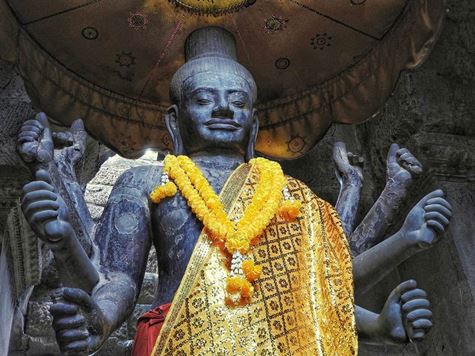
Angkor Thom, part of the Angkor complex near Siem Reap
November is one of the most rewarding months to travel in Vietnam, as long as you let the weather shape the route: the north for cool, dry days in Hanoi, Halong Bay, Ninh Binh and the mountains, the south for warm weather in Ho Chi Minh City, the Mekong Delta and Phu Quoc, and only a short, flexible stop on the central coast. If you would like a route built around your dates, contact us, or choose one of our tours below.
Planning your trip?
Save time and get expert advice for FREE!
✅ 15 years of local experience
✅ Save up to 40 hours of planning
✅ Travel stress-free from start to finish
Book your free consultation today!










 Our team

 Our team

 Our team

 Our team






 Other
 Add us as a preferred source