Northern Thailand Travel Guide: Map, Cities and Best Time to Go
Some of the country's most spectacular natural beauty and abundant cultural tapestry are found in Northern Thailand. The land is steeped in the roots of the ancient Lanna Kingdom and stands out for unique traditions, architecture, and a singular cuisine that dazzles with exquisite flavors. With its majestic landscapes, captivating heritage, and delectable food, Northern Thailand offers something like no other place.
To really feel the culture in this culturally rich area, be inspired by this ultimate guide to explore through the heart of Northern Thailand.
Written by Preetika Narula (Local Expert)
Updated on Oct 12, 2026
7 comments
At 35 years old, Preetika is an enthusiastic explorer deeply connected to Thailand, Laos and Cambodia's rich heritage. As a Bangkoker, her local insights and experiences imbue authenticity into her narratives. She discovers solace within the pages of a book as much as amidst Southern Asian vibrant landscapes and bustling street markets. With an ardent passion for travel and a profound affection for literature, Preetika effortlessly integrates her personal adventures into captivating stories, providing a perspective uniquely rooted in local experience.
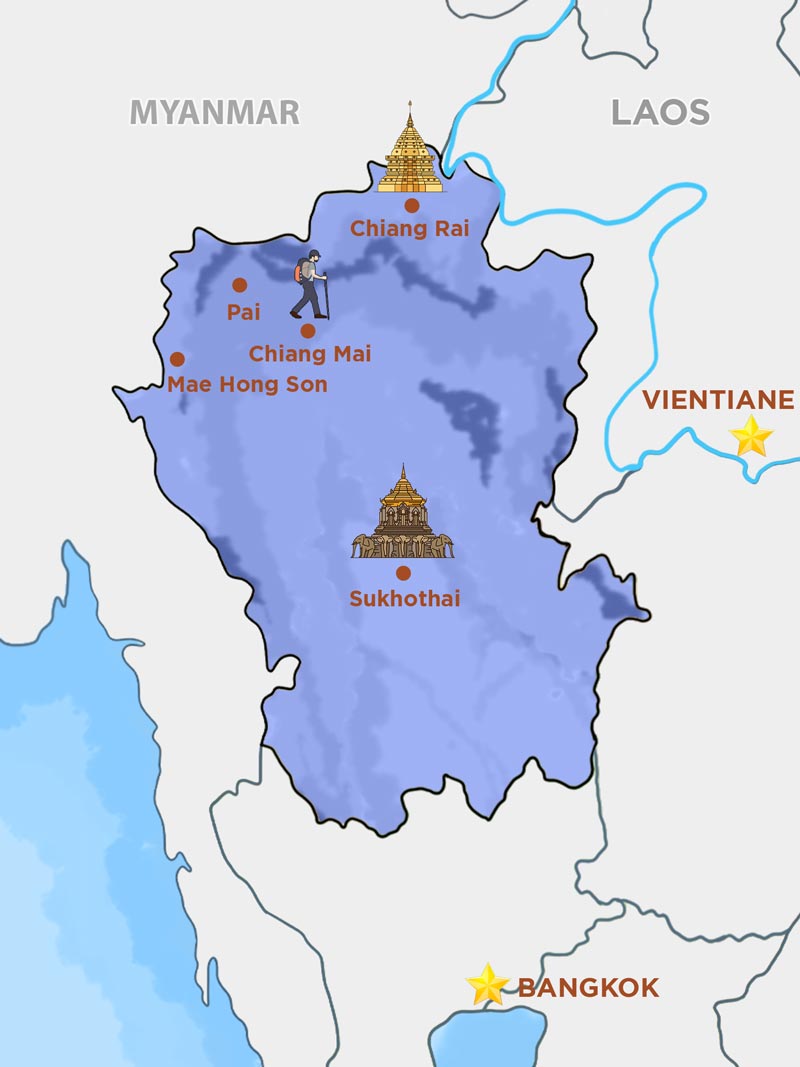
Northern Thailand is the mountainous top of the country, bordering both Myanmar and Laos, and it is usually defined as nine provinces centred on Chiang Mai and Chiang Rai, or 17 provinces when the lower north is included.
The nine-province count follows the six-region system, while the 17-province count comes from a four-region system that adds eight lower-north provinces, including Sukhothai, Phitsanulok and Tak. We treat Sukhothai as part of the north because it is a standard stopover between Bangkok and Chiang Mai.
The Map of Northern Thailand
In Chiang Rai Province, the area around Sop Ruak is associated with the historic Golden Triangle, once known for the regional opium trade and today visited for its Mekong scenery and museums exploring that history.
What Is Northern Thailand Known For?
Northern Thailand is known for its mountains and cool-season climate, the Lanna heritage of Chiang Mai and Chiang Rai, Buddhist temples old and new, dishes such as khao soi, and highland communities including the Karen, Hmong, Akha and Lisu, which is why people choose it for culture and trekking rather than beaches.
Doi Inthanon, Thailand's highest mountain, rises to 2,565 metres in Chiang Mai Province. Sukhothai, a UNESCO World Heritage site, was the capital of a kingdom that predates Ayutthaya,.
What Cities Are in Northern Thailand?
The main cities in Northern Thailand are the capitals of its nine provinces: Chiang Mai, the biggest hub, then Chiang Rai, Lampang, Lamphun, Nan, Phrae, Phayao, Uttaradit and Mae Hong Son, with Sukhothai and Phitsanulok added if you count the lower north.
City or town
Known for
Suggested stay
Chiang Mai
Old City temples, Doi Suthep, night markets, base for Doi Inthanon
3 to 4 nights
Chiang Rai
White Temple, Blue Temple, Golden Triangle area, Doi Mae Salong
1 to 2 nights
Pai (Mae Hong Son)
Hot springs, Pai Canyon, walking street
2 nights
Mae Hong Son
Mountain mist, Ban Rak Thai, Doi Mae U-Kho in the cool season
1 to 2 nights
Nan
Wat Phumin murals, Bo Kluea salt wells, Doi Phu Kha
2 to 3 nights
Lampang
Wat Phra That Lampang Luang, horse-drawn carriages
1 night
Phrae and Phayao
Phae Mueang Phi and Wat Phra That Cho Hae in Phrae; Kwan Phayao lake in Phayao
1 night each
Sukhothai (lower north)
UNESCO historical park, cycling among the ruins
1 to 2 nights
Best Places and Things to Do in Northern Thailand
Chiang Mai: The Cultural Capital
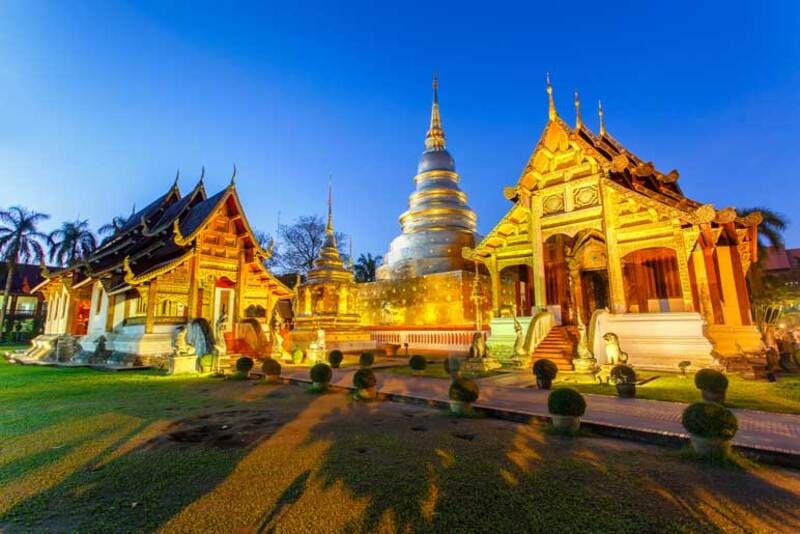
Chiang Mai is the main hub for most trips to Northern Thailand. King Mangrai founded it in 1296 as the center of the Lanna Kingdom, and the old quarter, still outlined by sections of ancient walls and moat, is filled with centuries-old temples.
Chiang Mai: The Cultural Capital
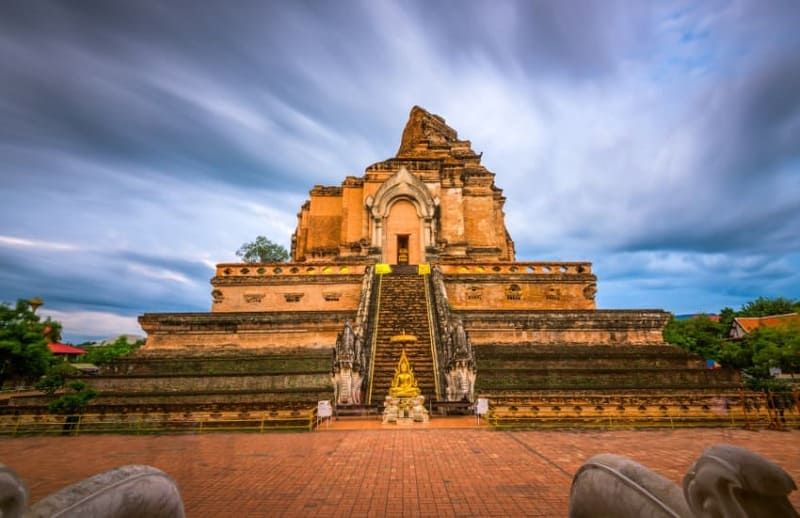
Wat Phra Singh shows refined Lanna architecture, Wat Chedi Luang is a monumental ruin that once housed the Emerald Buddha, and Wat Phra That Doi Suthep sits high on the slopes of Doi Suthep, reached by a naga-lined staircase, with an entry fee of about 30 THB for foreign visitors.
Wat Chedi Luang
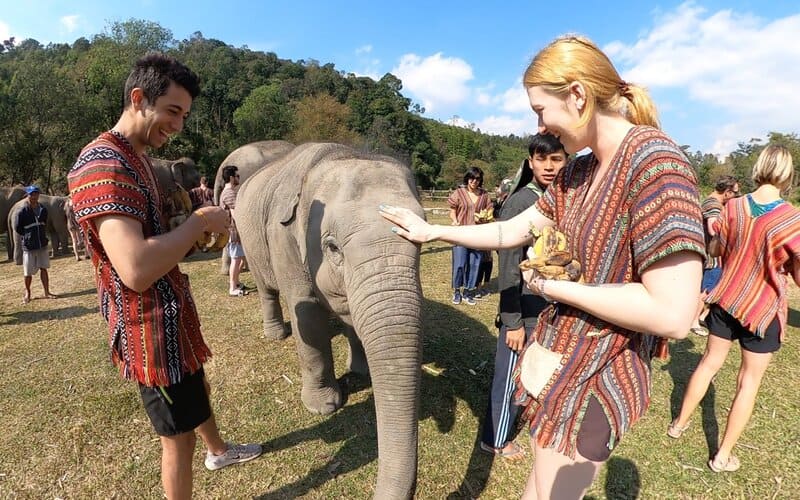
Beyond the old city, you can walk mountain trails and visit elephant sanctuaries, although standards differ: look for no riding, no shows, no chains or hooks and small groups, and ask where the elephants came from.
Elephant sanctuary, Chiang Mai
My advice is to give Chiang Mai three or four nights, then move on, and to budget for ride-hailing, songthaew taxis or a hired driver because sights outside the Old City are spread out.
Doi Inthanon National Park: Thailand's Highest Peak
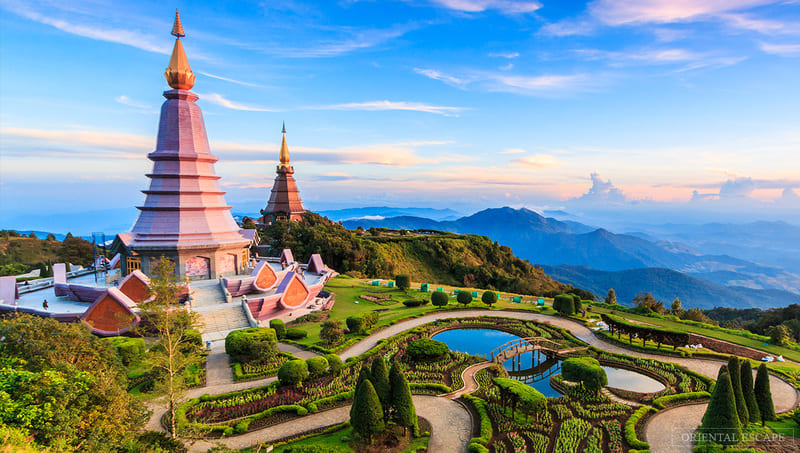
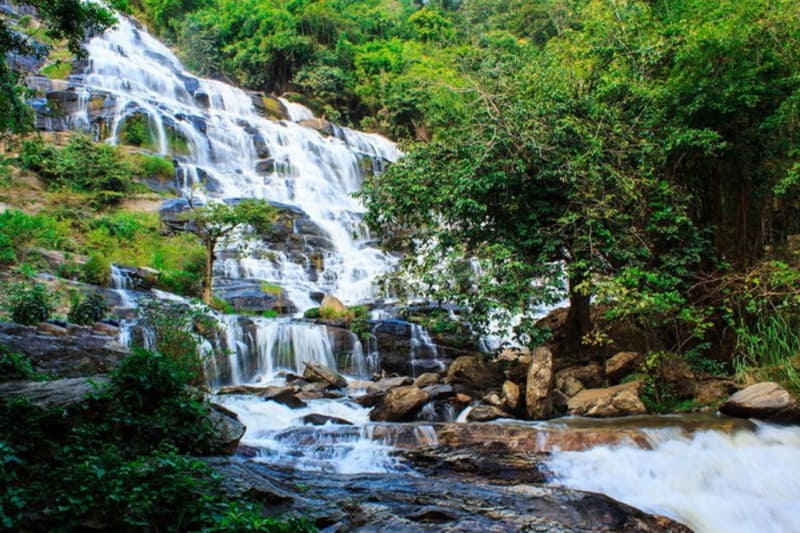
Doi Inthanon, about two hours' drive southwest of Chiang Mai in Chom Thong District, has trails through cloud forest, large waterfalls such as Wachirathan and Mae Ya, and a summit often shrouded in mist.
Doi Inthanon
The Kew Mae Pan Nature Trail follows a high ridge through cloud forest and open viewpoints. It is seasonal: in the 2025-26 season it opened from November to May with assigned local guides, so check the dates. Entry to the national park is 300 THB for foreign adults, and the trail needs a local guide for about 200 to 220 THB. Doi Inthanon deserves a full day on any Northern Thailand itinerary.
Mae Hong Son is known for mountain scenery, temples and culturally diverse communities.
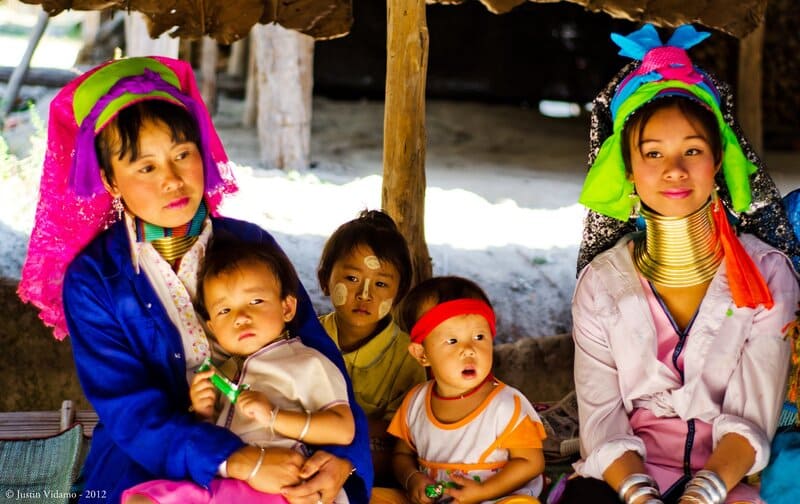
Hill tribe in Chiang Mai. Source: Justin Vidamo
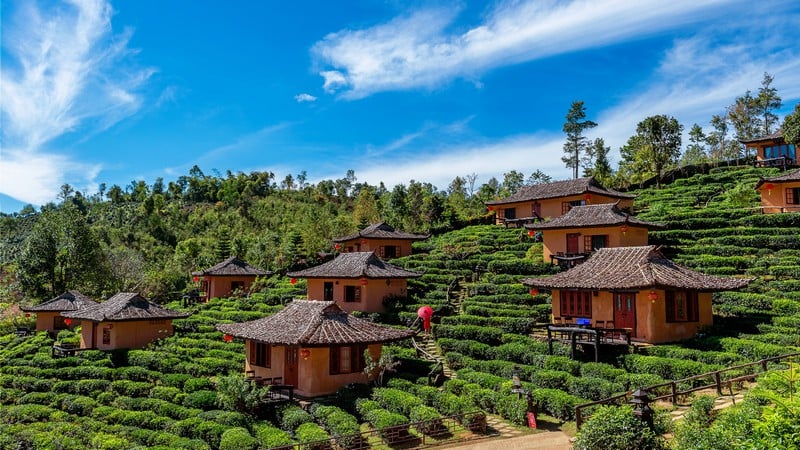
Karen, Hmong, Lisu, Shan and Yunnanese Chinese communities live in the province, and Baan Rak Thai is a Yunnanese Chinese village among tea plantations. Visit communities respectfully, ideally through community-based tourism.
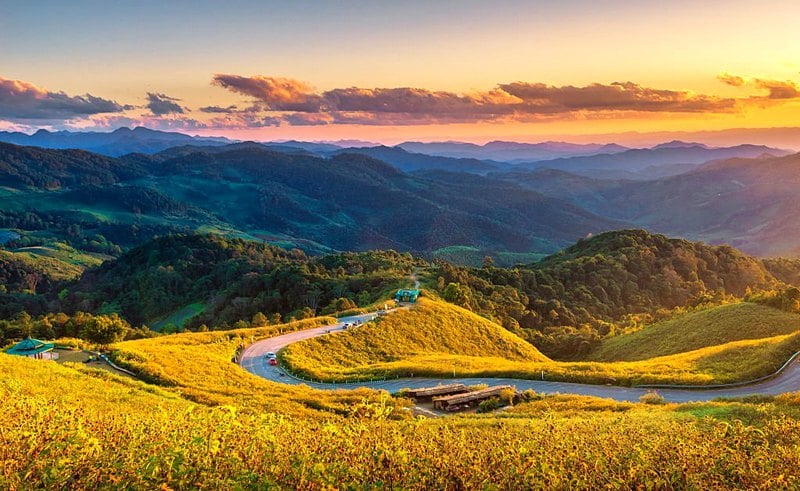
Wild sunflowers on Doi Mae U-kho in November.
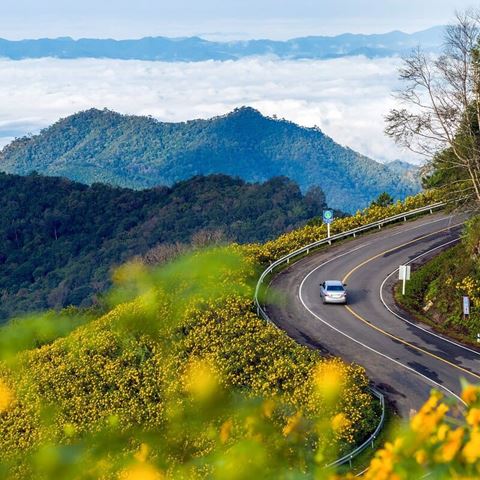
Doi Mae U-Kho is famous for its Bua Tong (Mexican sunflower) fields, which turn the hillsides yellow from mid-November to early December. Entry is free, the site is about two hours from Mae Hong Son town, and timing shifts with rainfall. Many travellers see it on the Mae Hong Son Loop, a circuit of about 600 km that takes at least four days.
Pai is a small town in a valley of Mae Hong Son Province, close to the Myanmar border.
Pai: A Relaxed Mountain Getaway
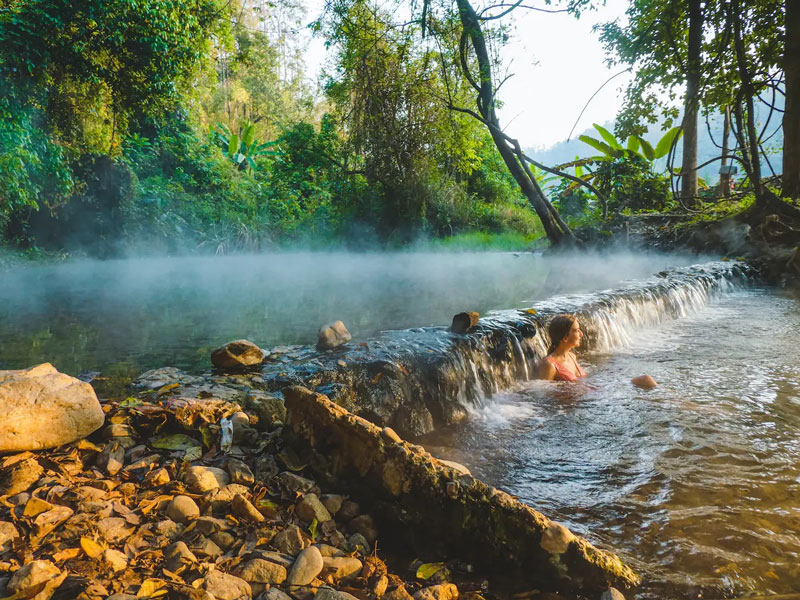
Popular sights around Pai include Tha Pai Hot Springs, Pai Canyon, the World War II Memorial Bridge, Pai Walking Street, Tham Lod Cave and Wat Phra That Mae Yen (the White Buddha). Tha Pai Hot Springs charges foreign adults about 300 THB, while Pai Canyon is free. Access varies with weather.
Pai's hot spring
Pai divides opinion more than any other stop in the north: some travellers like its relaxed scene of live music, cafes and wellness retreats, while others feel it has changed too much since it became popular. I would give it two nights and keep quieter Mae Hong Son or Nan in mind if the first impression is not for you.
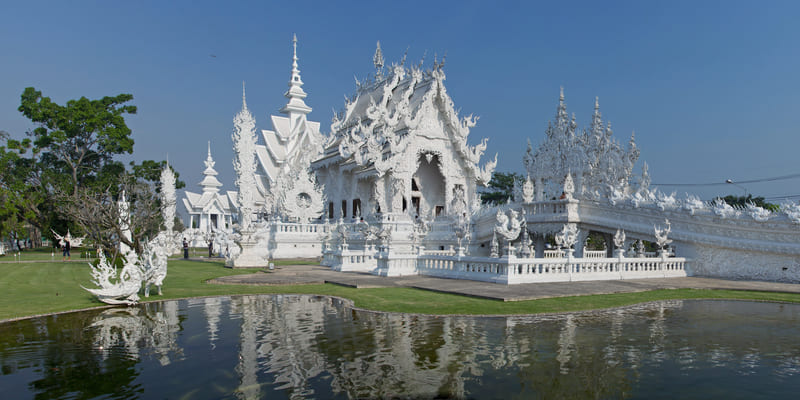
Though Chiang Rai seems like a sleepy provincial city at first glance, it has some of the north's most unusual architecture. The White Temple (Wat Rong Khun) is a white, mirrored modern take on Thai temple art. Entry for foreign visitors doubled from 100 to 200 THB on 1 January 2026, according to Khaosod English.
White Temple (Wat Rong Khun)
Set against it is the royal-blue Rong Suea Ten (Blue Temple), a traditional Buddhist temple that shows the old beside the new.
Rong Suea Ten (Blue Temple)
Visit Doi Mae Salong, shaped by Yunnanese Chinese heritage and known for tea, or Akha villages through responsible community-based tours, then end the day at the Chiang Rai Night Bazaar.
An Akha woman in traditional clothing selling traditional handmade Akha souvenirs.
>>> Good to know:
In addition to its rich Buddhist and cultural heritage, Chiang Rai is closely associated with the history of the Golden Triangle and the regional opium trade. You can visit the Hall of Opium, a museum near Sop Ruak, for multimedia exhibitions exploring the history of opium, its social impact, and efforts to provide sustainable alternatives for local communities. Entry is 200 THB for foreign adults, and the museum is closed on Mondays.
Inside the Hall of Opium
Sukhothai: Ancient Ruins and History
Sukhothai, a former capital that predates Ayutthaya, is the north's main UNESCO-listed ancient city, and it counts as lower north rather than upper north. The Historical Park holds the remnants of the 13th-14th century royal palace and dozens of temples and chedis (stupas).
Highlights include Wat Mahathat, the ceremonial heart of the ancient city, with its lotus-bud chedi, and Wat Si Chum, home to the monumental seated Buddha known as Phra Achana. Bicycles are a popular way to get around the central area.
Beyond the park, Sukhothai province also offers hiking in Ramkhamhaeng National Park and Thai craft lessons.
>>> Good to know: Sukhothai Historical Park is divided into three archaeological zones (central, north and west), and tickets are sold per zone: foreign visitors pay about 200 THB for the central zone and 100 to 120 THB for each of the north and west zones, or about 400 THB for all three. Hours and fees differ between sources, so check the Fine Arts Department before your visit.
Nan, Phayao and Chiang Dao: The Quieter North
Nan is the strongest option for travellers who have seen Chiang Mai and Chiang Rai. Wat Phumin is known for its murals, including the "Whisper of Love", in Bo Kluea villagers still boil salt from mountain wells, and Doi Phu Kha National Park, about 80 km northeast of Nan town, has limestone mountains, waterfalls and sunrises above the mist. Nan is about 331 km from Chiang Mai, a 6 to 7 hour bus ride.
Three shorter stops: Phrae, about 200 km from Chiang Mai, has the sandstone pillars of Phae Mueang Phi and the Wat Phra That Cho Hae chedi; Phayao is a lake town about 3 hours from Chiang Mai, with a sitting Buddha 18 metres high at Wat Si Khom Kham; and Chiang Dao, about 72 km north of Chiang Mai, has a cave with lantern-guided passages and a wildlife sanctuary with more than 300 bird species.
In my view, Nan is the best answer to the complaint that every northern Thailand guide lists the same four stops, and it suits travellers with a week or more. If you only have five days, I would skip Nan and stay with Chiang Mai and one other stop.
Is It Worth Going to North Thailand?
Yes, North Thailand is worth visiting if you want mountains, temples, local food and a slower pace instead of beaches, and it works best for about 7 to 10 days between mid-October and mid-February, when the weather is usually cooler and drier.
In my view the north is comfortable for solo travellers, since day tours, cooking classes and hostel common rooms make it easy to meet people without a party scene.
Where the north can disappoint:
There are no beaches, so it will not replace an island holiday.
Smoke and haze can spoil views and air quality from mid-February to April, and March is usually the worst month.
Distances are real: mountain roads make a 100 km day feel long.
Is South or North Thailand Better?
Neither is better overall: the north is better for mountains, temples, trekking, northern food and cooler weather, while the south is better for beaches, islands and diving, so the right choice depends on whether you want culture and landscapes or sand and sea.
Factor
Northern Thailand
Southern Thailand
Main appeal
Mountains, temples, local culture, food
Beaches, islands, snorkelling and diving
Best season
Cool season, roughly mid-October to mid-February
Depends on the coast: the Andaman side and the Gulf side have different rainy seasons
Weak point
Smoke and haze, from mid-February to April and worst in March
Rainy months can cancel boat trips; check each coast
Starting in the north works well if you want culture first and beach time at the end: October 2026 flight listings show nonstop flights from Chiang Mai to Phuket and Krabi of about two hours and to Koh Samui of about 1 hour 45 minutes. Schedules change seasonally, so verify your date.
If you can only choose one region for March or April, I would choose the south, because smoke is at its worst in the north then.
Northern Thailand Weather and Best Time to Visit
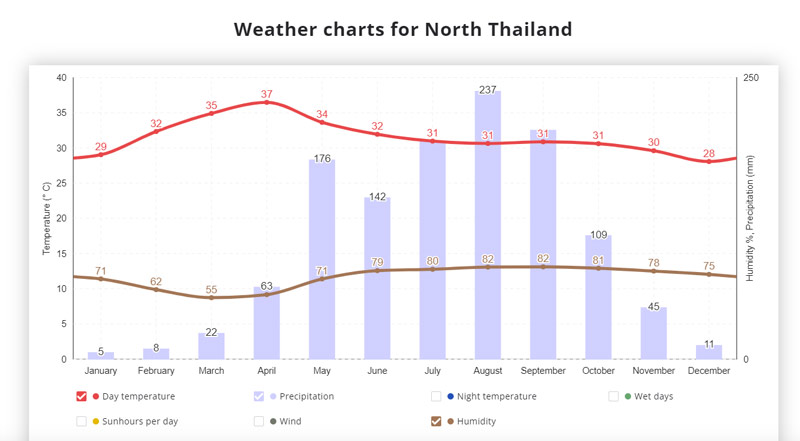
The best time to visit Northern Thailand is the cool season, roughly mid-October to mid-February, when days are warm, nights in the hills are cool and rain is least likely, while the hot months that follow bring heat and smoke, worst in March.
Season
Roughly
What to expect
Cool and dry
Mid-October to mid-February
Chiang Mai averages about 29 to 30°C by day and 16 to 17°C at night in December and January, with very little rain
Hot, with smoke
Mid-February to mid-May
April highs in Chiang Mai average about 37°C; smoke builds from mid-February, peaks in March and eases as rain arrives in April or May
Rainy
Mid-May to mid-October
Greener landscapes and heavier showers; August and September are the wettest months in Chiang Mai
NASA notes that smoke over northern Thailand is most common in March and April, with fires peaking in March and fading by May. Chiang Mai recorded 10,849 hotspots between 1 January and 27 April 2026, and Visit Thailand Today reports a PM2.5 reading of 188 µg/m³ on 30 March, about twelve times the WHO 24-hour guideline. Check live air quality before booking anything for mid-February to April.
>>> Worth Knowing: In 2026, Loy Krathong falls in late November rather than October. Chiang Mai celebrates Loy Krathong together with Yi Peng around this lunar period, while Sukhothai's official Loy Krathong and Candle Festival is scheduled for 15-24 November 2026. Exact local programs in Chiang Mai should be checked before travel. Thailand also hosts other major festivals throughout the year, including Songkran and regional cultural celebrations. You can read more in the article: Thailand Festivals.
Northern Thai Food: What to Eat
Northern Thai food is known for curry noodles, spiced sausage and chilli dips, and the dishes most visitors are told to try first are khao soi, sai oua, nam prik ong, khanom jeen nam ngiao and kaeng hang lay, all easy to find in Chiang Mai.
Khao soi is a Burmese-inspired coconut curry noodle soup, and sai oua is a pork sausage spiced with lemongrass and galangal. If I had to pick one dish it would be khao soi, then sai oua from a market stall; see our guide to Signature Thai Cuisine.
People and Culture of Northern Thailand
The main local people of Northern Thailand are the Khon Mueang, or Northern Thai, whose Lanna heritage and Kham Mueang language shape the region's temples, festivals and food, living alongside highland communities such as the Karen, Hmong, Akha, Lisu and Lahu, and Shan and Yunnanese Chinese communities.
Book village visits through community-based tours so income reaches local people, ask before photographing anyone, and avoid human zoos and unethical animal attractions.
How to Get to and Around Northern Thailand
Most visitors reach Northern Thailand by flying from Bangkok to Chiang Mai, which takes about 1 hour 15 minutes, while the overnight sleeper train takes about 12 hours 35 minutes and express or VIP buses take 10 to 11 hours.
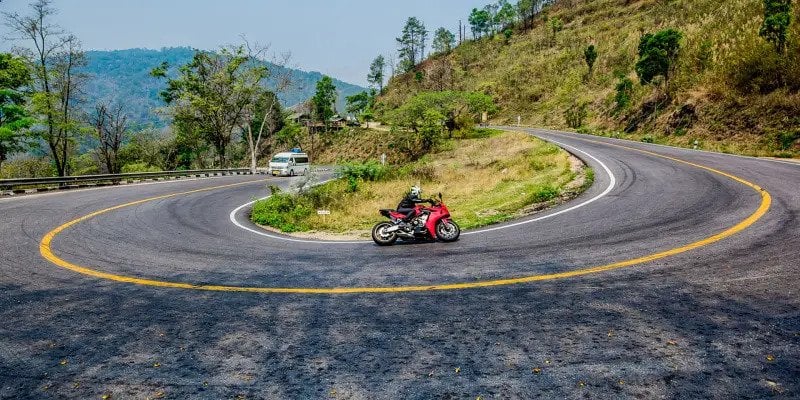
Traveling to the North of Thailand by motorbike.
Foreign visitors who drive need a licence valid in Thailand, such as an International Driving Permit, and should be comfortable with left-hand traffic and mountain roads.
My advice is to rent a motorbike only if you already ride one at home, and to hire a car with a driver for long mountain days. Some roads, such as Route 1095 between Chiang Dao and Pai, have tight bends that can be slippery or covered in gravel, so finish mountain drives before dark.
Trains connect Bangkok with Phitsanulok, Lampang and Chiang Mai, while buses and vans cover places without railway stations; check current schedules before departure.
Typical road distances and times from Chiang Mai, from guides checked in October 2026; confirm live schedules.
Route
Road distance
Typical time
Chiang Mai to Pai
about 130 km
3 to 4.5 hours by minivan on Route 1095, which has 762 curves
Chiang Mai to Chiang Rai
about 190 to 200 km
3 to 3.75 hours by express bus or car; minivans 3.5 to 4.5 hours
Chiang Mai to Sukhothai
about 275 to 305 km
About 5.5 to 6 hours by bus, 4.5 to 6 hours by car or van
Published 2026 budget guides put backpacker spending in Thailand at about 900 to 1,500 THB a day and mid-range spending at about 1,800 to 4,400 THB, excluding flights.
Item
Typical price
Note
Street food or night-market meal
40 to 80 THB
Khao soi is usually 50 to 80 THB
Guesthouse or budget hotel room
300 to 1,000 THB
Chiang Mai and Pai guesthouses are often 400 to 800 THB
Mid-range hotel room
1,000 to 3,500 THB
Chiang Mai boutique hotels run about 1,500 to 3,500 THB
Scooter rental, per day
150 to 300 THB
Deposit 1,000 to 2,500 THB and a passport copy, not the original
Bangkok to Chiang Mai by sleeper train
690 to 1,650 THB
Second class about 690 to 1,040, first class about 1,250 to 1,650
A practical first-trip pattern is three or four nights in Chiang Mai's Old City or Nimmanhaemin, then one or two nights each in Chiang Rai, Pai and Mae Hong Son, with Sukhothai optional. These are area suggestions, not hotel recommendations.
Base
Area
What to know
Chiang Mai
Old City
Best for first-timers; walkable, with temples, markets and cafes close by
Chiang Mai
Nimmanhaemin
Cafes, bars, live music and boutiques; busiest at night
Pai
Walking Street, riverside or rice paddies
Walking Street is busy but convenient; riverside and paddy bungalows are quieter, and the paddies need a scooter
Sukhothai
New Sukhothai or near the park
New Sukhothai is cheaper and better connected, about 14 km from the park; near the park puts you beside the ruins
Northern Thailand Itineraries: 10 and 14 Days
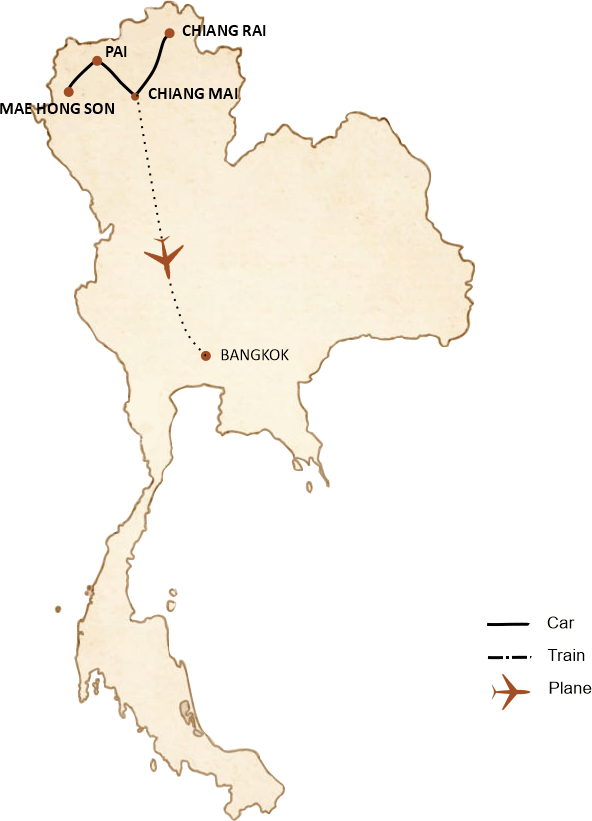
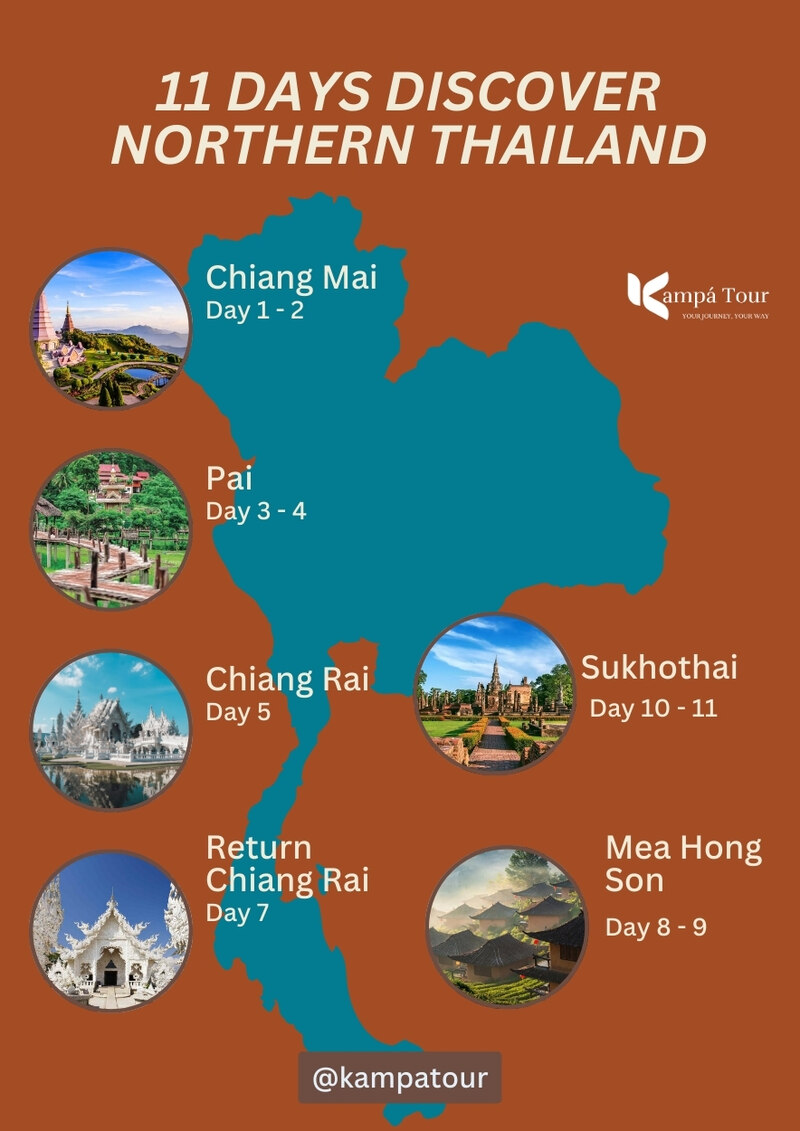
A classic route linking Chiang Mai, Chiang Rai, Pai and Mae Hong Son works well over 7 to 10 days, and two weeks gives you time for rural villages and a wider loop through Sukhothai and Lampang. We suggest these two routes:
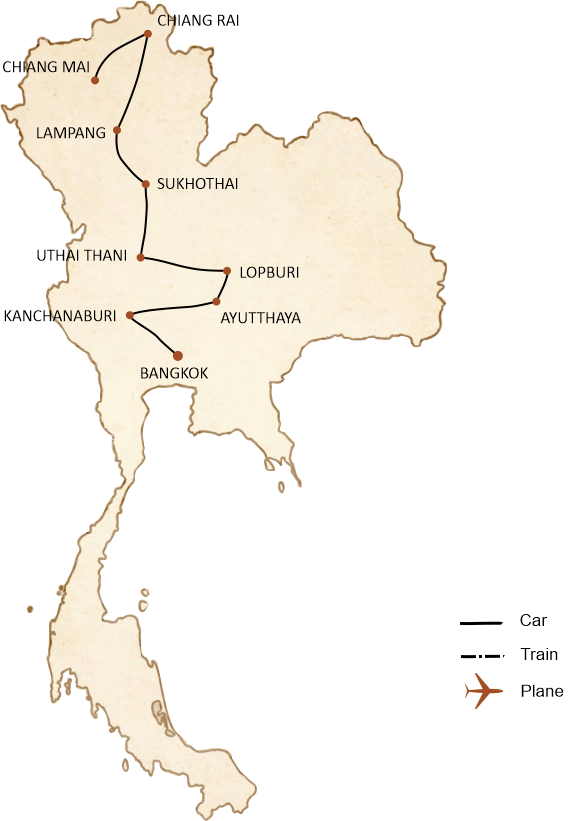
For travellers who want the outdoors, rural villages and cities in one trip, extend your stay to 14 days. Note that this route starts in Bangkok and passes through Kanchanaburi and Ayutthaya, so it covers central Thailand on the way up to the north. The upper north starts with Lampang on days 7 to 8:
Day 1-3: Bangkok
Day 4: Kanchanaburi - Ayutthaya
Day 5-6: Ayutthaya - Uthai Thani - Sukhothai
Day 7-8: Sukhothai - Lampang
Day 9-10: Chiang Rai - Chiang Saen - Chiang Dao
Day 11: Chiang Dao - Chiang Mai (about 72 km)
Day 12-14: Chiang Mai
That leaves about eight days in the upper north; if the north is your main reason to travel, shorten the central stops or start from Chiang Mai.
Tuk-tuks in Bangkok, where the 14-day route starts
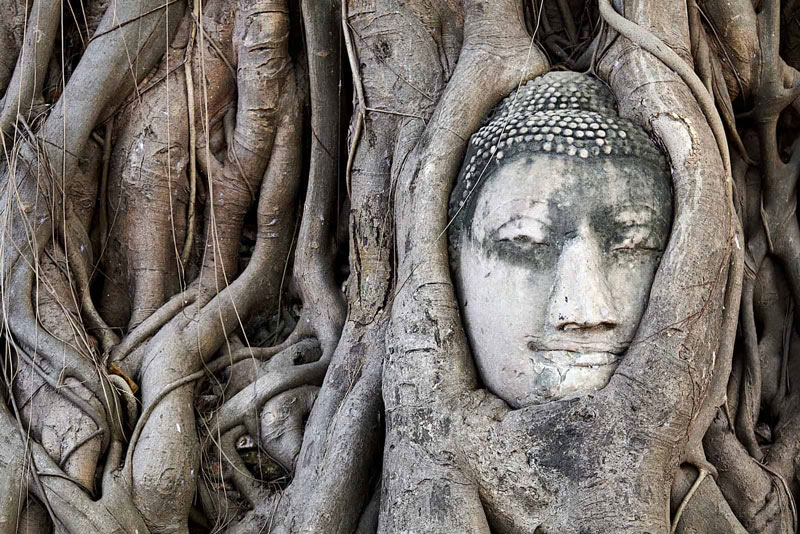
Wat Mahathat in Ayutthaya, a stop on the 14-day route
Northern Thailand itinerary
Tips:
If you want a varied overview, you can discover the whole north. However, if you don't have a lot of time, we advise you to favor Chiang Mai. It has landscapes, temples and a peaceful pace: one day for a city tour, one day for a nature hike in Doi Inthanon National Park, and one day to visit an elephant sanctuary. To add more, combine Chiang Mai with Mae Hong Son, which gives a short northern tour with the main points for people with limited time.
Tips for Making the Most of Your Northern Thailand Trip
Respect Local Customs
When visiting temples, cover your shoulders and knees. Remove shoes before entering homes and monasteries. Ask before photographing people, especially members of ethnic minorities. Simple Thai phrases such as "Hello" in Thai show respect and help in rural villages.
Kampá Tour designs private trips across Thailand, Vietnam, Cambodia and Laos. Send us your dates and interests and we will shape the routes above into one itinerary.
>>> Every month, everything you need to know about Thailand
Hi, kindly advice if it's possible to drive by making a loop from Chiang Mai to Sukhothai to NAN to Chiang Rai to PAI and back to Chiang Mai. I intend to spend a few days in each place with about 3 weeks for this tour using a rental car. Thank you.
0Reply
Oliver Phung29 Apr 2025
Dear Roy!
Yes, it’s absolutely possible, and three weeks is a very comfortable amount of time for a beautiful driving loop like that!
Here’s a quick breakdown:
Chiang Mai → Sukhothai: about 4.5–5 hours
Sukhothai → Nan: about 5–6 hours (some mountain roads but doable and scenic)
Nan → Chiang Rai: about 5 hours (via Pua and Chiang Klang – very scenic countryside drive)
Chiang Rai → Pai: about 5–6 hours (you’ll pass near Chiang Mai, so you could tweak this if needed)
Pai → Chiang Mai: about 3 hours (very winding road but in good condition)
Be aware, however, that while the roads are generally good, the hilly sections (especially Nan to Chiang Rai and Pai to Chiang Mai) are winding — drive carefully.
Nan and Pai are quieter than Chiang Mai/Chiang Rai, so make sure your rental car is reliable (check the spare tire, brakes, etc.).
Gas stations are available frequently, but fill up when you can, especially between Nan and Chiang Rai.
Car rental companies in Chiang Mai allow this type of multi-stop loop, just confirm unlimited mileage when booking.
1Reply
A
Alexandra Bennett28 Sep 2024
Hello I would also like to participate in the Loy Krathong and Yi Peng festivals in northern Thailand. Can you give me some advice? Thank you.
1Reply
Kampá Tour28 Sep 2024
Hello Mrs. Alexandra Bennett.
Indeed, Chiang Mai is the exceptional place where the Loy Krathong and Yi Peng festivals are celebrated simultaneously on the same day. This is an amazing experience not to be missed. Be sure to book your accommodations in advance as this period is very popular with visitors. Enjoy this magical experience in Chiang Mai!
I really like Doi Inthanon National Park, and this coming November I plan to go to Doi Inthanon National Park, and some other national parks in Thailand, but I don't know the geography well, do you have any useful information for me?
0Reply
E
Emma Gonzalez06 Aug 2024
Hello, are Chiang Rai and Chiang Mai similar with many temples? I've heard that and I'm hesitant to choose one of the two. Thank you for your advice.
0Reply
K
Kampá Tour06 Aug 2024
Hello, Chiang Mai and Chiang Rai both have many temples. If you have to choose, prefer Chiang Mai, as it offers a wider variety of activities and sites to visit. Chiang Rai is mainly known for the Golden Triangle, once famous for drug trafficking. Feel free to ask any more questions. Kind regards.
Planning your trip?
Save time and get expert advice for FREE!
✅ 15 years of local experience
✅ Save up to 40 hours of planning
✅ Travel stress-free from start to finish
Book your free consultation today!








 Our team
 Our team
 Our team
 Our team


%20(1).jpg)
.jpg)
.jpeg)

(3).jpg)


 Other
Other Add us as a preferred source









Dear Roy!
Yes, it’s absolutely possible, and three weeks is a very comfortable amount of time for a beautiful driving loop like that!
Here’s a quick breakdown:
Be aware, however, that while the roads are generally good, the hilly sections (especially Nan to Chiang Rai and Pai to Chiang Mai) are winding — drive carefully.
Nan and Pai are quieter than Chiang Mai/Chiang Rai, so make sure your rental car is reliable (check the spare tire, brakes, etc.).
Gas stations are available frequently, but fill up when you can, especially between Nan and Chiang Rai.
Car rental companies in Chiang Mai allow this type of multi-stop loop, just confirm unlimited mileage when booking.
Hello Mrs. Alexandra Bennett.
Indeed, Chiang Mai is the exceptional place where the Loy Krathong and Yi Peng festivals are celebrated simultaneously on the same day. This is an amazing experience not to be missed. Be sure to book your accommodations in advance as this period is very popular with visitors. Enjoy this magical experience in Chiang Mai!
If you want to get more information about these festivals, read this article: Thailand Lantern Festival 2024: Loy Krathong and Yi Peng.
Good trip!
Hello, Chiang Mai and Chiang Rai both have many temples. If you have to choose, prefer Chiang Mai, as it offers a wider variety of activities and sites to visit. Chiang Rai is mainly known for the Golden Triangle, once famous for drug trafficking. Feel free to ask any more questions. Kind regards.