If your trip includes multiple days of hiking, you can bring hiking shoes. Otherwise, a good pair of sneakers will suffice.
2. What is the duration of the hikes offered in your tours?
The walks and hikes offered in our tours are of easy to moderate difficulty level and typically last for 3-5 hours per day. However, the duration and difficulty of the hikes depend on your fitness level. You can shorten or extend the duration of the hikes according to your preferences. This private program can be customized on-site.
3. Can we combine must-see sites and off-the-beaten-path excursions?
All our tours are private and tailor-made, and we can certainly customize the itinerary by combining must-see sites with off-the-beaten-path excursions. Feel free to let us know your preferences, and our advisors will be able to accommodate your every request.
4. What is the most beautiful region for hiking?
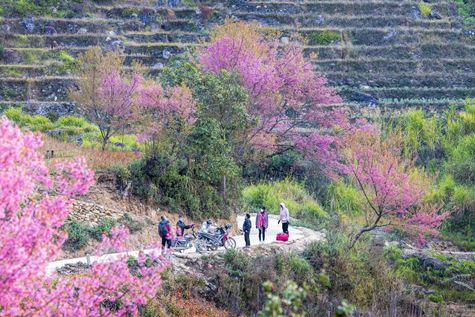
It's certainly the North, which comprises the Northeast and Northwest mountains. Located along the country's Laotian and Chinese borders, Northern Vietnam's mountains boast incredibly wild and breathtaking landscapes: limestone peaks and vast rolling hills as far as the eye can see, lush valleys with stunning terraced rice fields, winding roads and switchbacks on the mountain slopes. It's also the only region where the culture of minority ethnic groups remains strongly present: traditional villages, unique customs, colorful attire, and vibrant weekly markets. The region is a must-visit for nature enthusiasts, those interested in ethnic culture, and travelers looking to venture off the beaten path.
5. Which are the must-visit sites for a first exploration of the region?
Among the country's three regions, the North, the Central, and the South, it's the North that is the most beautiful and interesting. For your first exploration, don't forget to visit the ancient capital of Hanoi, the land-based Halong Bay in Ninh Binh, and, most importantly, Halong Bay on a cruise. If time allows, take a detour to the Northern mountains, such as Sapa or Pu Luong, to discover stunning landscapes and diverse, authentic cultures.
6. When to go to see the terraced rice fields?
Terraced rice fields can be found in the Mai Chau, Pu Luong, Mu Cang Chai, and Sapa regions.
In Mai Chau and Pu Luong, there are two rice seasons each year: the first season is from February to May, and the second lasts from June to October.
As for Mu Cang Chai and Sapa, there is only one rice season per year, from May to September.
During the rest of the year, even though the fields may be empty, visits are still possible because these destinations not only feature rice fields but also pristine forests and, most importantly, ethnic villages with their traditional houses.
7. When is the best time to visit Northern Vietnam?
In general, the best time to visit Northern Vietnam is from September to November and from March to May. During this range of months, temperatures remain very pleasant, and there is less rainfall.




 Our team
 Our team
 Our team
 Our team