Thailand E-Visa: What You Need to Know Before Applying
The e-visa, or electronic visa, is an online visa application system specifically for Thailand. It allows travelers to submit their application and download their visa for Thailand directly from the official website.
Written by Preetika Narula (Local Expert)
Updated on Oct 27, 2026
0 comment
At 35 years old, Preetika is an enthusiastic explorer deeply connected to Thailand, Laos and Cambodia's rich heritage. As a Bangkoker, her local insights and experiences imbue authenticity into her narratives. She discovers solace within the pages of a book as much as amidst Southern Asian vibrant landscapes and bustling street markets. With an ardent passion for travel and a profound affection for literature, Preetika effortlessly integrates her personal adventures into captivating stories, providing a perspective uniquely rooted in local experience.
The e-visa, or electronic visa, is an online visa application system specifically for Thailand. It allows travelers to submit their application and download their visa for Thailand directly from the official website. Thus, the applicant usually does not need to visit the Thai Embassy except in exceptional situations.
Do You Still Need a Visa? Visa-Free Stays Changed on 15 September 2026
Until 14 September 2026, travelers from 93 countries and territories could enter Thailand without a visa for up to 60 days. That scheme ended on 15 September 2026. Under the new rules, nationals of 60 listed countries and territories can stay up to 30 days per entry for tourism, nationals of Seychelles and Mauritius can stay 15 days, and nationals of Azerbaijan, Belarus and Serbia need a visa on arrival. Some nationalities keep longer stays under bilateral agreements, so check the rule for your passport before you book. Travelers who entered before 15 September keep the stay stamped on arrival.
The 30-day stay can be extended once, by up to 30 days, at a Thai immigration office for a fee of 1,900 baht, at the officer's discretion. If you plan to stay longer than 30 days, a tourist e-visa, which allows 60 days per entry, is the main alternative.
Why Choose an Electronic Visa?
An eVisa, particularly the 'stickerless visa,' offers many benefits, including reduced travel expenses and time for applicants. Moreover, you can apply from home and follow the status of your application on your online dashboard.
Where Can You Apply for the Thailand E-Visa?
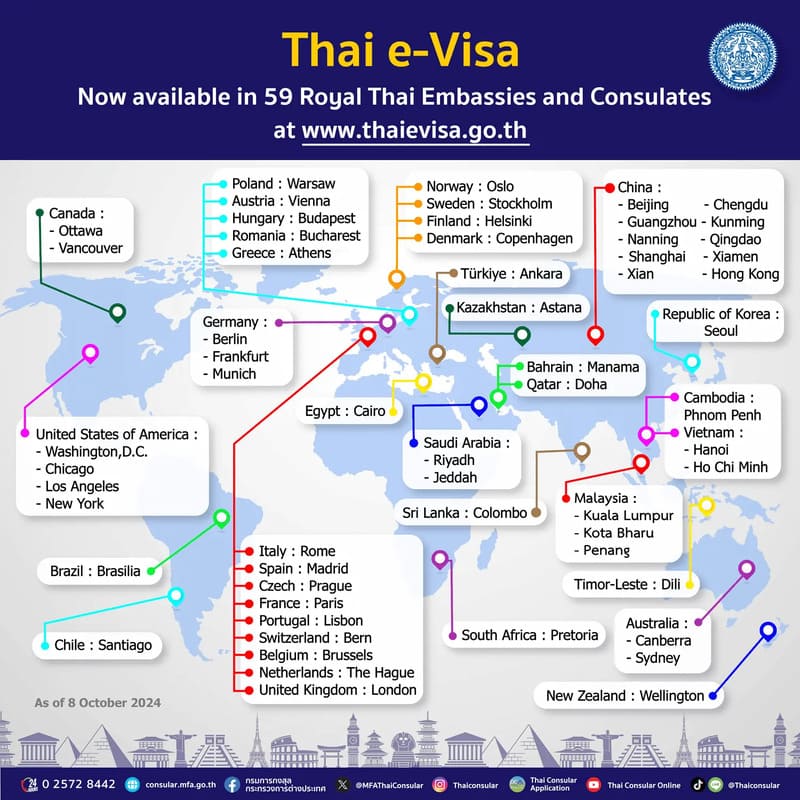
Since 1 January 2025, the e-visa has been available through Thai embassies and consulates around the world, instead of only the 59 missions that offered it in the second half of 2024. In practice, you apply at www.thaievisa.go.th through the Thai embassy or consulate that covers the country where you live, and many missions ask for proof of residence in that country. The portal shows whether the e-visa is available for your passport and which mission handles your application.
Embassies and consulates offering the e-Visa in late 2024 (the list has since expanded)
Thailand E-Visa: Types and Key Benefits
This is currently the easiest way to obtain a visa and plan your vacation in Thailand. The Thailand e-visa provides access to two popular tourist visas, both of which allow entry into Thailand by air, land, or sea.
Single-Entry Tourist Visa
It grants permission for a foreigner to enter the Kingdom of Thailand for tourism, leisure, or medical purposes, with only one entry allowed. In Thailand, holders can stay for up to 60 days, which can be extended for an additional 30 days by visiting the local Thai immigration office, for a fee of 1,900 baht.
The visa is valid for 3 months, which is the window in which you must enter the country. Validity is not the same as your permitted stay: the immigration officer sets the length of stay when you arrive, normally up to 60 days for this visa, so plan your trip accordingly.
Multiple-Entry Tourist Visa
The visa permits the foreigner to enter and exit Thailand as many times as they wish within a 6 month time span. This visa type is offered to individuals who intend to visit the country for vacation, recreation or health treatment. Holders of this type of visa may remain in Thailand for a maximum of 60 days during each visit.
One of the key benefits of this Thai visa is how travelers are allowed to exit and re-enter the country without the need of worrying about getting another visa. It is most appropriate for individuals who would like to travel to other countries in Southeast Asia with Thailand as a base. Furthermore, the length of stay may also be increased by an additional 30 days by going to the nearest immigration office.
Proof-of-funds requirements are higher than for the single-entry visa, and some embassies limit this visa to residents of the country where you apply, so check the requirements of the mission that handles your application.
How to Submit Your Application
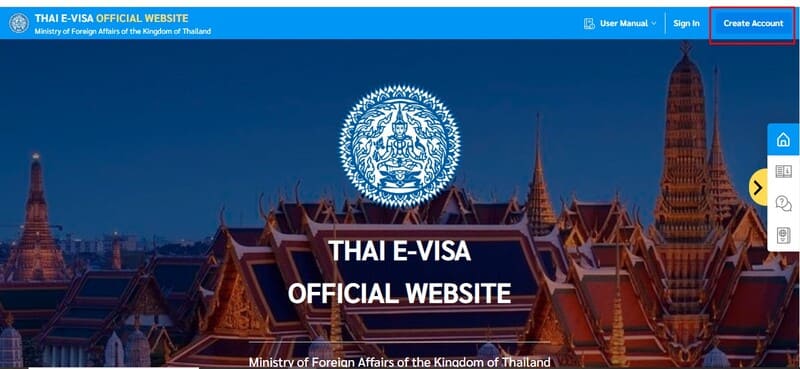
Step 1: Create an account on the official Thai government website: www.thaievisa.go.th. After submitting your request, you will receive a verification email. Be sure to review it to finalize your account creation.
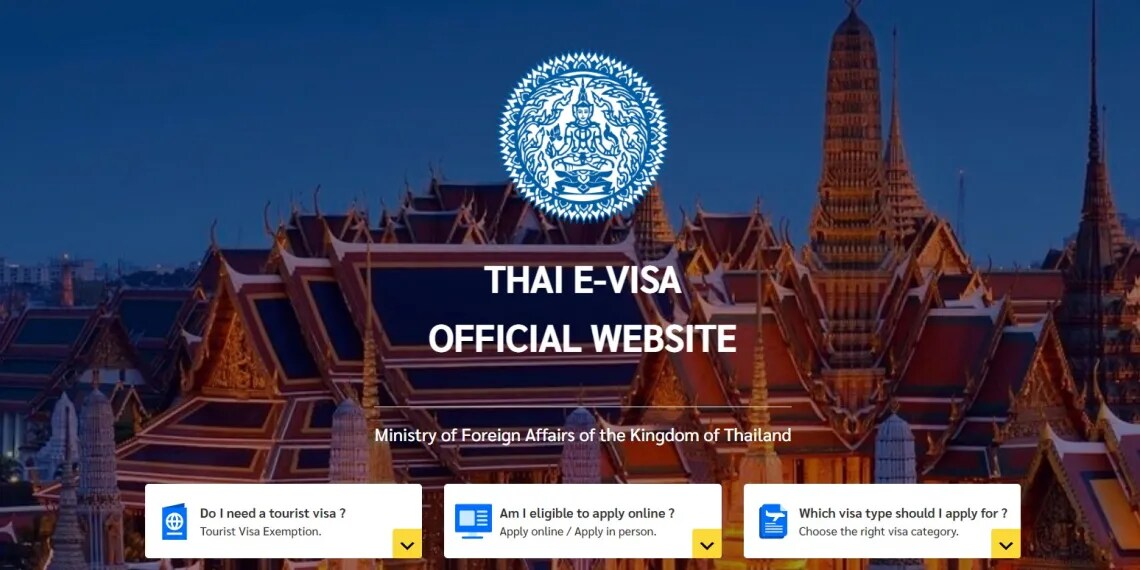
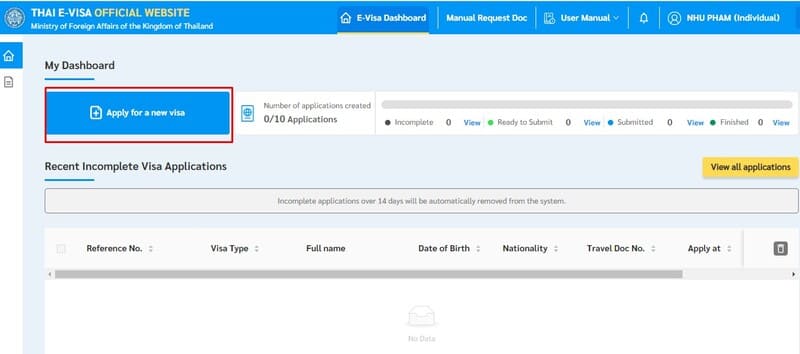
Step 2: Click on "Apply for a New Visa" as shown in the image.
Step 3: Fill in the requested information
At this crucial stage, it is essential to fill out the online application form, providing all the necessary details. Ensure that your application is complete and accurate, as any mistakes or missing information may delay the processing of your application.
Embassies commonly ask for a passport valid for at least six months from your date of entry, a recent photo, a confirmed flight booking, proof of accommodation, proof of funds (20,000 baht per person, or 40,000 baht per family, is a common benchmark for the single-entry tourist visa) and proof of residence in the country where you apply. The embassy may email you to ask for more documents or an interview, so check your spam folder.
Visa fees are set by each embassy and shown in the local currency on the portal before you pay. They are not refundable, even if the application is refused. Processing time varies by embassy: embassy guidance ranges from about 5 to 20 days, and some recommend applying at least one month before you travel, and no more than three months ahead.
NOTE: For the part about uploading your photo.
There are specific requirements that must be met for the visa photos for Thailand. The photos should be 3.5 x 4.5 cm, or roughly 1.4 x 1.8 inches, taken within the last six months against a white background. The photo must be a standard passport photo, showing your full face from the front, with no shadows or objects obstructing it. Additionally, ensure that while your face is fully visible, you do not smile broadly or wear anything that covers your face, such as sunglasses.
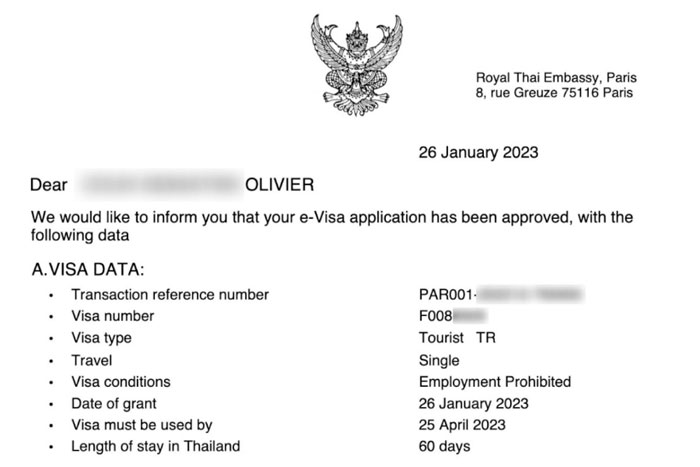
Once you complete and submit the application, you will receive a confirmation email. When the visa is approved, print the e-visa and carry it with your passport: airlines and Thai immigration officers ask to see it, and you cannot renew an e-visa, so a new application is needed if it expires before you travel.
Before You Fly: Thailand Digital Arrival Card (TDAC)
An e-visa is not the only entry requirement. Since 1 May 2025, all foreign travelers must complete the Thailand Digital Arrival Card (TDAC) online, which replaced the paper TM6 form. Submit it within the 3 days before you arrive in Thailand, on the official website tdac.immigration.go.th. The TDAC is not a visa and it does not guarantee entry, so you need it whether you hold an e-visa or travel visa-free.
Conclusion
An e-visa for Thailand is a time-saving option for travelers who need more than the 30 days of visa-free stay, or whose nationality is not visa-exempt. Choose between the single-entry and multiple-entry tourist visa, apply through the embassy that covers your country of residence well before your trip, and complete the TDAC before you fly.
Keep in mind that there are additional categories of visas for Thailand. To learn more about these, please read our article 'Thailand Visa'.
Planning your trip?
Save time and get expert advice for FREE!
✅ 15 years of local experience
✅ Save up to 40 hours of planning
✅ Travel stress-free from start to finish
Book your free consultation today!



















 Our team

 Our team

 Our team

 Our team




 Other
 Add us as a preferred source