Vietnam in October: Weather, Where to Go and What to Skip
By October, Vietnam's two monsoons are pulling in opposite directions at once. The northeast monsoon settles over Hanoi, Ha Long Bay and the northern mountains, clearing the summer haze into some of the year's driest, clearest days, while that same wind pushes moisture against the Truong Son range and holds the central coast at the peak of its rainy season. Further south, the wet season that began in May is only starting to ease.
The difference is not only north versus south. Whether you travel in the first week of October or the last can matter almost as much as where you go, from the tail end of the typhoon season in the north to the flood risk that peaks on the central coast late in the month. The guide below covers both: what to expect region by region, and how that picture shifts as the month goes on.
Written by Hung DAO (Local Expert)
Updated on Sep 28, 2026
0 comment
Originally from Phu Tho, a beautiful mountainous region in the north of Vietnam, Hung DAO did his higher education in France (University of Nantes) before returning to work in Vietnam. He has a great passion for Vietnamese and Asian culture as well as travel. Aside from Vietnam, his native country where he knows every corner, he lived 3 years in Thailand, Laos and Cambodia. All his knowledge acquired from his travels and studies makes him an expert on the Southeast Asian region. He shares with you all his knowledge and experiences in these articles. If you have any questions, do not hesitate to contact him by leaving your comment at the bottom of his article.
Best region: the north (Hanoi, Ha Long Bay, Ninh Binh and the northern mountains).
Keep flexible: Hue, Da Nang and Hoi An, where rain and flood risk peak.
Improving through the month: Ho Chi Minh City and the Mekong Delta.
Not beach season yet: Phu Quoc and most of the coast.
2026 dates: World Culture Festival in Hanoi (1 to 4 October), Katé Festival (9 to 12 October).
Is October a Good Time to Go to Vietnam?
Yes, if you build the trip around the north. October brings drier air, cooler evenings and clearer views to Hanoi, Ha Long Bay and the mountains. The central coast is at its wettest and most flood-prone, while the south is still in its rainy season and dries out gradually as the month goes on.
That split is why October suits travelers who are happy to focus. Two weeks spent between Hanoi, Ninh Binh, a night on the bay and a few days in the mountains will usually bring more dry days than wet ones, and families with young children can plan the same way. The October trips that go wrong tend to be the ones that try to cover everything from Hanoi to the Mekong on fixed dates, with no room for a storm on the central coast. How long to stay depends on the place, but every stop deserves at least one night, and a spare day in the plan gives you room to move a boat trip or a mountain walk if the weather turns.
Vietnam Weather in October by Region
The figures below are long-term monthly averages, not a forecast. They show why there is no single answer to "what is the weather like in Vietnam in October".
Place
Avg high / low
Rainfall
Rainy days
What it means
North
Hanoi
30°C / 23°C
155 mm
11
Warm days, cooler evenings, rain easing through the month
Sapa
19°C / 14°C
201 mm
19
Cool and often misty, the wettest part of the north this month
Ha Long
29°C / 22°C
143 mm
9
Good cruising weather between showers
Central
Hue
29°C / 23°C
773 mm
21
Peak of the rainy season
Da Nang (Hoi An is 30 km away)
30°C / 24°C
628 mm
20
Heavy rain, storm and flood risk
Da Lat
23°C / 15°C
245 mm
20
Still in its rainy season until late in the month
South
Ho Chi Minh City
32°C / 25°C
340 mm
16
Hot, with afternoon downpours that thin out toward November
Phu Quoc
30°C / 25°C
354 mm
22
Rainy season; beach weather usually returns in November
Source: monthly climate normals from the Vietnam Institute for Building Science and Technology and the World Meteorological Organization.
What season is October in Vietnam? A changeover month. The north's dry season begins, the central coast enters the core of its rainy and storm season, and the south's rainy season, which starts around May, winds down toward November.
Is Vietnam cold in October? Not in the cities. Hanoi still reaches around 30°C in the afternoon. Only the northern highlands feel cold, with Sapa mornings around 14°C and cooler still on the high passes.
Early vs Late October: Why Your Dates Matter
The first and last weeks of October can feel like different months. Early October is still the tail of the typhoon season, and storms that come ashore further south can push heavy rain into the north. In 2025, the remnants of Typhoon Bualoi flooded dozens of streets in Hanoi between 30 September and 2 October, and a week later Typhoon Matmo caused record flooding in Thai Nguyen province. That does not happen every year, but it is why the first week of October in the north is good rather than guaranteed. The first week is also China's National Day Golden Week (1 to 7 October in 2026), when Ha Long Bay, Sapa and Ban Gioc Waterfall are noticeably busier.
Early October has one thing late October lacks: ripe rice in the high valleys of Mu Cang Chai and Hoang Su Phi. The first two weeks sit comfortably within the harvest season, and most fields are cut by the third week.
By late October the north is usually at its clearest, the first buckwheat flowers appear around Ha Giang, and the south sees fewer downpours. The central coast moves the other way. Some of its worst flooding tends to arrive late in the month: on 26 and 27 October 2025, a station on Bach Ma mountain near Hue recorded 1,739 mm of rain in 24 hours, a national record, and residents and visitors were moved out of Hoi An. If central Vietnam is part of your plan, no week of October is risk-free, so the answer there is flexibility rather than timing.
Where to Go in Northern Vietnam in October
This is the half of the country that October favors. Each stop below has a reason to be on an October itinerary specifically, not just a reason to visit Vietnam.
Our travelers trekking past terraced rice fields in northern Vietnam
Hanoi
Hanoi in October is at its most walkable. The heavy summer humidity has eased, and the city has two small seasonal markers that locals look forward to: the scent of milk flowers (hoa sữa) drifting along some streets in the evening, and cốm, young green sticky rice sold wrapped in lotus leaves around the Old Quarter. In 2026 the second World Culture Festival takes over the Thang Long Imperial Citadel from 1 to 4 October, with food, music and exhibitions from nearly 50 countries. For the city's main sights and neighborhoods, see our Hanoi travel guide.
Hanoi in autumn, when the air turns drier and evenings cooler
Ha Long Bay and Lan Ha Bay
October is one of the better months to sail. The summer haze is lifting, the sea is usually calmer than in the storm months, and Ha Long averages around nine rainy days. Swimming is not banned in October: on warm, sunny days you can still swim from the boat or a beach stop, and it is only rain or a cool spell that makes crews hold back. The one caveat is weather notices. When a storm approaches, cruises can be suspended at short notice, so an overnight cruise sits better in the middle of a trip than on its last day. That is what happened when the storms of early October 2025 reached the north: our tours to Quang Ninh, the province around Ha Long Bay, were postponed, and we offered guests an alternative, either more time in Ninh Binh than planned or a detour to Pu Luong and Mai Chau. Our guide to choosing a Ha Long Bay cruise covers routes and boat types.
If you would rather see the karsts with fewer boats around you, look at Lan Ha Bay, reached from Cat Ba Island. The limestone scenery is the same and the transfer takes a little longer, and one night on board is enough for most travelers who want to keep time for the rest of the north.
Ninh Binh
Ninh Binh is about two hours south of Hanoi by road. By October the rice in its valleys has been cut, so the fields are stubble rather than gold, but the rowing boats at Trang An and Tam Coc glide through the limestone just the same and the cooler air makes the climb to the viewpoint at Mua Cave far easier than in summer. Spend at least one night rather than doing it as a day trip; the early morning and late afternoon light is when the valleys are quietest. Late in the month, pack a light rain shell and a thin fleece: between them they cover a drizzly boat ride in the morning and a cool evening without filling your bag. If the bay comes next, there is no need to go back through Hanoi: the road from Ninh Binh takes about three and a half to four and a half hours, and our guide to getting from Ninh Binh to Ha Long Bay compares the options. Our Ninh Binh guide has the full picture.
Mai Chau and Pu Luong
If you want ripe rice in October without the long drive to the far north, look west of Hanoi. Pu Luong has two rice crops a year, and the second ripens in September and October, so the valleys there can still be gold in the first half of the month. Mai Chau, about three and a half hours from Hanoi, sits on the way and is easy to combine with Pu Luong. Both suit cycling between stilt-house villages at an unhurried pace, and both work well for families who prefer short walks to full trekking days.
Ta Xua
October opens the cloud-hunting season in Ta Xua, a ridge in Son La province roughly five to six hours by road from Hanoi, and it is one of the best months to go. On clear, cool mornings after a humid night, a sea of cloud fills the valleys below the ridge, with the narrow crest known as the Dinosaur's Spine rising above it. The cloud usually shows around sunrise and burns off by mid-morning, so plan to stay overnight nearby rather than arriving in the afternoon, and allow a second morning in case the first one is clear.
Sapa, Mu Cang Chai and Hoang Su Phi
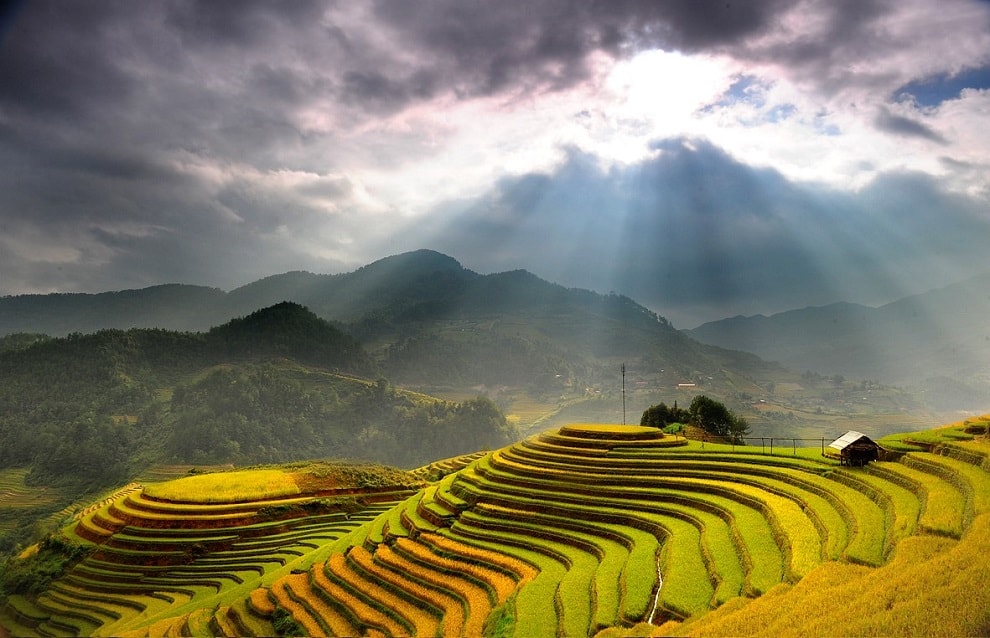
If golden rice terraces are the reason for your trip, aim for the first half of October. The terraces of Mu Cang Chai and Hoang Su Phi start ripening in September and usually stay gold until around the third week of October, when most of the harvest is in. After that you will see cut terraces and drying straw, which has its own quiet look but is not the sea of gold in the photos.
Terraced rice fields in northern Vietnam stay gold from September until around the third week of October
What October does offer in the mountains is good walking weather. Sapa sits at 1,500 meters, so days are cool (around 19°C) and mist often rolls through the valley, with rain on more than half the days of the month. Trails between the villages get muddy after a shower, so proper shoes matter more than a heavy pack. Fansipan, at 3,143 meters the highest peak in Vietnam, can be reached by cable car or on a guided two-day hike; whether you get a view from the top depends on the cloud that day. If you can time it for a Sunday, the Bac Ha Market, about three hours from Sapa, is where Hmong, Tay and Dao families from the surrounding hills come to trade. Further east, Hoang Su Phi sees fewer visitors, with terraces that climb whole mountainsides.
Ha Giang and Cao Bang
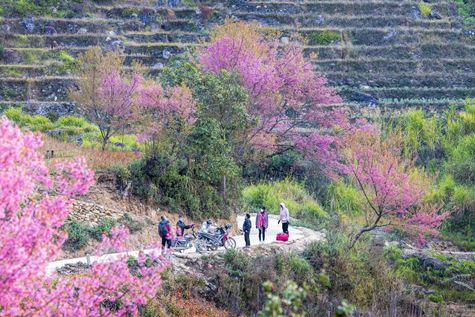
Ha Giang in October means dry roads most days and the first buckwheat flowers, which start to color the hillsides toward the end of the month, most visibly on the Dong Van Karst Plateau near the Chinese border. The main flowering comes in November, so an October visit catches the beginning of the season rather than its peak. The Ha Giang Loop runs normally, though after heavy rain early in the month it is worth checking for landslides on the higher passes before you set off.
Ha Giang during the buckwheat flower season
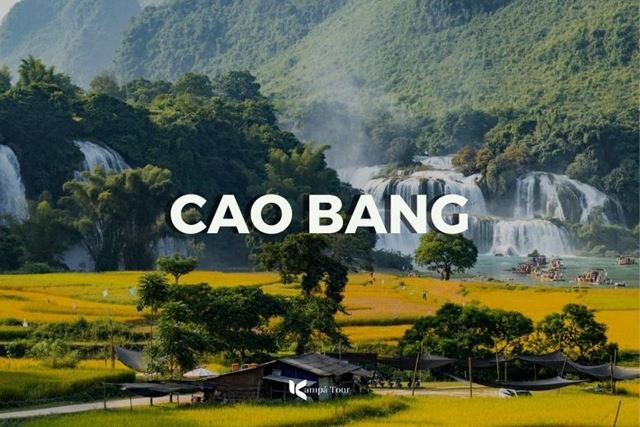
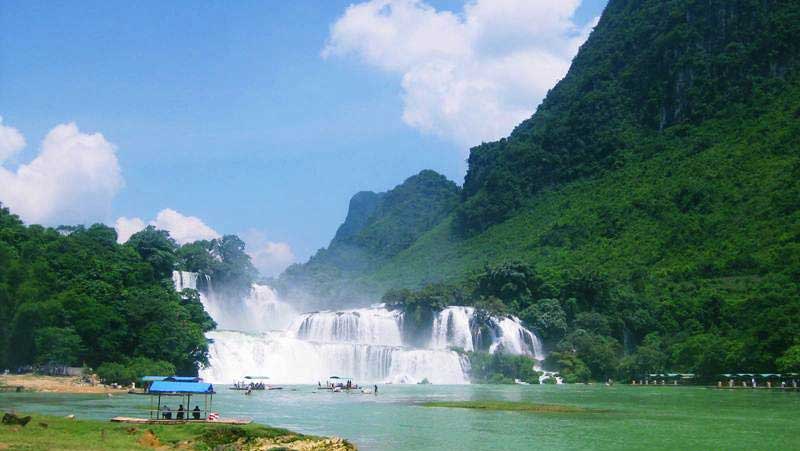
East of Ha Giang, Cao Bang is home to Ban Gioc Waterfall, a series of cascades roughly 300 meters wide on the border with China. October is a good month to see it because the river is still carrying the volume of the rainy season while the roads are drier. Ba Be Lake, on the way between Hanoi and Cao Bang, is worth an early-morning boat trip while the mist still sits on the water.
Central Vietnam in October: Go Only If You Can Stay Flexible
Central Vietnam runs on a different calendar from the rest of the country. From September to December the northeast monsoon pushes moist air against the Truong Son mountains, and this is also the season when typhoons most often reach this stretch of coast. The result is the wettest weather of the year exactly when the north is drying out.
Da Nang and Hoi An in October
Da Nang averages 628 mm of rain over about 20 days in October, and Hoi An, 30 km down the coast, shares the same weather. The rain is not constant: it often comes in heavy bursts, and some visitors get two or three dry days in a row. The risk that matters is flooding. Hoi An's Ancient Town sits on the Thu Bon River, and when the river rises its riverside streets are the first to go under water, sometimes knee to waist deep. Ba Na Hills can disappear into cloud, and its cable car may pause during heavy rain. Beach days are unlikely, and the sea is often too rough for swimming. Hoi An's monthly full-moon lantern night falls around 23 October in 2026, which is also the stretch of the month when flooding is most likely, so treat it as a bonus rather than a reason to go.
Hoi An Ancient Town sits on the Thu Bon River, which is why it floods first
If Hoi An is already booked, there is no need to cancel over a forecast. When heavy rain hits the central coast during a trip, we do one of two things for our guests: change the order of the itinerary so the outdoor visits fall on the drier days, or replace them with indoor activities in Hoi An and Da Nang on the wet ones. You can plan the same way on your own: keep a spare day, choose a hotel away from the riverside streets, put the things you cannot miss early in your stay, and check the forecast a week before you arrive.
Hue, Phong Nha and the Rest of the Centre
Hue is even wetter than Da Nang, with an October average of 773 mm, and some cave tours around Phong Nha pause when water levels rise, so check with your operator before you plan around them. Nha Trang receives a large share of its yearly rain in October and November, and Da Lat in the highlands stays in its rainy season until near the end of the month.
The simplest way around all of this is to fly. Hanoi to Ho Chi Minh City takes around two hours, and that single flight lets you pair the north with the south without spending days on the central coast. Flights are occasionally delayed by storms, so leave a buffer day before your international departure.
Southern Vietnam in October: Wet but Improving
The south is still in its rainy season in October, but the rain is on its way out. Ho Chi Minh City averages 340 mm over 16 days, usually as hard afternoon downpours that pass within a couple of hours, and November drops to around 128 mm. Plan museums and markets for the afternoons and you will lose little time.
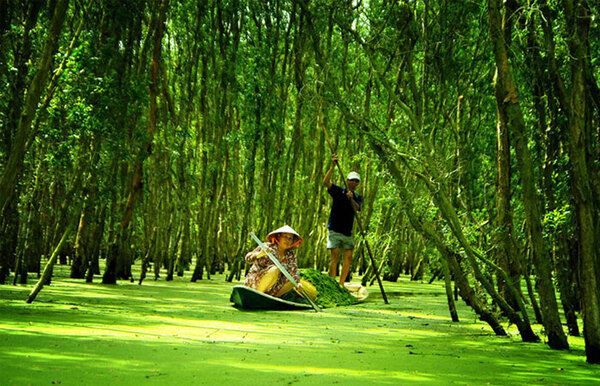
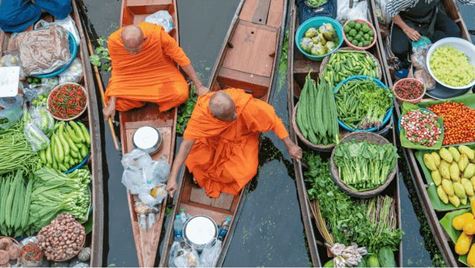
The Mekong Delta is at high water, which is good news for boat trips: the canals around Ben Tre and Vinh Long run full, which suits small-boat trips through the orchards and villages. The floating markets near Can Tho, such as Cai Rang, run as usual, and further west in An Giang the Tra Su melaleuca forest is at its best when the water is high enough to row a sampan through the trees. The trade-off is that the sky is still unsettled, so if a dry, sunny Delta matters more to you than full waterways, November is the safer month.
Small boats on the canals of the Mekong Delta, which run full in October
For beaches, October is the wrong month. Phu Quoc averages 354 mm over about 22 rainy days, against 164 mm and 14 days in November, so a beach holiday there works far better from November onward. The coast around Mui Ne and Phan Thiet is usually drier than the rest of the south, though it can be windy.
Festivals and Events in October 2026
Vietnam has no national public holiday in October, so there is no domestic travel rush like the ones around Tet, 30 April or 2 September. Dates such as 10 October (Hanoi Liberation Day) and 20 October (Vietnamese Women's Day) are commemorations rather than days off. Two events are worth planning around this year:
World Culture Festival in Hanoi, 1 to 4 October 2026: the second edition, held at the Thang Long Imperial Citadel, with cultural spaces, food stalls and performances from nearly 50 countries.
Katé Festival, 9 to 12 October 2026: the largest festival of the Cham community, with offerings, dances and Saranai oboe performances at the Po Sah Inu towers near Phan Thiet and the Cham Culture Display Center in Bac Binh (Lam Dong province), alongside a Bau Truc pottery festival in Ninh Phuoc (Khanh Hoa province).
The Katé Festival, the largest celebration of the Cham community in south-central Vietnam
Two festivals often listed for October fall outside it in 2026. The Mid-Autumn Festival lands on 25 September, and the Khmer Ok Om Bok festival in the Mekong Delta falls in late November.
Crowds, Prices and Booking in October
October is the start of the busy season in the north, not the end of it. International visitors return to Hanoi, Ha Long Bay and the mountains as the weather improves, so overnight cruises and the better homestays around Sapa and Ha Giang are worth booking a few weeks ahead. If your dates fall in China's Golden Week (see above), book Ha Long, Sapa and Ban Gioc even earlier or save them for after 7 October. The central coast and the south stay quieter. Because there is no public holiday this month, you will not meet the domestic crowds that fill the country around Tet or early September.
Is October cheap or expensive? It depends on where you stay. You will not pay the holiday surcharges that come with Tet, and the central coast and south are outside their busiest months. In the north the picture is different: rising demand for cruises, mountain lodges and central Hanoi hotels means October is not a bargain month there, whatever some guides suggest. The practical rule is simple: the more of your trip sits in the north, the earlier you should book.
October rewards travelers who choose a region rather than trying to cover the whole map. Put the north at the center of the trip, add the south if you have the days, and keep the central coast flexible, and the month gives you some of the clearest mountain and bay weather of the year.
>>> See more about things to do in Vietnam by month:
Planning your trip?
Save time and get expert advice for FREE!
✅ 15 years of local experience
✅ Save up to 40 hours of planning
✅ Travel stress-free from start to finish
Book your free consultation today!














 Our team
 Our team
 Our team
 Our team

(1)(2).jpg)
(1)(1)(1).jpg)

%20(1)%20(1)(1).jpg)
.jpg)
(3).jpg)
(1)%20(1)(1).jpg)
(1).jpg)


 Other
Other Add us as a preferred source